Large-scale volcanic eruptions are key natural drivers of short-term global climate variability.
The diagram below illustrates the physical and chemical interactions following an explosive volcanic eruption:
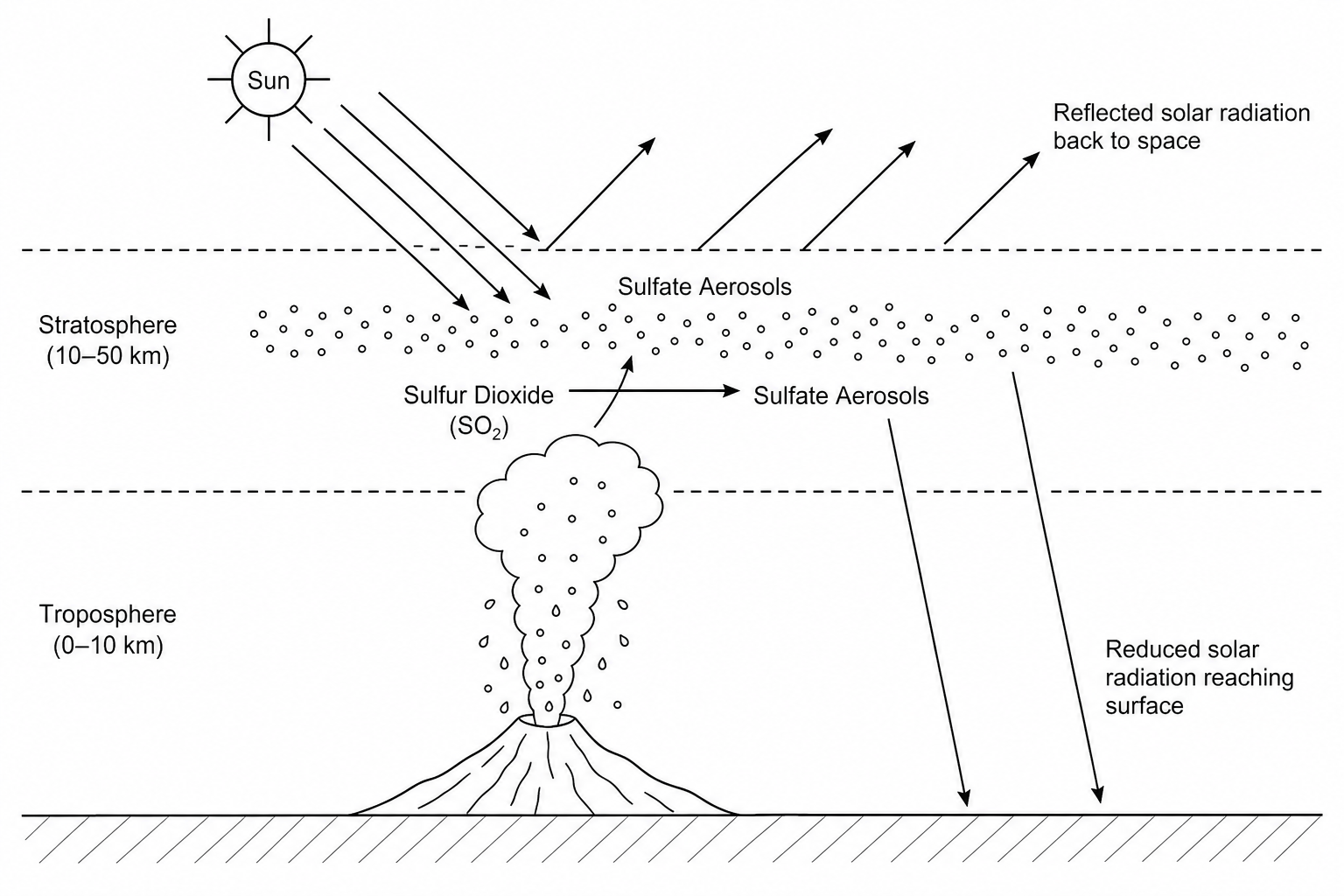
Which of the following statements correctly identifies the primary natural mechanism by which volcanic eruptions cause short-term global cooling?
The release of large volumes of water vapour (H2OH_2OH2O) into the troposphere, which increases global cloud condensation nuclei, leading to highly reflective low-level stratus clouds.
The injection of carbon dioxide (CO2CO_2CO2) directly into the stratosphere, which absorbs and re-radiates longwave terrestrial radiation back out into space.
The injection of sulfur dioxide (SO2SO_2SO2) into the stratosphere, which reacts to form highly reflective sulfate aerosols that scatter incoming shortwave solar radiation back into space.
The deposition of dark volcanic ash on polar ice sheets, which decreases planetary albedo and enhances the absorption of incoming shortwave solar radiation.