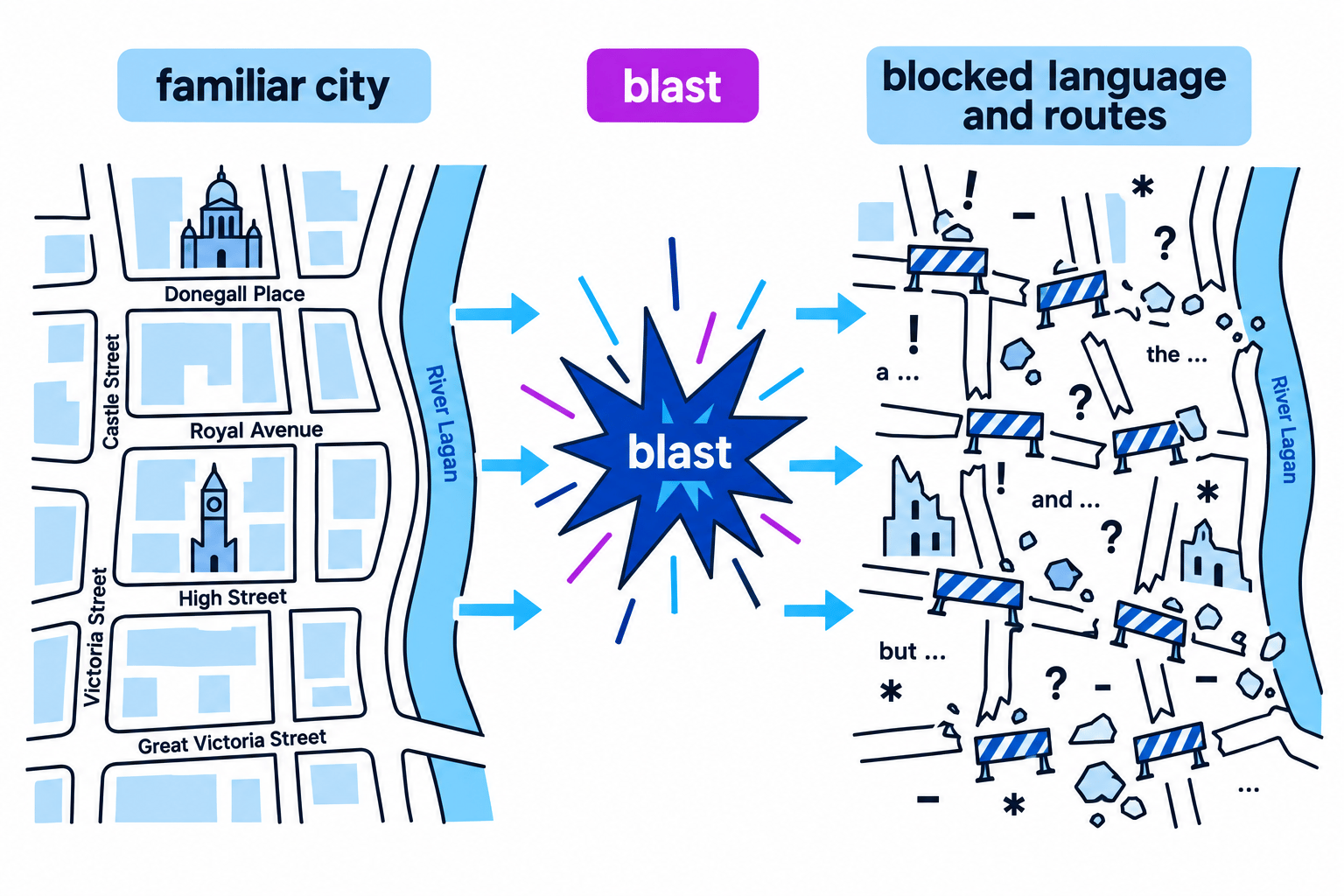
Belfast Confetti: Overview and bomb-blast aftermath
- Explosion: A bomb scatters improvised shrapnel as the speaker is caught amid riot police and tries to understand what has happened.
- Escape: Familiar Belfast streets become blocked or unreadable, turning the speaker's own city into a maze.
- Ending: A volley of questions and armed confrontation leaves identity, direction and language unresolved.
- The poem's city and sentences fail together: when violence fractures Belfast, the speaker also loses the language and direction needed to navigate it.
Belfast Confetti: Violence, language and entrapment
- Disorientation: The speaker cannot organise perception into a stable account because violence has shattered both physical space and thought.
- Language: Punctuation marks become shrapnel and barriers, suggesting that conflict attacks the structures used to communicate and make meaning.
- Entrapment: Street names and military checkpoints convert local knowledge into a map of blocked routes and political control.
- Analyse falling punctuation as literal shrapnel and broken syntax to connect physical danger with a crisis of expression.
Belfast Confetti: Punctuation, form and structure
- Extended metaphor: Exclamation marks, asterisks, hyphens and question marks make printed language visually resemble blast debris and obstacles.
- Long lines: Crowded lines press towards the page edge, reproducing excess, panic and the difficulty of finding an exit.
- Questions: The final interrogatives enact confusion while also resembling hostile questioning by armed authority.
- Do not turn the poem into a general history essay; keep the speaker's immediate confusion, the city map and the language imagery central.
Belfast Confetti: Context, comparison and exam use
- Context: Published in The Irish for No in 1987, the poem recalls Belfast during the Troubles and, according to Carson, August 1969.
- Comparison: Compare it with conflict poems by asking how violence changes perception, language and the ordinary geography of home.
- Exam route: Track one punctuation image from blast to blocked route, showing how form makes psychological disorientation visible.
- What is Belfast confetti literally?
- How does punctuation become violent?
- Why do street names fail to guide the speaker?
- What effect do the final questions create?
Developing a critical argument
A strong response to Belfast Confetti by Ciaran Carson should move beyond retelling and build a clear interpretation of how meaning develops. Begin with the central tension, relationship or idea that the text explores, then trace how it changes across the work or extract. Each paragraph should make a claim that can be debated, support it with a brief and precise reference, and explain how the writer’s choices shape the reader’s understanding. Where the evidence allows more than one reading, acknowledge the alternative and explain why one interpretation is more convincing. This creates a sustained argument instead of a sequence of disconnected observations.
Evidence, method and context
When analysing Belfast Confetti by Ciaran Carson, choose evidence for analytical value rather than length. Focus on individual words, images, contrasts, patterns of sound or syntax, narrative viewpoint, dramatic action, form and structural turning points. Name a method only when the term helps the explanation. The essential move is to connect the detail to its immediate effect and then to the larger theme or character development. Context should clarify the text rather than replace analysis: link relevant social, historical, literary or biographical knowledge directly to a specific choice in the writing, and avoid broad background paragraphs that could apply to any text.
Exam application
Before writing about Belfast Confetti by Ciaran Carson, turn the question into a provisional argument and select three or four moments that show development, contrast or complication. Organise the response around ideas rather than following the text mechanically. Use topic sentences to answer the question, embed concise quotations, and end each paragraph by returning to the significance of the evidence. Reserve time to discuss the ending or final movement because it often confirms, unsettles or transforms the text’s earlier concerns. In the final check, remove unsupported assertions, replace vague comments such as “this makes the reader want to read on” with precise effects, and confirm that every paragraph advances the same overall interpretation.