Revision notes for AQA GCSE English Literature Princess & The Hustler. Open the guide for explanations and worked examples. Written against the AQA GCSE English Literature (8702) specification, so the content matches what's examinable rather than general English Literature background.
Princess & The Hustler
Chinonyerem Odimba's Princess & The Hustler is a vibrant, moving, and politically charged play set in Bristol during the hot summer of 1963. It tells the story of ten-year-old Princess, a Black girl who dreams of winning a beauty pageant, while her family and community are swept up in the historic Bristol Bus Boycott.
What you'll learn
- The Historical Context: How the 1963 Bristol Bus Boycott and the Windrush experience shape the characters' lives.
- Character Dynamics: The complex relationships within the central family and how they react differently to racial prejudice.
- Themes and Motifs: How Odimba uses beauty pageants, fashion, and music to explore colorism, identity, and protest.
- Dramatic Methods: How to analyse Odimba's use of language, stage directions, and symbolism for your GCSE exam.
Historical & Social Context (AO3)
To fully appreciate Princess & The Hustler, you must understand the environment in which the play is set. Odimba uses the micro-drama of one family to explore the macro-politics of post-war Britain.
Definition
Windrush Generation
The Windrush Generation refers to the citizens of Caribbean countries who migrated to the UK between 1948 and 1971. Invited by the British government to help rebuild the country after World War II, many faced severe systemic racism, housing discrimination, and social isolation upon arrival.
The Bristol Bus Boycott (1963)
The central historical event of the play is the Bristol Bus Boycott.
- The Cause: The Bristol Omnibus Company refused to employ Black or Asian bus crews, enforcing a racist "colour bar".
- The Protest: Led by youth worker Paul Stephenson and the West Indian Development Association, the Black community and their allies boycotted the buses for four months.
- The Outcome: On 28 August 1963—the very same day Martin Luther King Jr. delivered his "I Have a Dream" speech in Washington—the company officially overturned the colour bar. This event was a major catalyst for the UK's Race Relations Act of 1965.
Key Idea
The Intersection of Personal and Political
Odimba links Princess’s personal struggle for self-acceptance (wanting to be seen as beautiful in a society that values whiteness) with her community's public struggle for civil rights (the Bristol Bus Boycott). Both are fights to be seen, respected, and valued.
Character & Family Dynamics (AO1)
At the heart of the play is the Windrush family living in Bristol. Each character represents a different response to the pressures of living in a racially hostile society.
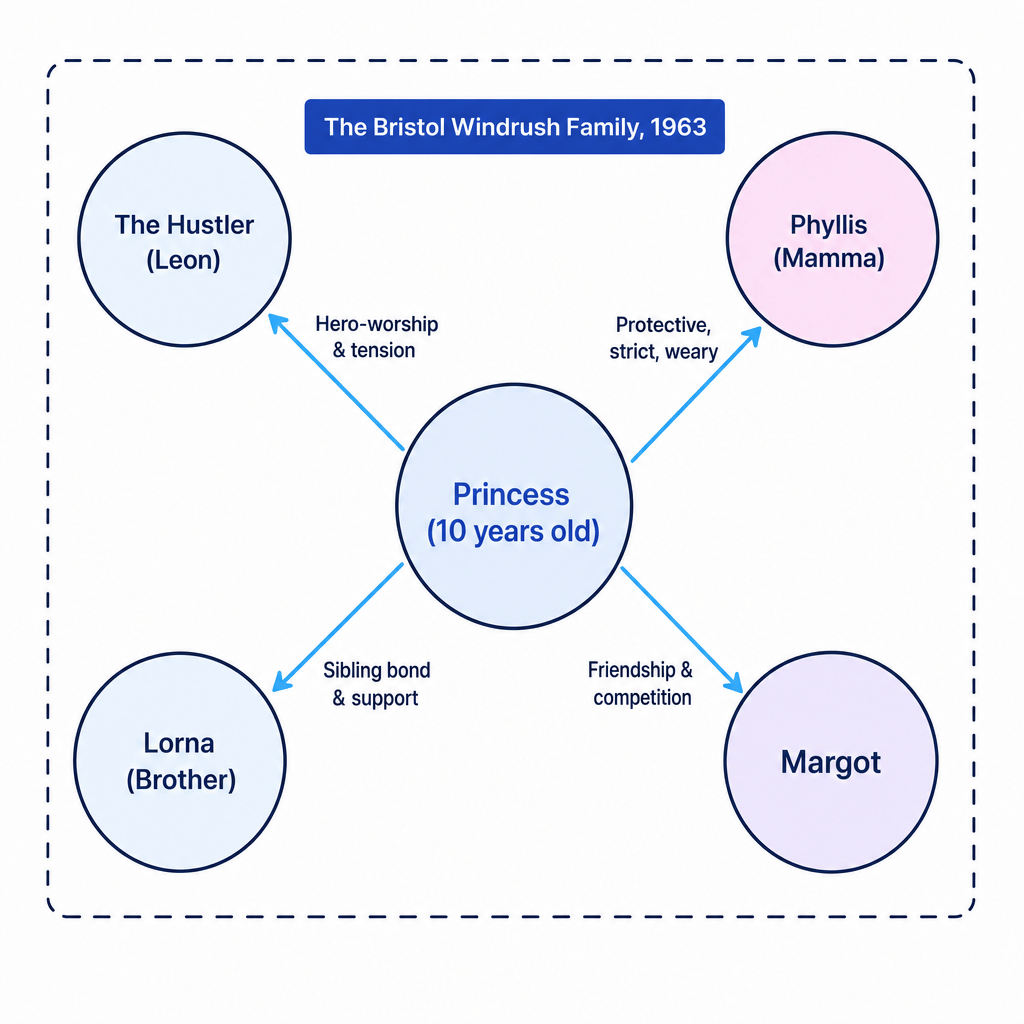
Princess
Ten-year-old Princess is the protagonist. She is imaginative, spirited, and obsessed with the Weston-super-Mare beauty pageant. However, she is also deeply vulnerable. Through her eyes, the audience witnesses the painful dawn of self-consciousness and the impact of systemic racism on a child's self-esteem.
Leon ("The Hustler")
Leon is Princess’s father. Charismatic, charming, and a dreamer, he is known as "The Hustler" because he tries to make a living through informal deals rather than traditional employment. While he is initially seen as unreliable by his wife, his involvement in the Bus Boycott transforms him into a community leader, giving him a renewed sense of dignity and purpose.
Phyllis ("Mamma")
Phyllis is the emotional anchor of the family. Pragmatic, hardworking, and weary, she is deeply protective of her children. Unlike Leon, who wants to stand up and fight, Phyllis’s survival strategy has been to keep her head down, work hard, and avoid conflict with white society.
Lorna
Princess’s older brother. Lorna is caught between the playful world of childhood and the harsh realities of teenage life as a young Black man in 1960s Britain. He is supportive of Princess but is deeply affected by the racism he witnesses and experiences.
Common Mistake
Ignoring Phyllis's Perspective
Students often write Leon as the "hero" of the play and Phyllis as a "barrier" to progress because she opposes his political activism at first. Avoid this simplistic view. Phyllis’s caution is born of love and a realistic fear for her family's physical safety in a racist society.
Key Themes
1. Identity, Colorism, and Beauty
Princess’s desire to enter the beauty pageant is not just a childish whim; it is a search for validation.
Definition
Colorism
Colorism is prejudice or discrimination against individuals with a dark skin tone, typically among people of the same ethnic or racial group, where lighter skin is systematically privileged over darker skin.
Odimba explores colorism through Princess’s interactions with her lighter-skinned friend, Margot. Princess is painfully aware of how her dark skin is perceived, lamenting that her skin is the colour of "chocolate that's been left in the sun" or "a wet Sunday afternoon". The pageant represents her desire to be crowned a "princess" in a world that tells her she is invisible.
2. Protest, Resilience, and Belonging
The play asks: How do we claim our space in a country that does not want us?
- Leon's approach: Active, public resistance. He realizes that keeping quiet will not protect his children's future: "We have to stand up... For the boy. For Princess."
- Phyllis's approach: Quiet resilience. Her preservation of Caribbean culture, food, and family is its own form of resistance.
Dramatic Methods (AO2)
Chinonyerem Odimba uses a variety of dramatic techniques to bring the world of 1963 Bristol to life.
Language and Dialect
Odimba uses a blend of Patois (Jamaican dialect) and British English.
- Phyllis and Leon frequently slip into Patois, especially during moments of high emotion or when reminiscing about home. This acts as a linguistic comfort and a connection to their heritage.
- Princess and Lorna speak with Bristolian accents mixed with elements of their parents' dialect, structurally demonstrating their dual identity as Black British children.
Stage Directions and Music
Music is a vital dramatic tool in the play. Odimba incorporates Ska, Bluebeat, and traditional Caribbean folk songs.
- Music is used to transition between scenes, underscore emotional tension, and represent the cultural wealth the Windrush generation brought to the UK.
- Stage directions often highlight the contrast between the warmth inside the family home and the cold, hostile atmosphere of the streets outside.
Tip
Quoting Stage Directions
Do not just quote what characters say. Top-grade students analyse what characters do. Look at Odimba's stage directions (e.g., how Phyllis handles objects, or how Princess hides her hair) to comment on character subtext and physical theatre.
Deconstructing a Key Passage
When writing an analytical essay for GCSE English Literature, you must link your points closely to the writer's methods and the historical context. Let's look at how to build a high-scoring analytical paragraph.
Example
Deconstructing a key quotation on racial identity
Question: How does Odimba present Princess's struggle with her identity in the play?
- Point: Formulate a clear, direct answer to the prompt that introduces a specific aspect of Princess's struggle.
- Example: Odimba presents Princess's identity struggle as a painful internalisation of Eurocentric beauty standards, which leaves her feeling inadequate and physically unappealing.
- Evidence: Integrate a short, precise quotation from the play to support your point.
- Example: This is clear when Princess looks at her reflection and asks why her skin is the colour of "chocolate that's been left in the sun."
- Method: Identify the specific linguistic or dramatic method the writer uses within that quotation.
- Example: Odimba employs a vivid, child-like metaphor comparing Princess's skin to melted or spoiled chocolate.
- Effect: Explain how this method affects the audience and what it reveals about the character's psychology.
- Example: The image of chocolate "left in the sun" suggests something ruined, discarded, or damaged by exposure. By using this metaphor, Odimba illustrates how deeply Princess has internalised the racist beauty standards of 1960s Britain, viewing her own dark skin not as beautiful, but as a flaw or a mistake.
- Context (AO3): Link your analysis directly to the wider social and historical context of the play.
- Example: This reflects the wider social context of the Windrush generation, where Black immigrants and their children were constantly bombarded with media and cultural messaging that excluded them, highlighting the psychological toll of growing up in a culturally hostile environment.
Exam technique
In the exam
- Answer the question directly: Do not write a general essay about the plot. Every paragraph must directly address the specific focus of the prompt (e.g., family conflict, the presentation of hope, the role of Leon).
- Use the PEMEC structure: Ensure every paragraph moves from a conceptual Point, through embedded Evidence and detailed Method analysis, to the Effect on the audience, concluding with relevant historical Context (AO3).
- Analyse the play as a play: Remember that this is drama. Discuss staging, lighting, music, and how an audience sitting in a theatre would react to the action on stage.
- Integrate context naturally: Never "bolt on" historical facts at the end of a paragraph. Context must be woven into your analysis of the characters' motivations and the writer's intentions.
Self review
Check yourself
- Why is the setting of 1963 Bristol so significant to the central conflict between Phyllis and Leon?
- What does the beauty pageant symbolize for Princess, and how does this change by the end of the play?
- How does Odimba use music to represent cultural heritage and political resistance?
You've reached the end
Test yourself on this topic, or move on to the next guide.
How was this guide?