Revision notes for AQA GCSE English Literature Leave Taking. Open the guide for explanations and worked examples. Written against the AQA GCSE English Literature (8702) specification, so the content matches what's examinable rather than general English Literature background.
Leave Taking
Winsome Pinnock’s Leave Taking (first performed in 1987) is a landmark of Black British theatre. Set in Deptford, South London, in the mid-1980s, the play explores the lives of a Jamaican immigrant mother, Enid, and her two British-born daughters, Del and Viv. It is a deeply moving exploration of displacement, generational conflict, and what it means to find "home."
As part of your GCSE English Literature course (AQA Paper 2, Section A: Modern Texts), you will be expected to write a detailed essay about this play. This guide will break down the essential context, structural beats, characters, and dramatic techniques you need to achieve top marks.
What you'll learn:
- How the historical context of the Windrush generation and 1980s Britain shapes the characters' struggles.
- How to analyse the complex dynamics of the Matthews family.
- How Pinnock uses staging, dialect, and symbolism to present themes of identity and belonging.
- How to write a high-scoring analytical response under closed-book exam conditions.
Context: The World of the Play
To understand the motivations and pain of the characters in Leave Taking, you must understand the world they inhabit. The play is set in 1980s London, but its emotional roots lie in the mid-twentieth century.
The Windrush Generation
In 1948, the HMT Empire Windrush arrived in Essex, carrying hundreds of passengers from the Caribbean who had been invited to help rebuild post-war Britain.
Definition
Windrush Generation
The group of immigrants from Caribbean countries who arrived in the UK between 1948 and 1971. They held British citizenship and migrated to fill labour shortages, but frequently faced systemic racism, housing discrimination, and social isolation upon arrival.
Enid and her friend Broderick belong to this generation. They left the warmth and familiar community of Jamaica for the "mother country," expecting prosperity and warmth, only to encounter a cold climate and a hostile white British society.
1980s Britain: Tension and Rebellion
By the mid-1980s, the children of the Windrush generation—including characters like Del and Viv—were young adults. This era was marked by high unemployment, political instability, and intense racial tension.
- Systemic Racism: Black British youths faced heavy-handed policing, including the infamous "Sus" (suspicion) laws, which led to widespread civil unrest, such as the Brixton riots of 1981 and 1985.
- The Identity Crisis: Unlike their parents, who still viewed the Caribbean as "home," these British-born children had never seen the Caribbean. Yet, British society often refused to accept them as fully English. This left them suspended between two worlds.
Key Idea
The Double Displacement
While Enid suffers from the trauma of leaving her physical home, her daughters suffer from a different kind of displacement: being born in a country that treats them as outsiders, while being disconnected from the land of their ancestors.
Plot and Dramatic Structure
Leave Taking is structured around key shifts in relationships and understandings of home. Let's trace the narrative arc of the play.
[Exposition] ------------------> [Rising Action] -------------> [Climax] ---------------> [Resolution]
Enid tries to keep               Del rebels; Viv suffers        Enid visits Mai;        The daughters find
control. Viv studies;            academic breakdown.            family secrets are      their own paths; Enid
Del clashes.                     Broderick shows limits.        revealed.               accepts the "leave taking".
Exposition: The Clean, Safe Home
The play opens in Enid’s pristine living room. Enid has worked tirelessly as a hospital cleaner to provide a respectable, safe environment for her daughters. She is obsessed with respectability, believing that if her daughters work hard and speak "properly," they will escape the racism she endured.
Rising Action: The Cracks Appear
The pressure on both daughters begins to tear the family apart:
- Viv is suffocating under the weight of her mother’s academic expectations. She memorises dates and facts but feels completely disconnected from herself, suffering from severe anxiety.
- Del rebels against her mother's strictness. She moves out, gets involved in petty crime, and seeks comfort in her Black identity, rejecting the "white-ass country" Enid tries so hard to appease.
- Broderick acts as a warning sign. He is stuck in the past, constantly dreaming of returning to Jamaica but never actually making the leap.
Climax: The Visit to Mai
Desperate to save Del from her self-destructive path and heal the rift in her family, Enid takes Del to see Mai, an Obeah woman (a traditional Afro-Caribbean spiritual healer).
During this spiritual consultation, long-buried truths emerge. Enid is forced to confront her own unresolved grief over her mother's death in Jamaica—a funeral she could not afford to attend. Mai acts as the catalyst for the family's emotional breakthroughs.
Resolution: Acceptance and "Leave Taking"
By the end of the play, the traditional family unit has fractured, but a healthier, truer dynamic is born:
- Viv decides to pause her studies and travel to Jamaica to find her roots on her own terms.
- Del assumes a position of strength, helping her mother learn to read and write, reversing the parent-child roles.
- Enid finally lets go of her tight control, accepting that her daughters must make their own "leave taking" from her expectations to survive.
Character Analysis
Understanding the characters is crucial because the exam will often ask you to explore how Pinnock presents a specific character or relationship to reveal her central themes.
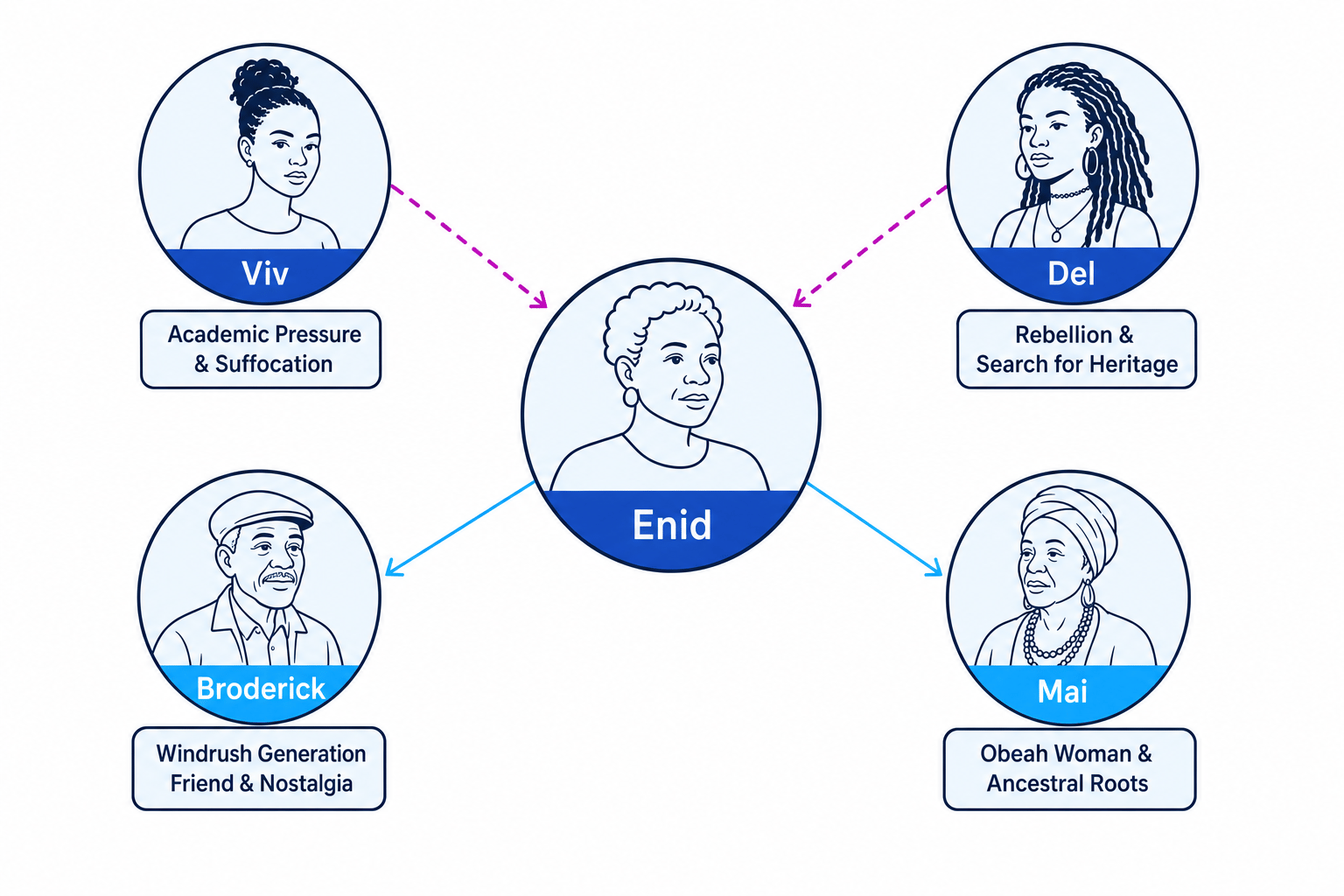
Enid: The Protector
Enid is a complex mixture of fierce love and damaging rigidity. Her obsession with cleanliness, education, and "proper" English is her armor against a hostile white society.
- Methods: Pinnock presents Enid's language as formal and strict when dealing with her daughters, but we see her vulnerability when she speaks to Broderick in her native patois.
- Key Quote: "I don't want you growing up like me... I want you to be someone."
- Analysis: This quote highlights Enid's internalized shame. She equates her own labor as a cleaner with being "no one," driving her to push Viv to the brink of collapse.
Del: The Rebel seeking Identity
Del refuses to assimilate. She is angry at her mother's submissiveness and eager to claim her Caribbean heritage, even if she doesn't fully understand it yet.
- Methods: Del uses street slang and confrontational language to reject her mother's domestic ideals. Her messy, unstructured lifestyle acts as a foil to Enid’s immaculate home.
- Key Quote: "You brought us up to be polite to white people... You made us soft."
- Analysis: Del challenges Enid's survival strategies, viewing them as cowardice rather than the painful sacrifices they actually were.
Viv: The Dutiful Daughter
Viv is trapped between her mother's aspirations and her sister's rebellion. She is the "good girl," but her obedience is slowly killing her spirit.
- Methods: Pinnock structures Viv's dialogue with frantic, lists of historical facts (e.g., memorising the dates of British kings). This structural choice illustrates how her mind is cluttered with white colonial history, leaving no room for her own heritage.
- Key Quote: "I feel like I'm drowning... My head is full of other people's words."
- Analysis: This metaphorical drowning represents the suffocating nature of assimilation. Viv is forced to consume a history and culture that does not validate her own existence.
Mai: The Spiritual Anchor
Mai lives on the margins of society, practicing Obeah. While Enid initially views her as a last resort, Mai is actually the most grounded character in the play. She bridging the gap between London and Jamaica, the living and the dead.
- Methods: Mai's space is sensory, filled with the smell of herbs and the sound of rituals, contrasting sharply with Enid's sterile living room.
- Key Quote: "You have to remember who you are before you can know where you're going."
Common Mistake
Reducing Mai to a stereotype
Do not write about Mai as a simple "witch" or caricature. Pinnock presents Obeah not as primitive "superstition," but as a vital repository of ancestral memory, survival, and psychological healing for women who have been stripped of their history.
Key Themes
When writing your exam essay, you must always link your analysis of characters and techniques back to the big ideas—the themes.
1. Identity, Belonging, and Cultural Heritage
The characters in Leave Taking are all trying to answer the question: Where do I belong?
- Enid tries to belong by erasing her past and blending in.
- Del tries to belong by aggressively claiming a Jamaican identity she has never personally experienced.
- Viv must physically travel to Jamaica to reconstruct an identity that combines both her British reality and her ancestral heritage.
2. Mother-Daughter Relationships and Generational Conflict
The conflict between Enid and her daughters is not just teenage rebellion; it is a clash of historical experiences.
- Enid’s parenting is shaped by the trauma of migration and the need for survival.
- Her daughters' reactions are shaped by the frustration of growing up Black in 1980s Britain.
- The play argues that healing can only occur when the daughters acknowledge their mother's sacrifices, and the mother allows her daughters the freedom to define their own lives.
3. "Leave Taking" as a Motif
The title itself is a rich, multi-layered motif.
Definition
Motif
A dominant, recurring image, idea, or phrase in an artistic work that helps to develop and inform the central themes.
In this play, "leave taking" occurs on several levels:
- The physical migration from Jamaica to England (Enid and Broderick).
- The departure from childhood and parental control (Del and Viv).
- The emotional letting go of the dead and of unrealistic dreams.
- The final "leave taking" of the play, where Viv departs for Jamaica to start her own journey.
Dramatic Methods: Form and Language
AQA examiners are looking for your ability to analyse the writer's craft (AO2). You must show how Pinnock uses the medium of theatre to convey her themes.
Language and Dialect
Pinnock uses language as a battleground for identity.
- Standard English vs. Patois (Creole): Enid speaks to her daughters in precise Standard English to encourage their assimilation. However, when she is emotional, or speaking with Broderick and Mai, she slips into Jamaican patois. This linguistic shift reveals her true self and her deep connection to her homeland.
- Silence and Unspoken Grief: Much of the trauma in the play is found in what is not said. Enid's inability to speak about her mother's death or the pain of her early years in London creates a toxic silence that her daughters inherit as anxiety and anger.
Stage Design and Symbolism
The physical setting of the play mirrors the psychological state of the characters.
- Enid's Living Room: Immaculate, clean, and rigid. It represents Enid's attempt to control her environment and project a "respectable" image to the outside world. It feels like a cage to Viv and Del.
- The Contrast of Mai’s Room: Mai’s room is cluttered, organic, and filled with spiritual items. It represents the subconscious, the past, and the untamed Caribbean heritage that Enid has tried to lock away.
Tip
Set changes as transition
In your essays, write about the transitions between these two sets. The movement of characters between the sterile cleanliness of Enid's home and the earthy, spiritual realm of Mai's room symbolizes their journey from repression to emotional truth.
Worked Analysis
Let us look at how to construct a high-scoring analytical paragraph on Leave Taking.
Remember the formula for high-level analysis:
Point→Evidence→Method→Effect→Context (AO3) \text{Point} \to \text{Evidence} \to \text{Method} \to \text{Effect} \to \text{Context (AO3)} Point→Evidence→Method→Effect→Context (AO3)Example
Analysing the theme of cultural displacement
Question: Explore how Winsome Pinnock presents the theme of cultural displacement in Leave Taking.
- Formulate a clear point: Pinnock presents cultural displacement not just as a geographical separation, but as a deep psychological fracturing that distorts relationships between generations.
- Select and embed precise evidence: This is evident when Enid reflects on her initial arrival in Britain, describing the transition from Jamaica by stating, "It was cold... like the whole world was wash out in grey."
- Identify and analyse the writer's methods: Pinnock employs a bleak simile ("like the whole world was wash out in grey") to contrast the vivid warmth of Enid's memories of Jamaica with the sterile, draining reality of London. The adjective "grey" acts as a visual metaphor for the emotional deflation and lack of vitality Enid experienced upon arrival. This sensory language of coldness directly mirrors her internal sense of alienation.
- Link the analysis to the historical context (AO3): This description captures the profound disillusionment felt by many of the Windrush generation. Having been raised on colonial education to view Britain as a golden "mother country," their physical arrival was often a shock of hostile climates and systemic discrimination, forcing them to suppress their natural cultural vibrancy in order to survive in a "grey", unwelcoming landscape.
Exam Strategy
When you enter the exam hall for Paper 2, you must be prepared to tackle a single, essay-based question on Leave Taking. There will be a choice of two questions—usually one focusing on a character/relationship and one on a theme.
Exam technique
In the exam
- Choose the question carefully: Spend 2 minutes reading both options. Select the one where you can write about the deepest structural and thematic ideas, not just the one where you remember the most quotes.
- Plan your thesis statement: Write a 2-3 sentence introduction that directly answers the prompt. Do not just repeat the question; state what Pinnock is trying to teach the audience through this character or theme.
- Trace the character/theme structurally: Ensure your essay moves chronologically through the play. Show how a character changes or how a theme develops from the exposition, through the climax at Mai's, to the final resolution. This demonstrates your understanding of the text as a play, not just a list of quotes.
- Integrate context (AO3) naturally: Never dump historical facts in a separate paragraph. Always tie the context of the Windrush generation or 1980s racial tensions directly to the language or structural choices you are analysing.
Check Your Understanding
Before you move on to essay planning, make sure you can answer these key questions.
Self review
Check yourself
- Why is Enid so obsessed with Viv's academic success, and what is the psychological cost of this pressure on Viv?
- How does Winsome Pinnock use the character of Mai to challenge Western, colonial ideas of "progress" and "respectability"?
- What is the symbolic significance of Viv's decision to travel to Jamaica at the end of the play?
You've reached the end
Test yourself on this topic, or move on to the next guide.
How was this guide?