Revision notes for AQA GCSE English Literature DNA. Open the guide for explanations and worked examples. Written against the AQA GCSE English Literature (8702) specification, so the content matches what's examinable rather than general English Literature background.
DNA
Dennis Kelly’s 2007 play DNA is a gripping, dark, and highly psychological modern drama. It forces us to confront uncomfortable questions about human nature, group pressure, and the lengths to which people will go to protect themselves at the expense of others. Written for the National Theatre Connections program, it has become a staple of GCSE English Literature for its sharp dialogue and profound moral questions.
What you'll learn
- Plot & Structure: How the four-part structure of the play reflects the escalating moral corruption of the gang.
- Character Dynamics: The psychological struggle between characters like Phil, Leah, and Cathy, and how power shifts between them.
- Key Themes & Context: How Kelly uses the setting of "a street, a wood, a field" to explore teenage alienation, evolutionary biology, and collective guilt.
- Analytical Success: How to construct highly focused essays that analyse Kelly’s specific dramatic methods to hit the highest marks.
The Plot and Dramatic Structure
To write a great exam response, you must look beyond the plot events and analyse how Dennis Kelly structures the play. DNA does not use traditional acts and scenes. Instead, it is divided into four distinct parts, marked by repeating locations: "A Street", "A Wood", and "A Field".
These settings are symbolic:
- A Street: Represents the sterile, public, and mundane everyday world of the teenagers.
- A Wood: Represents the dark, chaotic, and lawless natural world where moral boundaries blur and crimes are committed.
- A Field: Represents a space of reflection, where Leah tries to connect with Phil, and where we witness the emotional fallout of their choices.
The narrative arc of the play maps the transition from a cruel teenage prank to a calculated, cold-blooded conspiracy.
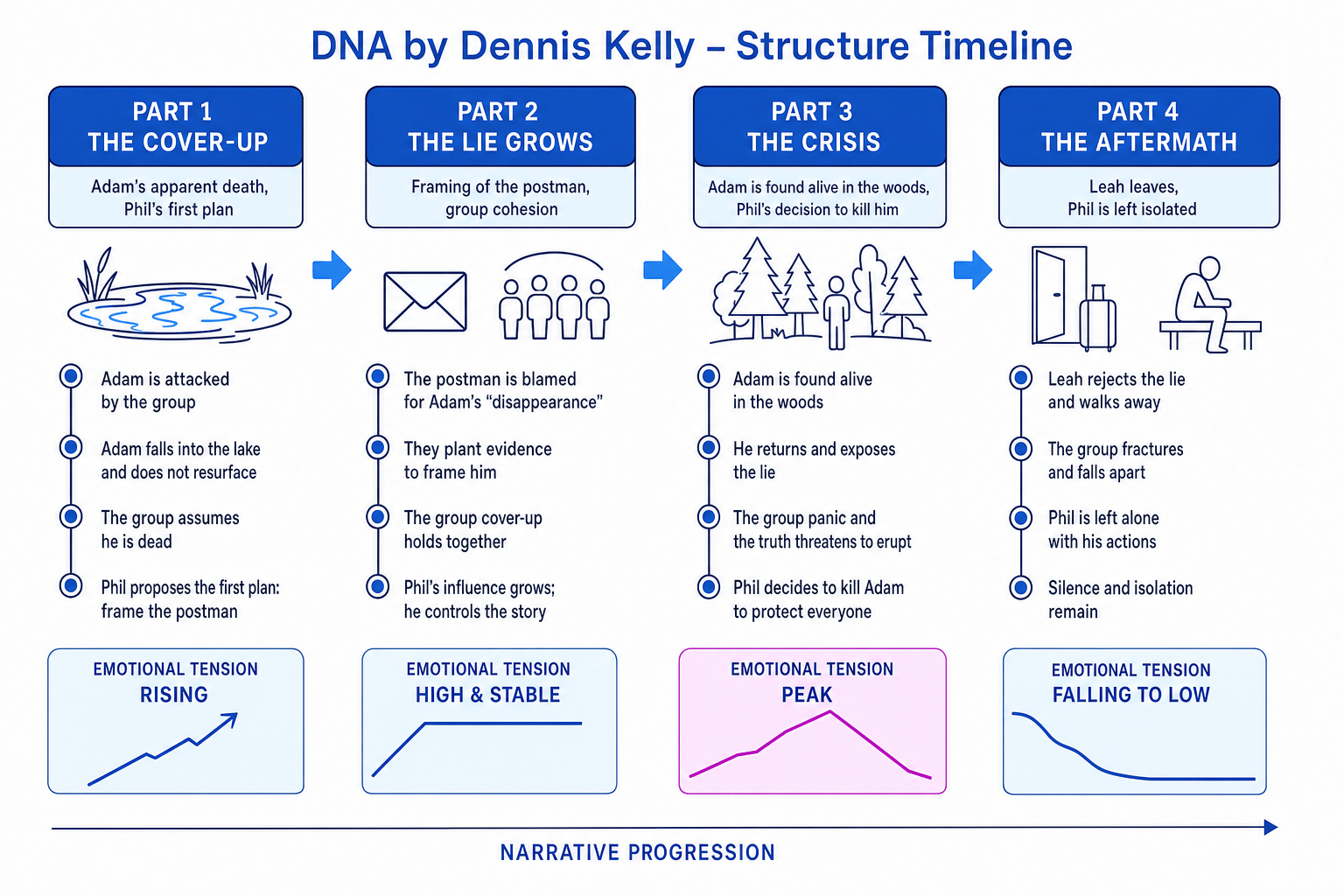
Key Idea
The Cycle of Complicity
The structural repetition of scenes in DNA shows that the characters are trapped. Every time they return to the wood, they sink deeper into moral corruption. What starts as a cover-up for an accidental fall ends with the deliberate, cold-blooded murder of an innocent boy.
Character Dynamics and Power Shifts
The power dynamics in DNA are fluid and terrifying. Kelly uses his characters to represent different psychological reactions to guilt and authority.
Phil: The Silent Mastermind
Phil is arguably the most chilling character in the play. He barely speaks in the early scenes, yet he exerts total dominance over the group.
Kelly uses Phil’s physical actions as a dramatic method. Phil is constantly eating—waffles, chocolates, crisps, and ice cream—while others panic around him. This consumption symbolises his cold, insatiable, and predatory nature. When he does speak, his words are precise, imperative, and devoid of empathy: "We shut up, we quiet down, we stand together."
Leah: The Ignored Moral Compass
Leah provides the audience's moral entry point into the play. She is hyperactive, anxious, and deeply philosophical. Her long monologues directed at the silent Phil represent her desperate attempt to find order, connection, and morality in a world that is rapidly losing both.
Definition
Nihilism
Nihilism is the philosophical belief that life is meaningless, and that traditional moral values have no objective foundation. Phil's actions represent a form of practical nihilism, where human life (like Adam's) can be sacrificed for the convenience of the group.
Cathy: The Ruthless Opportunist
While John Tate starts as the gang's leader, he quickly crumbles under the pressure of guilt. His collapse creates a power vacuum that is filled first by Phil, and later by Cathy. Unlike Leah, who suffers immense guilt, Cathy finds excitement and social status in the criminal cover-up. She represents the terrifying ease with which individuals can be desensitised to violence.
Common Mistake
The 'Evil villain' trap
Do not write about Phil or Cathy as cartoonish villains who are bad simply because they want to be. Kelly is not writing a simple melodrama. Instead, explain why they act this way: they are driven by a primal survival instinct and the pressure of the group collective. They are products of their environment.
Form and Dramatic Methods
To secure high marks in AO2 (Analysis of Language, Form, and Structure), you must name and analyse Kelly’s specific dramatic techniques.
Stichomythia
Kelly frequently uses very fast, fragmented, and overlapping dialogue between characters, particularly Jan and Mark. This technique is known as stichomythia.
Definition
Stichomythia
Stichomythia is a dramatic technique in which rapid, brief, alternating lines of dialogue are spoken by two characters. In DNA, it creates a sense of panic, breathless anxiety, and shared responsibility.
For example, at the start of the play:
Jan: Dead? Mark: Yeah. Jan: What, dead? Mark: Yeah. Jan: Like dead, dead?
The staccato rhythm of this dialogue immediately establishes a state of panic. It also shows how Jan and Mark act as a single unit, reflecting the theme of group conformity. They refuse to take individual ownership of their words or actions.
Analogy
The Ant Colony
Think of the gang in DNA like an ant colony. No single ant makes decisions based on individual morality; they act solely to protect the nest. When Adam threatens the survival of the "nest" (the gang's freedom), the collective mind decides to eliminate him, regardless of individual feelings.
Worked Example: Analysing Character and Theme
Let's walk through how to write a high-level analytical paragraph. We will focus on Leah’s monologue in Act 2, where she compares human behaviour to chimps and bonobos, and how this links to Kelly's wider themes.
Example
Analysing Leah's scientific monologue
Write an analysis of how Dennis Kelly presents the theme of human nature through Leah's monologues.
- Point (Thesis): Kelly uses Leah’s scientific comparisons to explore whether human cruelty is an inevitable, evolutionary trait coded into our DNA.
- Evidence: In Act 2, Leah explains to the silent Phil that "chimpanzees are evil" and will "kill each other... to protect territory," whereas bonobos are "essentially hippies" who resolve conflict through empathy. She despairingly asks, "Which one are we?"
- Method & Analysis: By structuring Leah’s speech as an unreciprocated monologue, Kelly highlights her profound isolation. Her use of evolutionary biology acts as a metaphor for the gang's actions. The reference to chimpanzees killing for "territory" directly mirrors the gang's willingness to sacrifice Adam to protect their own social boundaries and freedom.
- Link to Context & Theme (AO3): This dialogue reflects the play's title, DNA. Kelly prompts the audience to consider whether violent tribalism is an inescapable part of human genetic makeup, or if we have the free will to choose the empathetic path of the bonobo. Leah's ultimate departure from the group suggests that while the "chimpanzee" nature dominates the collective, individual morality is still possible.
Tip
Memorising Key Quotes
Because the exam is closed-book, focus on short, high-impact quotes that can be applied to multiple characters or themes. For example:
- "Suddenly there's us, and the rest of the world." (Group identity vs. outsiders)
- "Are we pathetic?" (Leah's self-awareness and anxiety)
- "I'm in charge. Everyone is happier." (Phil's authoritarian control)
- "She's cutting things up." (Cathy's descent into physical violence)
Contextual Influences (AO3)
When Kelly wrote DNA in the mid-2000s, several social and political contexts influenced his writing:
- The "ASBO" Era and Teen Panic: During this period, the UK media frequently demonised teenagers, using terms like "hoodies" and portraying youth culture as inherently criminal and anti-social. Kelly challenges this stereotype by showing that these teenagers are not unthinking monsters; they are deeply terrified, highly articulate, and struggling with complex psychological pressures.
- Political Allegory: Many critics view the cover-up in DNA as an allegory for state-level political scandals (such as the decisions leading up to the Iraq War). It explores how leaders lie to protect their group, how the public is manipulated, and how an innocent bystander (the framed postman) is destroyed to protect the powerful.
Exam technique
In the exam
- Focus on the prompt: Do not just write a character study or a plot summary. Ensure your thesis statement directly answers the specific question (e.g., if the question is about guilt, focus on how different characters manifest guilt).
- Track character arcs: Show how characters change from the beginning to the end of the play. For example, track Cathy's rise from a passive follower to a terrifyingly active leader.
- Analyse stage directions: Kelly’s stage directions are highly deliberate. Comment on Phil's constant eating, Leah's frantic physical movements, or the moments of silence between lines. Silence is just as important as dialogue in this play!
- Integrate context smoothly: Never "bolt on" historical facts. Always link context back to Kelly's dramatic intentions. For instance, explain how the theme of peer pressure reflects the universal, timeless struggle of adolescent identity.
Self review
Check yourself
- Why does Phil eat continuously throughout the play, and what happens to his eating habits when Leah finally leaves him?
- How does Dennis Kelly use the repeating settings of "A Wood" and "A Field" to structure the moral descent of the characters?
- What is the dramatic significance of Adam's physical state and speech patterns when he reappears in Act 3?
You've reached the end
Test yourself on this topic, or move on to the next guide.
How was this guide?