Revision notes for AQA GCSE English Literature Blood Brothers. Open the guide for explanations and worked examples. Written against the AQA GCSE English Literature (8702) specification, so the content matches what's examinable rather than general English Literature background.
Blood Brothers
Welcome to your study guide for Willy Russell's Blood Brothers. First performed in 1983, this powerful musical play is a staple of modern British drama. It explores how social class, fate, and economic inequality shape the lives of two twin brothers separated at birth.
What you'll learn
- How the cyclical, tragic structure of the play heightens dramatic tension.
- The contrasting presentation of the working-class Johnstone family and the middle-class Lyons family.
- How Willy Russell uses dramatic techniques like the Narrator, foreshadowing, and symbolism to critique 1980s British society.
1. Understanding the Genre and Form
Before looking at the story, we must understand how the play is written. Blood Brothers is a musical play that combines elements of traditional tragedy with social realism.
Definition
Social Realism
A style of drama or literature that depicts the everyday struggles of the working class, highlighting social inequalities, poverty, and systemic political issues.
Unlike naturalistic plays, which try to mimic real life exactly, Blood Brothers uses highly stylized dramatic devices. It features songs, a highly symbolic set, and a Narrator who regularly speaks directly to the audience.
The Tragic Cyclical Structure
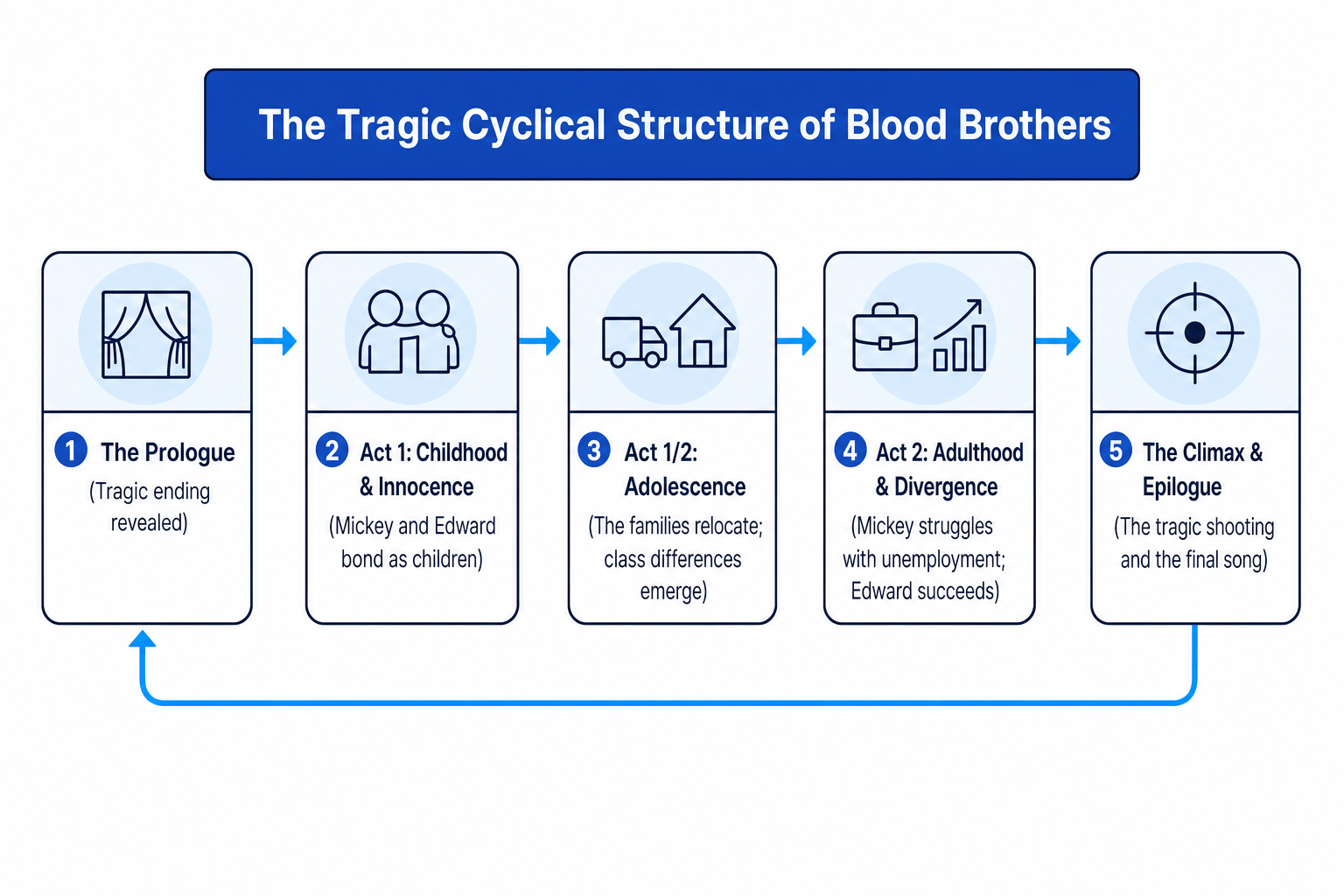
Willy Russell designs the play as a tragedy where the ending is inevitable. He uses a cyclical structure—meaning the play ends where it begins.
In the very first minutes, the Narrator shows us the dead bodies of the twins, Mickey and Edward. This means the audience experiences the entire story through prolepsis (flash-forward). Because you already know they are going to die, every happy moment of their childhood is tinged with sadness and tension. This technique is called dramatic irony.
Definition
Dramatic Irony
A literary device where the audience knows vital information that the characters on stage do not.
2. Characterisation: The Power of Contrasts
The core of the play lies in the contrast between its characters. Russell uses characters as foils to highlight the differences between social classes.
Definition
Foil
A character who contrasts sharply with another character in order to highlight particular qualities, values, or flaws of both.
The Two Mothers: Mrs. Johnstone vs. Mrs. Lyons
The play's conflict begins with a desperate pact between two very different women:
- Mrs. Johnstone: A working-class mother struggling to feed her many children. She is warm, superstitious, and deeply loving, but economically vulnerable. She is forced to give up one of her newborn twins because she cannot afford to keep both.
- Mrs. Lyons: A wealthy, middle-class woman who is unable to have children. She is cold, insecure, and manipulative. She exploits her employee's poverty to buy one of the twins, later becoming consumed by paranoia and guilt.
The Twin Brothers: Mickey vs. Edward
The twins represent the "nature versus nurture" debate. Though genetically identical (nature), their different upbringings (nurture) lead them to completely different lives:
- Mickey Johnstone: Raised in poverty, Mickey's childhood is filled with freedom but limited by resources. As an adult, he is trapped by unemployment, industrial decline, and eventually prescription drug addiction. He speaks in a strong Liverpudlian dialect.
- Edward Lyons: Raised in privilege, Edward attends a private boarding school and later university. He secures a high-paying job in local politics. His speech is standard English, reflecting his upper-class education.
Key Idea
The Class Divide
Russell does not show Mickey and Edward as inherently good or bad. Instead, he shows that their outcomes are determined entirely by their social class. Edward's success is not due to superior talent, but superior opportunity. Mickey's downfall is not due to personal failure, but systemic inequality.
3. Themes: Social Class and Superstition
Nature vs. Nurture
Russell asks us: Are we born to be who we are, or does our environment shape us? The twins are separated at birth. Edward is given every advantage, while Mickey is dealt a poor hand. By the end, Mickey bitterly screams at his mother:
"I could have been him!"
This line highlights the devastating realization that his life was ruined not by his biology, but by his lack of opportunity.
Fate, Destiny, and Superstition
To keep Mrs. Johnstone from telling the truth, Mrs. Lyons invents a superstition:
"If either twin learns that he once was a pair, they shall both immediately die."
Though Mrs. Lyons invents this lie, it becomes a self-fulfilling prophecy. Throughout the play, the Narrator acts as a constant reminder of this impending doom, warning the mothers that "the devil's got your number." Superstition in the play represents the inescapable nature of fate and the mental trap of working-class guilt.
Common Mistake
Confusing Superstition with Magic
Do not write that the twins died because of the "curse." Russell is a social realist writer. The curse is a psychological tool used by Mrs. Lyons to control Mrs. Johnstone. The twins actually die because of class divisions, mental illness, and unemployment—real social issues, not magic.
4. Analyzing Key Quotes and Methods
To get top marks in your GCSE, you must analyze how Russell uses language, structure, and stagecraft to convey his ideas. Let's look at how to build an analytical paragraph.
Example
Analyzing the Narrator's use of foreshadowing
- State your point clearly: Russell uses the Narrator to introduce the theme of inescapable fate and class-based consequence.
- Embed a short, precise quote: The Narrator warns the mothers that no matter how much they try to hide their secret, "the devil's got your number."
- Identify the method: Russell employs a dark, colloquial metaphor of the "devil" to represent both a supernatural force of fate and the cold reality of debt and guilt.
- Analyze the connotations and effect: The phrase "got your number" suggests a calculated, inevitable reckoning. The casual, rhythmic tone of the line makes the threat feel insidious and unavoidable, building dramatic tension for the audience who knows the tragic ending is coming.
- Link to context and writer's intent: Through this, Russell suggests that working-class characters like Mrs. Johnstone cannot escape the social "debts" imposed on them by a capitalist system that penalizes the poor.
5. Key Dramatic Methods to Remember
When writing about Blood Brothers, make sure you mention these dramatic devices:
- The Narrator: He acts like a modern version of a Greek Chorus (a group of actors in ancient Greek drama who comment on the action of the play). He steps in and out of the action, reminding us of the twins' tragic fate.
- Motifs: Look out for recurring symbols, such as:
- Marilyn Monroe: Used to show Mrs. Johnstone's desire for romance and escape, and later, Mickey's dependency on anti-depressant pills (which are compared to how Marilyn Monroe died).
- Guns: Transitioning from harmless childhood games of "cowboys and Indians" to the real, lethal handgun Mickey uses at the end of the play. This is an excellent example of structural foreshadowing.
Tip
Look at the staging
Remember, this is a play script, not a novel! Always mention stage directions, lighting, and sound. For example, the use of red light or sudden, harsh musical chords often signals the presence of the Narrator or an approaching moment of danger.
Exam technique
In the exam
- Focus on the Question: Read the essay question carefully. If it asks about a character (e.g., Mrs. Lyons), make sure you still link your analysis to the wider themes of class and power.
- Integrate Context (AO3): Do not just drop in facts about 1980s Liverpool. Always link context to Russell's intent. For example: "Russell uses Mickey's redundant state to reflect the high unemployment rates under Margaret Thatcher's government in the early 1980s, which stripped working-class men of their identity."
- Analyze the Form: Remember to talk about Blood Brothers as a musical. Mention songs like "Easy Terms" or "Shoes Upon the Table" to demonstrate your understanding of the musical theatre medium.
Self review
Check yourself
- Why does Willy Russell choose to show us the ending of the play in the very first scene?
- What are the main differences in how Mickey and Edward are educated, and how does this affect their adult lives?
- Give two examples of symbols or motifs that Russell uses to foreshadow the tragic climax.
You've reached the end
Test yourself on this topic, or move on to the next guide.
How was this guide?