Welcome to your study guide for J.B. Priestley's classic 1945 play, An Inspector Calls. This text is a staple of the GCSE English Literature specification (Paper 2, Section A: Modern Texts).
Priestley's play is not just a gripping detective thriller; it is a fierce social critique of early 20th-century British society. By understanding how the play's structure, characters, and context intertwine, you will be able to write the high-level analytical essays that examiners love to see.
What you'll learn
- How the dramatic tension is structured across the play’s three acts.
- The vital historical distinction between 1912 (when the play is set) and 1945 (when it was written and performed).
- How Priestley uses his characters to represent competing political ideologies: Capitalism and Socialism.
- How to analyse Priestley’s dramatic methods to uncover his deeper moral message.
1. The Big Picture: Context is Key
To understand An Inspector Calls, you must understand when it was set versus when it was written. This gap is the foundation of Priestley's dramatic strategy.
Dramatic Irony
A literary device where the audience knows more about the situations, the causes of conflicts, and their resolutions than the characters do.
The play is set in 1912, during the Edwardian era, but was written in 1945, just as World War II was ending in Europe.
- In 1912: Society was highly unequal, divided strictly by class and gender. There was no welfare state (no NHS, no benefits, no council housing). If you fell on hard times, you relied entirely on private charity. Wealthy industrialists like Arthur Birling held absolute power over their workers.
- In 1945: Britain had just endured two devastating world wars. The public was eager for social change, leading to a landslide victory for the Labour Party and the creation of the modern welfare state.
Priestley, a passionate socialist, set his play in 1912 to show his 1945 audience how far society had come, and to warn them against slipping back into the selfish, individualistic ways of the past.
The Clash of Ideologies
At its heart, the play is a battleground between two opposing worldviews:
- Capitalism (represented by Mr and Mrs Birling): The belief that industry and trade should be privately owned for profit, and that individuals are solely responsible for themselves ("a man has to make his own way").
- Socialism (represented by Inspector Goole and J.B. Priestley): The belief that the means of production and distribution should be shared or regulated by the community as a whole, emphasizing collective social responsibility ("We are members of one body").
2. Structure: The Dramatic Timeline
Priestley constructs the play using elements of three distinct theatrical traditions:
- The Well-Made Play: A popular 19th-century genre featuring a tight, chronological plot where secrets are gradually revealed, building to a dramatic climax.
- The Detective Thriller: A crime is introduced, suspects are interrogated, and clues are pieced together. Priestley subverts this by making everyone guilty of a moral crime, rather than just one person committing a legal one.
- The Morality Play: A medieval drama that uses allegorical characters to teach the audience a moral lesson about sin, repentance, and redemption.
The play takes place in real-time over a single evening in the Barlings' dining room, adhering to the classical Unities of Time, Place, and Action. This creates a claustrophobic, intense atmosphere where the characters cannot escape the Inspector’s scrutiny.
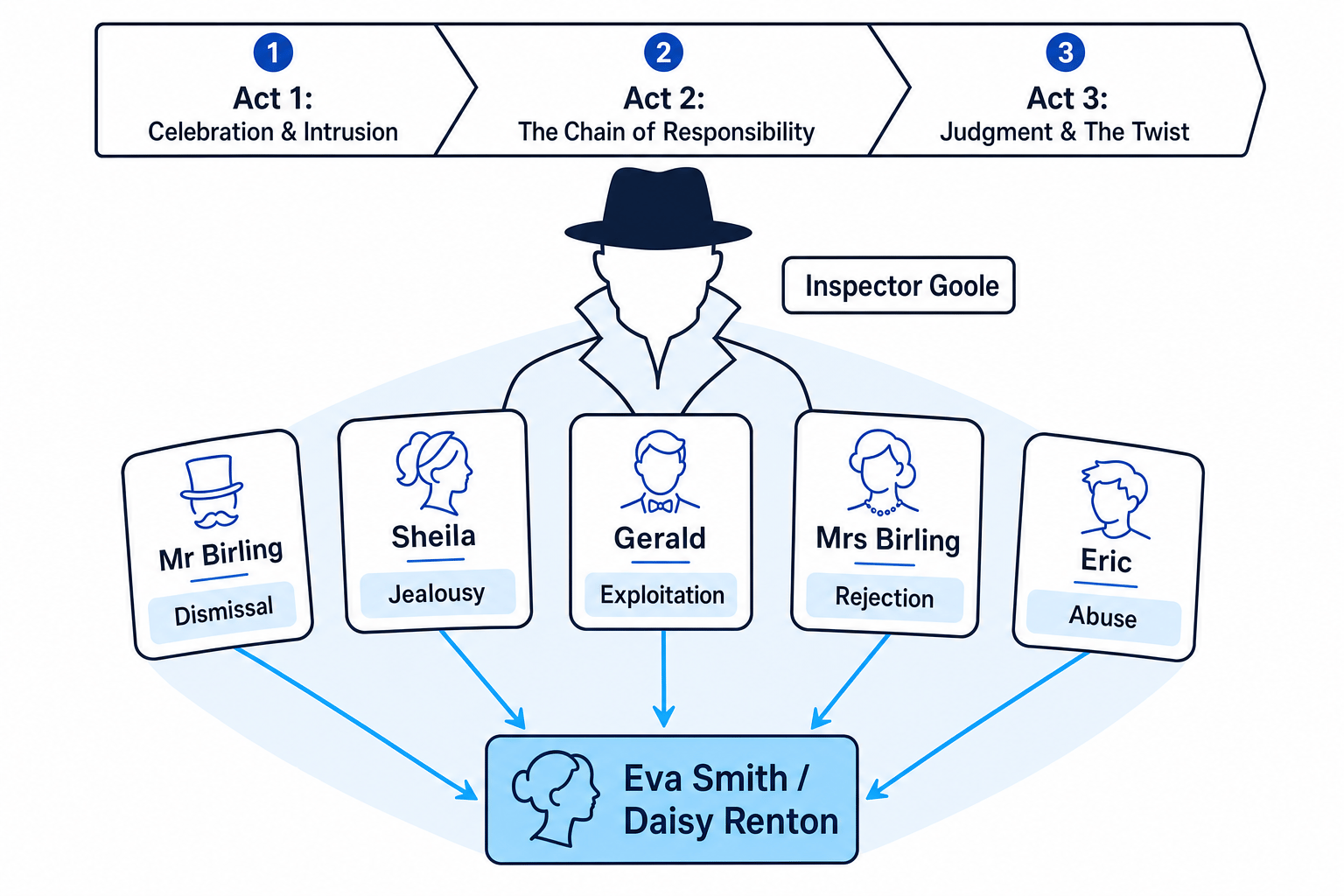
3. The Inspector as a Catalyst
The play begins with the Birling family celebrating the engagement of Sheila Birling to Gerald Croft. The atmosphere is warm, intimate, and self-congratulatory.
This bubble is burst by the sharp ring of the doorbell and the arrival of Inspector Goole.
Goole functions as a dramatic catalyst. He does not physically force the characters to confess; instead, he uses a single photograph and a diary to systematically break down their defences. He constructs a "chain of events" showing how each character's selfish actions contributed to the suicide of a young working-class woman, Eva Smith (also known as Daisy Renton).
Treating the characters as real people
Do not write about the characters as if they are real individuals with independent minds. Always refer to them as constructs created by Priestley to represent specific social classes, age groups, or political viewpoints. For example, write: "Priestley constructs Mr Birling as a caricature of capitalist greed to..." instead of "Mr Birling is greedy because..."
4. Deconstructing Priestley's Methods
To gain high marks in your exam (specifically targeting the analysis of language, form, and structure), you must look closely at how Priestley writes. You must link his linguistic and structural choices directly to his social message.
Let’s look at how to walk through a textual analysis of Mr Birling's early speeches.
Analysing Dramatic Irony in Mr Birling's Speech
Analyze how Priestley uses dramatic irony in Act 1 to undermine Mr Birling’s capitalist authority.
-
Identify the focus and select the evidence: Focus on Mr Birling lecturing the younger generation about the future in Act 1. Select the quotation where he describes the Titanic: "unsinkable, absolutely unsinkable".
-
Identify the writer's methods: Priestley uses dramatic irony and repetition of the word "unsinkable".
-
Analyse the language and connotations: The Titanic was a symbol of Edwardian technological progress, luxury, and class division (with lower-class passengers locked below deck). By repeating "unsinkable", Birling shows blind, hubristic faith in his own class's invincibility.
-
Link to the context and Priestley's message: The 1945 audience, looking back at 1912, knows the Titanic sank, just as they know World War I and World War II shattered the Edwardian capitalist dream. By making Birling look foolishly wrong about history, Priestley systematically destroys Birling's credibility as a "hard-headed practical man of business," urging the audience to reject his capitalist ideology.
The Power of the Inspector's Name
Think about the homophone of the Inspector's surname: Goole sounds like ghoul (a ghost or spirit). This hints at his supernatural or omniscient nature. He is not a normal policeman; he is a moral force or a physical manifestation of the characters' shared conscience.
5. The Generational Divide
One of Priestley's most hopeful themes is the generational divide.
- The Older Generation (Mr and Mrs Birling): They represent stubborn, unyielding capitalism. When the Inspector leaves and is revealed to be a potential hoax, they are relieved. They care only about avoiding a public scandal and protecting their social status. They learn nothing.
- The Younger Generation (Sheila and Eric): They represent the hope for a socialist future. They are deeply affected by their roles in Eva’s death. Even when they think the Inspector might be fake, they understand that their moral guilt remains. As Sheila says, "It doesn't make any difference... you're pretending everything's just as it was before."
The Birling Home as a Fortress
The Barlings' dining room starts as a fortress of privilege, shut off from the harsh realities of the working class. The Inspector represents the outside world breaking in, tearing down the walls of class complacency, and forcing them to look at the collateral damage of their capitalist lifestyle.
In the exam
- Address the prompt directly: Spend the first two minutes of your exam unpacking the key terms in the essay question. Write a thesis statement in your introduction that outlines your main argument.
- Use the PEEL structure: Every paragraph should state a clear Point, provide precise Evidence (short, memorised quotes), identify the writer's Effects/methods, and Link back to the question and the social/historical context.
- Weave in context naturally: Do not bolt on historical facts at the end of paragraphs. Integrate context directly into your analysis of Priestley's purpose (e.g., "Priestley presents Sybil Birling's charity work to critique the inadequate, biased nature of pre-welfare state Edwardian philanthropy...").
- Focus on the ending: The final lines of the play (the telephone call announcing a real police inspector is on his way) are structurally vital. Discuss how this cyclical structure warns the characters—and the audience—that they will be punished if they do not learn their lesson.
Check yourself
- Why did Priestley choose to set the play in 1912 but write and perform it in 1945?
- What are the three theatrical genres that Priestley blends together to create the structure of An Inspector Calls?
- How do the reactions of the older generation differ from the younger generation once they suspect Inspector Goole might be a fraud?
