Revision notes for AQA GCSE English Literature A Taste of Honey. Open the guide for explanations and worked examples. Written against the AQA GCSE English Literature (8702) specification, so the content matches what's examinable rather than general English Literature background.
A Taste of Honey
Shelagh Delaney’s 1958 play A Taste of Honey is a revolutionary piece of British drama. Written when Delaney was just 19 years old, it exploded onto the post-war theatrical scene, challenging the polite, middle-class conventions of British theatre by putting working-class women, single motherhood, homosexuality, and interracial relationships center stage.
What you'll learn
- The historical and social context of late-1950s Salford and how it birthed Kitchen Sink Realism.
- How the complex, co-dependent relationship between Helen and Jo drives the plot and themes.
- Key dramatic techniques, including stichomythia and Brechtian Epic Theatre devices.
- How to construct a top-tier analytical paragraph for your Paper 2 exam.
The Cultural Landscape: 1950s Britain and Salford
Before diving into the characters, you need to understand the world Delaney was reacting against. In the 1950s, mainstream British theatre was dominated by polite, upper-middle-class drawing-room comedies. Delaney, a working-class young woman from Salford, found these plays completely disconnected from real life.
She set her play in her hometown of Salford, Lancashire—an industrial city defined by poverty, back-to-back housing, coal dust, and economic struggle.
Definition
Kitchen Sink Realism
Kitchen Sink Realism is a British cultural movement of the late 1950s and 1960s that focused on the gritty, unromanticized, everyday lives of working-class people, using realistic dialogue and domestic settings to explore controversial social issues.
Delaney did not want to write a tragedy where working-class characters were punished for their lives. Instead, she presented their resilience, humor, and survival tactics without moral judgment.
Character Dynamics and Themes
At the heart of the play is a tight-knit, often claustrophobic web of characters trying to find their own "taste of honey"—a brief moment of happiness or escape from their bleak realities.
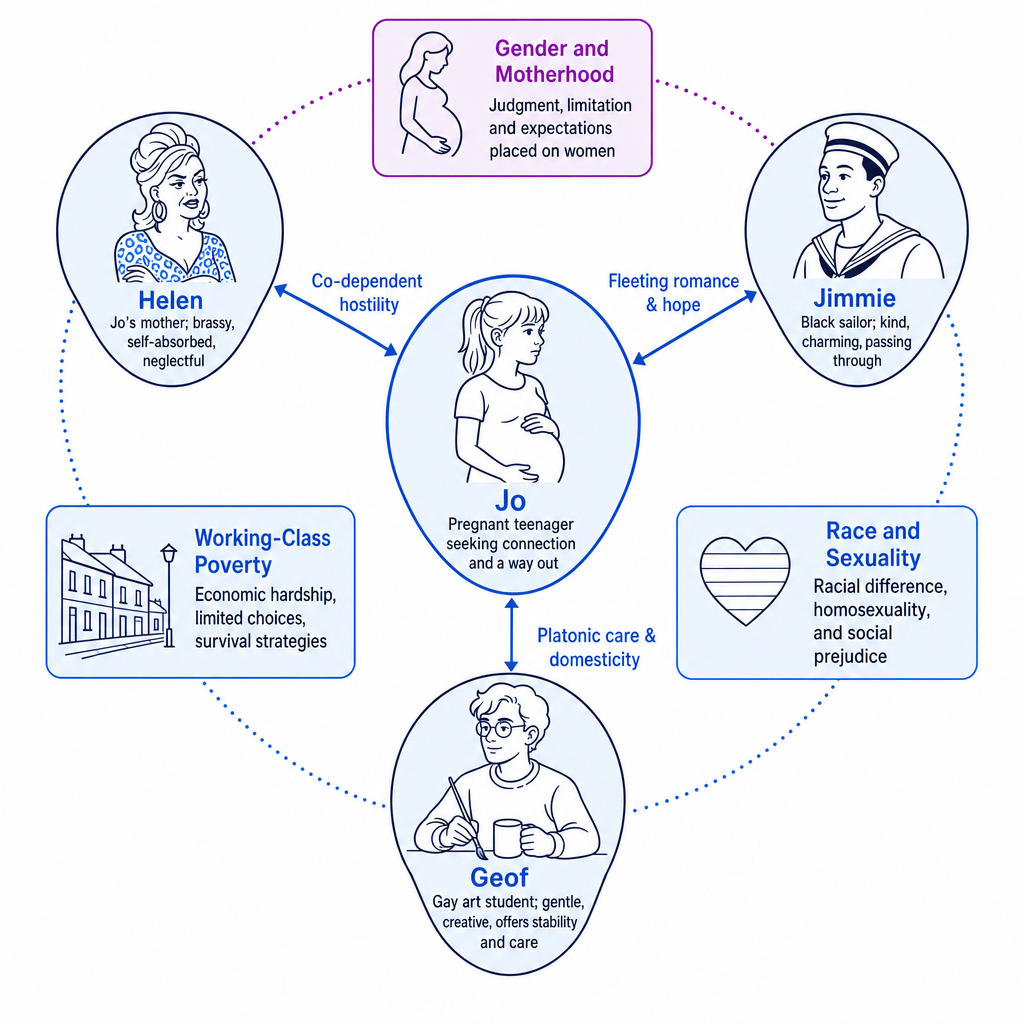
Helen and Jo: The Co-dependent Cycle
Helen (the mother) and Jo (the teenage daughter) share a volatile, circular relationship. They constantly bicker, trade insults, and abandon one another, yet they are deeply alike. Both are survivalists trapped by their gender and class.
- Helen: A self-described "semi-demi-monde" who relies on men for financial security. She is brassy, loud, and neglectful, yet her neglect stems from her own battle to survive in a patriarchal world where women without husbands have no economic safety net.
- Jo: Artistic, cynical, and deeply lonely. She seeks the affection she never received from Helen, first from Jimmie (the black sailor) and then from Geof (the gentle art student).
Key Idea
The Cycle of Generational Neglect
Jo’s pregnancy at the end of Act One mirrors Helen’s own past. Delaney uses this structural parallel to show how poverty and a lack of education trap working-class women in a repetitive cycle of early pregnancy and struggle.
Geof and Jimmie: Radical Representation
Delaney’s inclusion of Jimmie and Geof was incredibly daring for 1958:
- Jimmie is a black sailor who offers Jo genuine affection, but his departure highlights the transience of Jo's happiness. Their interracial relationship challenged the racial prejudices of post-war Britain, which was experiencing rising racial tensions following the windrush generation's arrival.
- Geof is a homosexual art student. In 1958, homosexual acts between men were illegal in the UK (not decriminalized until 1967). Geof is portrayed not as a caricature, but as the most nurturing, maternal, and emotionally intelligent character in the play, providing a safe domestic space for the pregnant Jo.
Delaney's Dramatic Methods
To write about A Taste of Honey effectively at GCSE, you must discuss how Delaney conveys her ideas. She blends gritty realism with experimental theatrical techniques.
1. Stichomythia and Colloquial Dialogue
Delaney uses the authentic working-class slang of Salford. Characters often engage in rapid-fire, competitive dialogue.
Definition
Stichomythia
Stichomythia is a dramatic technique where characters speak in quick, alternating single lines of dialogue. It creates a fast, rhythmic pace and often signals tension, conflict, or deep familiarity between characters.
2. Brechtian Epic Theatre
Delaney was heavily influenced by Joan Littlewood's Theatre Workshop, which utilized the ideas of German playwright Bertolt Brecht.
- Direct Address (Breaking the Fourth Wall): Characters frequently turn away from each other and speak directly to the audience, reminding us that we are watching a play and forcing us to judge the social situation objectively rather than just getting swept up in emotional melodrama.
- Use of Music: Characters dance, sing nursery rhymes, and are accompanied by a live jazz trio. This music-hall style breaks the realism and comments on the action.
Putting It Into Practice: Structuring Your Analysis
When writing your essay, you need to weave together AO1 (your argument and quotes), AO2 (Delaney's language/dramatic methods), and AO3 (the 1950s social context).
Let's look at how to analyze a crucial interaction between Helen and Jo in Act One, Scene One, where they discuss their bleak new flat.
Example
Analyzing Jo and Helen's Relationship
Analyze how Delaney uses dialogue to present the relationship between Helen and Jo in Act One, Scene One.
- Formulate your thesis statement (AO1/AO3): Start by identifying the core dynamic. Delaney establishes Helen and Jo's relationship as mutually hostile yet deeply co-dependent, reflecting how poverty forces them into constant conflict over limited resources.
- Select and embed your evidence (AO1): Focus on a specific exchange:
Jo: “You’ve got no right to call me a bloody little prostitute! I’m not a prostitute.” Helen: “You’re like me, Jo. You want keeping.”
- Identify the dramatic methods (AO2): Point out the use of stichomythia, the colloquial, taboo language ("bloody little prostitute"), and Helen’s direct, blunt declarative statement ("You’re like me... You want keeping").
- Analyze the meaning and effects (AO2): Explain how Helen's comparison ("like me") shows that despite her hostility, she recognizes their shared fate. The noun "keeping" implies that as working-class women in the 1950s, their only financial survival strategy is dependency on men. It highlights Helen’s cynical, pragmatist view of survival, which she forces onto her daughter.
- Link to the writer's social purpose and context (AO3): Explain that Delaney uses this raw, unromanticized depiction of mother-daughter conflict to shock her 1958 middle-class audience, exposing how systemic poverty and a lack of social mobility strip away traditional, gentle maternal instincts.
Common Mistake
Treating the characters as real people
Do not write about Jo or Helen as if they are your friends or real people who made bad choices. Always refer to them as constructs created by Delaney to highlight specific social issues (e.g., "Delaney constructs Helen to represent..." rather than "Helen is a bad mother because...").
Tip
The Power of Short Quotes
Because the exam is closed-book, memorize short, high-impact quotes that can be used for multiple themes. For example: "He's only a dream I had" (Jo) can be used to discuss Jimmie, the theme of hope/illusion, or Jo's disillusionment.
Exam technique
In the exam
- Deconstruct the prompt immediately: Identify the core theme or character in the question (e.g., "poverty" or "Geof") and jot down 3 distinct areas of the play where this is central.
- Spend 5 minutes planning: Create a quick thesis statement and outline three body paragraphs that move chronologically through the play to show how the character or theme develops.
- Balance your Assessment Objectives: Ensure every single paragraph contains a clear point (AO1), a short quote with named dramatic methods (AO2), and a direct link to Delaney's 1950s context and social message (AO3).
Self review
Check yourself
- Why did Shelagh Delaney write A Taste of Honey? What was she reacting against in British theatre?
- Name two Brechtian (Epic Theatre) techniques used in the play and explain their effect on the audience.
- How does the character of Geof challenge traditional 1950s gender roles and social norms?
You've reached the end
Test yourself on this topic, or move on to the next guide.
How was this guide?