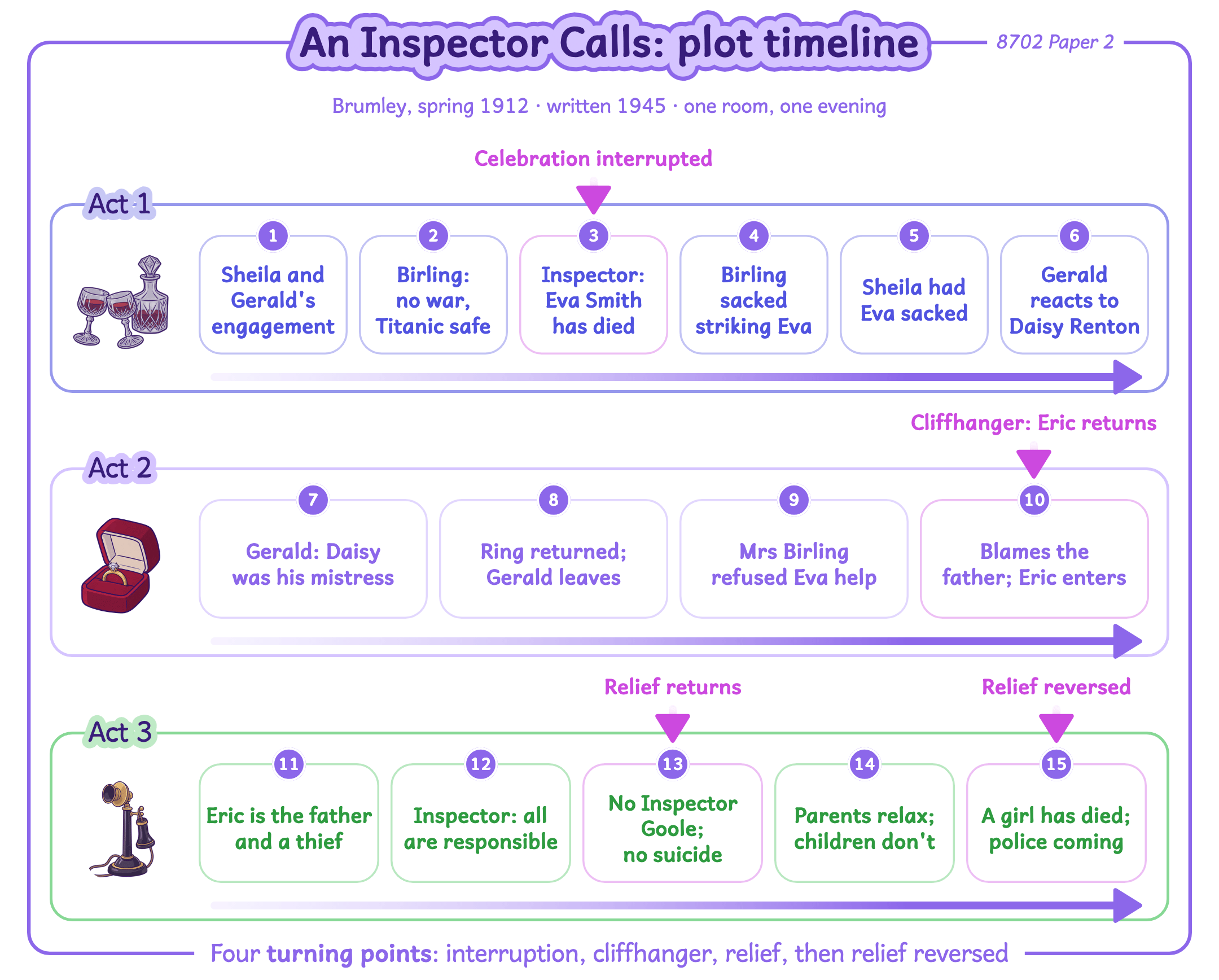
The celebration appears secure
Example
pink and intimate
- Opening stage direction | Act I, PDFp2, initial lighting.
- The engagement joins family affection with business interests, making the celebration a display of social and economic confidence.
- The soft lighting creates protected intimacy, allowing the household to enjoy an apparently comfortable account of itself.
- The harder lighting after the Inspector arrives changes the stage’s atmosphere, turning comfort towards exposure and scrutiny.
- Edna’s service supports the celebration while her limited voice hints at the unequal labour sustaining domestic privilege.
Birling’s predictions test his judgement
Definition
Dramatic irony
A situation in which the audience understands something that one or more characters do not.
- Birling confidently predicts security and progress, giving spectators claims they can test against their knowledge of later events.
- The Titanic reference creates dramatic irony, undermining his assurance that wealth and technology make danger negligible.
- His individualist advice links personal conduct with business principles, preparing a conflict over responsibility beyond the household.
- The Inspector’s interruption challenges both his speech and its authority, making timing part of the argument.
The inquiry controls what becomes visible
- The Inspector questions one person at a time, preventing the family from easily coordinating a shared defence.
- The photograph is shown selectively, controlling information while leaving the audience dependent on spoken reactions and testimony.
- The absent woman becomes central through the effects of their actions, keeping consequences present without staging her directly.
- The linked disclosures make apparently separate decisions accumulate, challenging the belief that each action was an isolated private matter.
Sheila recognises the worker as a person
Example
But these girls aren't cheap labour – they're people.
- Sheila | Act I, PDFp19, response to the Inspector’s account of unemployment.
- Sheila’s contrast rejects a purely economic label, demanding human recognition beyond commercial usefulness.
- The opposition between labour and people makes dehumanisation audible, exposing what business language leaves out.
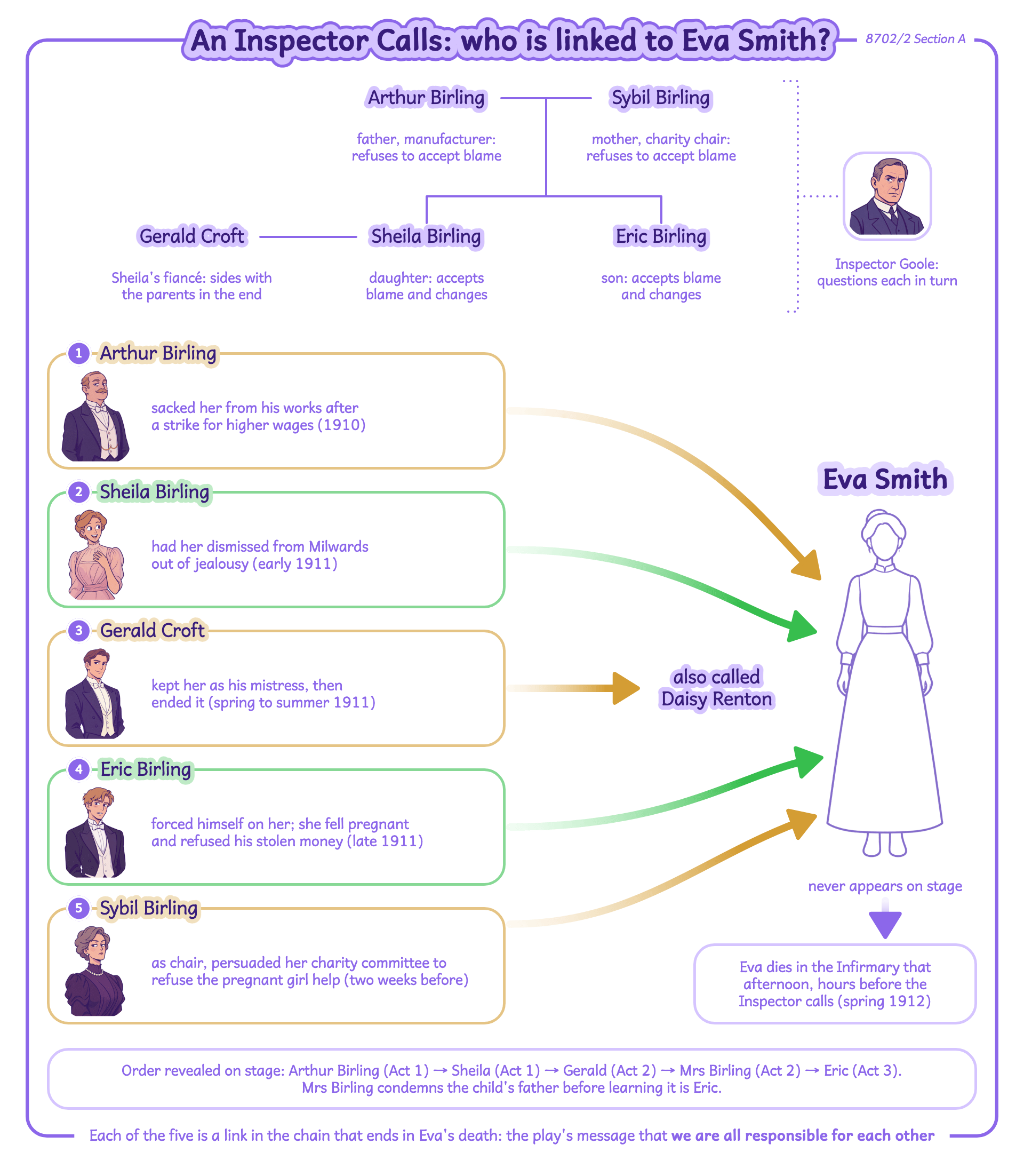
- Her complaint at the shop demonstrates a customer’s power over employment, turning jealousy into material harm.
- Her admission distinguishes remorse from undoing consequences, beginning a change in judgement without recovering the dismissed woman’s security.
Gerald’s help contains unequal power
- Gerald removes Daisy from an immediate threat and provides accommodation, giving his account a basis in real assistance.
- That assistance also creates dependence, complicating any claim that gratitude proves equal romantic attachment.
- His description centres his own experience of being needed, inviting scrutiny of who controls the relationship’s terms.
- Sheila’s return of the ring breaks the engagement’s apparent completion; its later reappearance does not secure an automatic reconciliation.
Mrs Birling judges through social deference
- The applicant’s use of her name provokes offence, allowing Mrs Birling’s concern with status to shape access to charitable aid.
- Her defence of duty turns refusal into moral self-approval, exposing the gap between institutional procedure and actual care.
- She demands punishment for the child’s father before recognising Eric’s involvement, creating dramatic irony through delayed knowledge.
- The judgement returns against her own family, testing whether supposedly firm principles survive personal implication.
Eric’s account requires moral judgement
- Eric describes coercive behaviour, making his responsibility more serious than a simple mistake within a regrettable romance.
- His stolen money cannot resolve the injury and creates another wrong, separating intended help from justified conduct.
- The account exposes a household where distress is difficult to discuss, without making parental failure erase Eric’s own agency.
- His remorse matters because it accepts consequences, rather than treating uncertain police procedure as proof that nothing happened.
The farewell makes responsibility collective
Example
We are members of one body.
- Inspector | Act III, PDFp52, farewell speech.
- The bodily metaphor joins separate people within one living whole, making interdependence the alternative to Birling’s individualism.
- The plural pronoun includes speaker and listeners, resisting a comfortable division between judges and people needing judgement.
- The warning imagines suffering as the consequence of refusing that connection, widening the inquiry beyond one family’s embarrassment.
- The Inspector’s authority remains mysterious, but the ethical demand can be assessed through the conduct already disclosed.
Doubts expose different responses to guilt
Example
It's still the same rotten story
- Eric | Act III, PDFp59, response to doubts about the Inspector’s identity.
- Gerald’s investigation raises genuine questions about identity and the photographs, separating legal certainty from moral accountability.
- The older characters treat possible escape from scandal as relief, while Sheila and Eric retain the significance of their actions.
- Eric’s description makes the story’s corruption survive a change of listener, rejecting procedure as moral absolution.
- The disagreement cuts across the temporary unity of the celebration, leaving the household divided over what it has learned.
The telephone interrupts renewed complacency
- Birling’s mockery of the younger generation attempts to restore authority, repeating the confidence challenged at the beginning.
- The ringing telephone interrupts that attempted recovery, making an ordinary object deliver renewed dramatic uncertainty.
- The report of a death and an approaching inspector refuses a settled escape, linking the ending with the inquiry’s beginning.
- The unresolved final reaction leaves spectators judging responsibility, rather than receiving a complete explanation of the Inspector’s identity.
Literary terms used in this guide
- Stage direction: An instruction or description outside the spoken dialogue concerning action, setting, delivery or other performance features.
- Structural reversal: A turn in events that changes the force of an earlier situation, expectation or apparent resolution.
A worked analytical paragraph
- Priestley’s lighting change makes moral scrutiny a theatrical experience. The soft opening atmosphere supports the family’s comfortable celebration, but the Inspector’s arrival replaces it with harder illumination. This contrast prepares spectators to question the account the household gives of itself. As individual disclosures accumulate, the room remains recognisable while its security changes, turning the same domestic space from a place of reassurance into one of exposure.
Using and checking quotations
- References: Locations follow the edition checked for this guide; compare them with your copy.
- Compare spelling, punctuation and line numbering with your assigned edition before learning a passage.
Self review
- How does the lighting change the atmosphere?
- How does Mrs Birling’s judgement turn against Eric?
- Why do the younger characters reject the adults’ relief?
- How does the final telephone call change the ending?