The Witches unsettle moral judgement
Fair is foul, and foul is fair;
- The three Witches | Act 1, Scene 1. Their opening chant establishes a world in which apparent opposites can exchange places.
- The opening paradox makes good and evil seem interchangeable, introducing uncertainty before Macbeth appears onstage.
- The balanced repetition of opposite words makes the Witches’ claim memorable, suggesting moral confusion beneath its neat pattern.
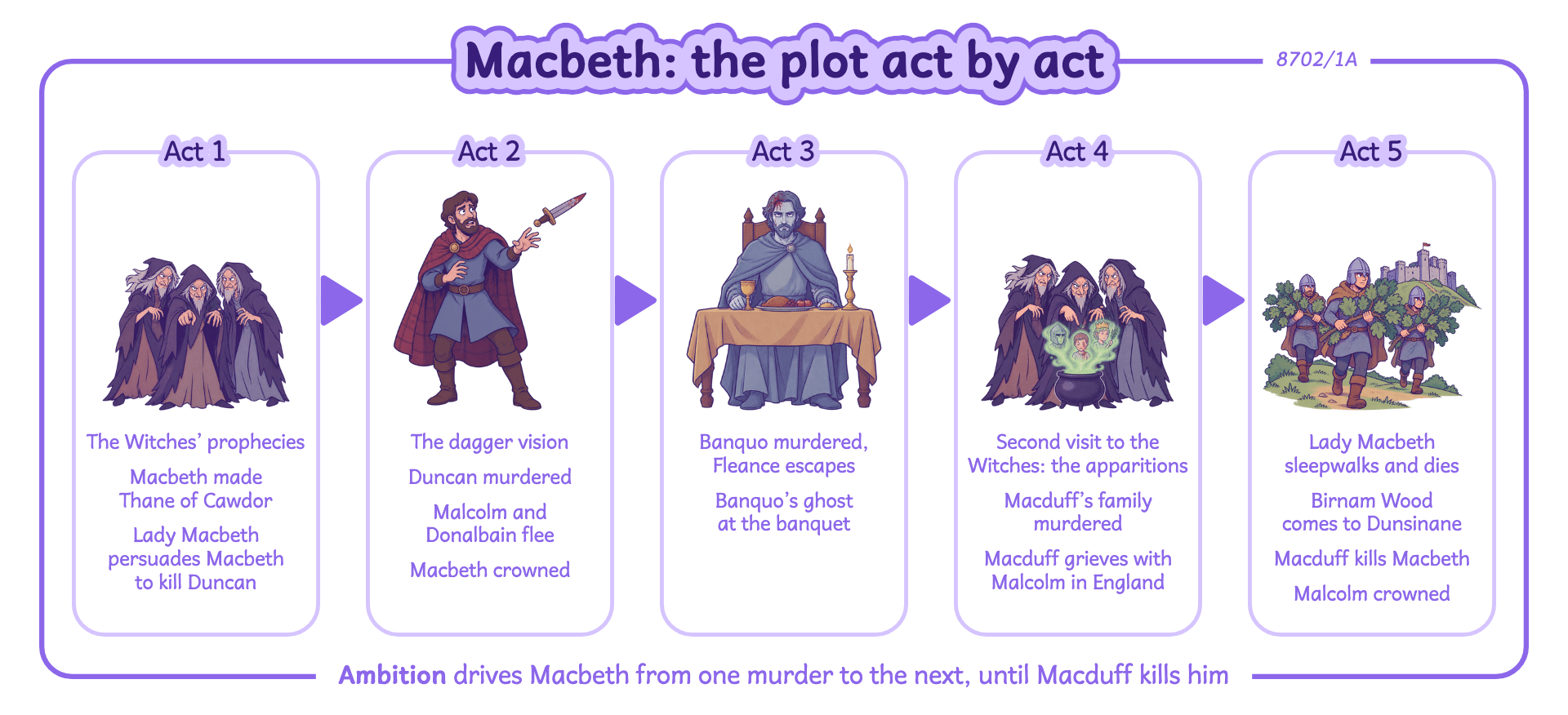
- Macbeth first wins praise for defending Scotland, so his later violence reveals a hero becoming a tyrant.
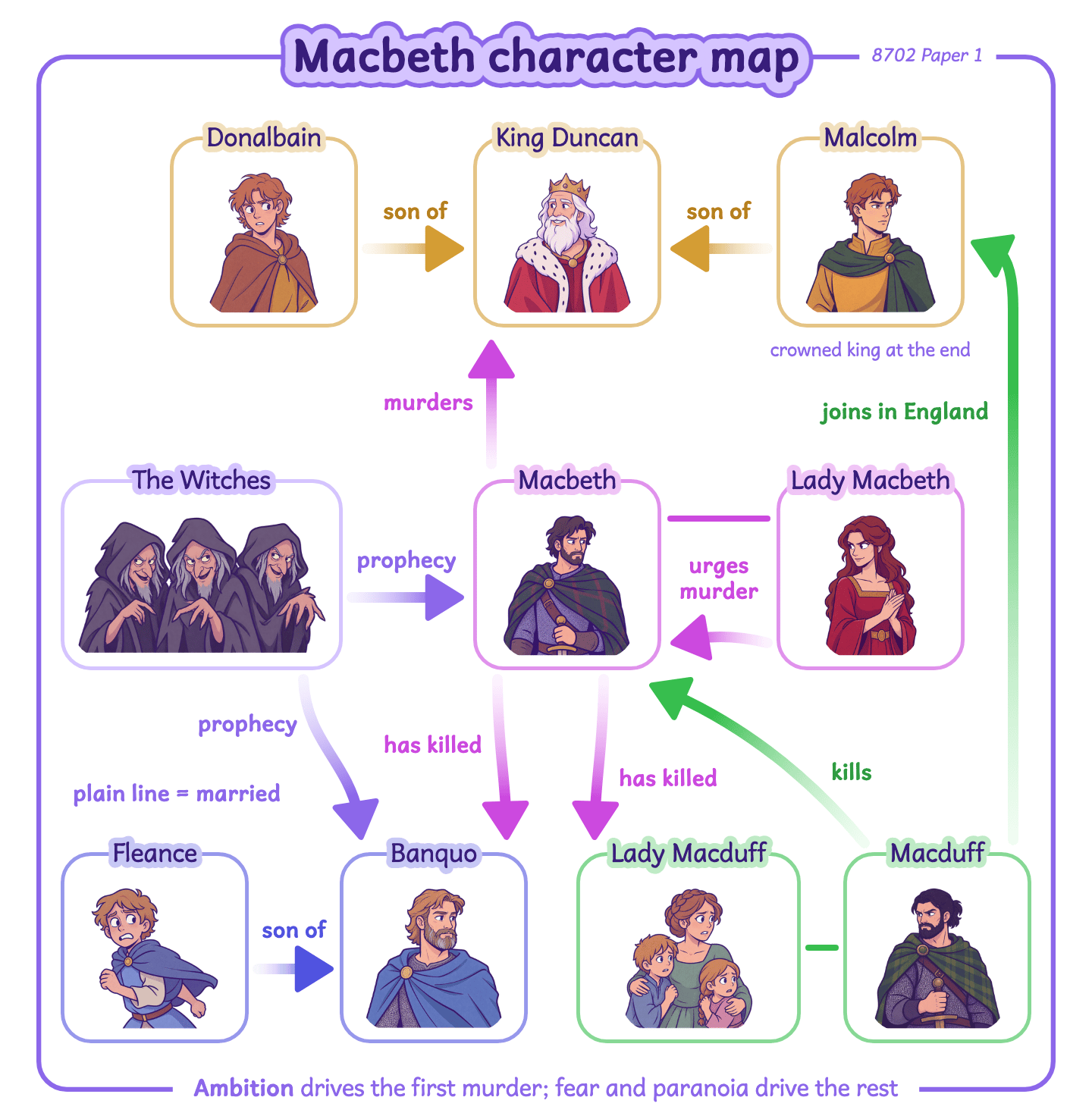
- The Witches predict power, but Macbeth chooses murder as the route towards it, preserving his responsibility.
Macbeth recognises his ambition
Stars, hide your fires; Let not light see my black and deep desires.
- Macbeth | Act 1, Scene 4. He privately reacts to Duncan naming Malcolm as his heir.
- Macbeth asks the stars to hide, using personification to imagine light as a witness to his thoughts.
- The contrast between light and darkness links his ambition with wishes he already knows should be concealed.
- His admission shows self-awareness: he understands his desire before Lady Macbeth persuades him to act.
- Duncan trusts him, so the imagined murder threatens duties of loyalty and hospitality, not just a political rival.
Lady Macbeth attacks compassion
Metaphor
A comparison that presents one thing as another, shaping how it is understood.
It is too full o’ th’ milk of human kindness
- Lady Macbeth | Act 1, Scene 5. Reading her husband’s letter, she fears that his compassion will obstruct the fastest route to kingship.
- The milk metaphor connects kindness with nourishment, presenting compassion as part of Macbeth’s humanity.
- Lady Macbeth treats that kindness as an obstacle, showing how her ambition changes the way she judges moral qualities.
- She questions his manhood to pressure him, using masculinity as a weapon rather than giving him a convincing moral reason.
- Macbeth resists before agreeing, so her influence matters without removing his responsibility for the decision.
The decision predicts its own collapse
Soliloquy
A speech in which a character, usually alone, reveals thoughts and feelings to the audience.
Vaulting ambition, which o’erleaps itself
- Macbeth | Act 1, Scene 7. Alone before Duncan’s murder, Macbeth admits that ambition is his motive.
- The riding metaphor presents ambition as a leap that goes too far and ends in a fall.
- The word itself shows Macbeth knows his ambition could destroy him.
- He recognises Duncan’s goodness and his own duties, making the soliloquy a debate between moral judgement and personal desire.
- Choosing murder means rejecting objections he understands, so the tragedy depends on choice, not simply ignorance of consequences.
The dagger links imagination with action
Is this a dagger which I see before me,
- Macbeth | Act 2, Scene 1. He sees an apparent weapon shortly before entering Duncan’s chamber.
- In this soliloquy, Macbeth questions what he sees, letting the audience hear his uncertain perception directly.
- The imagined weapon points towards Duncan, giving Macbeth’s murderous intention a frightening visual form.
- He tries to test the vision, so uncertainty does not prove that supernatural forces have removed his agency.
- The bell signals the prepared moment to act, moving the scene from private fear towards murder.
Blood exceeds physical washing
Will all great Neptune’s ocean wash this blood Clean from my hand?
- Macbeth | Act 2, Scene 2. Looking at his bloodstained hands, he imagines a stain beyond physical cleansing.
- The vast ocean creates hyperbole, suggesting that Macbeth’s guilt is too great for ordinary washing to remove.
- The contrast between one hand and so much water makes the blood seem morally larger than its physical stain.
- Lady Macbeth initially trusts washing, creating a contrast with her later attempts to remove an imagined spot.
- The loss of peaceful sleep also makes guilt bodily, showing that murder damages ordinary rest and security.
Power produces further insecurity
O, full of scorpions is my mind, dear wife!
- Macbeth | Act 3, Scene 2. His new kingship has not removed his fear of Banquo and Fleance.
- The scorpion metaphor fills Macbeth’s mind with threatening creatures, showing that becoming king has not brought peace.
- The many creatures suggest multiplying fears, making royal power a source of anxiety rather than safety.
- He plans Banquo’s murder without telling Lady Macbeth the details, changing the balance of power within their marriage.
- The banquet exposes his fear publicly, while the attack on Macduff’s family turns insecurity into wider tyranny.
Macduff includes grief within manhood
But I must also feel it as a man.
- Macduff | Act 4, Scene 3. After learning that his family has been murdered, he answers Malcolm’s instruction to respond like a man.
- Macduff refuses to separate grief from manhood, offering an alternative to the play’s earlier masculine ideals.
- The word also places feeling beside action, challenging the belief that masculinity requires emotional hardness.
- His family’s deaths give resistance a personal cost, showing the human suffering beneath the struggle for political power.
- His response values feeling without proving that every act of revenge is right, keeping grief distinct from moral certainty.
Lady Macbeth cannot command guilt away
Out, damned spot, out, I say!
- Lady Macbeth | Act 5, Scene 1. Sleepwalking, she repeatedly attempts to remove an imagined stain.
- Lady Macbeth’s repeated imperatives try to command an imagined stain away, making her failed control audible.
- The tiny spot recalls Macbeth’s much larger blood image, showing guilt that does not depend on a visible wound.
- Her sleepwalking reveals memories she cannot contain, turning private fear into an unintended confession before witnesses.
- The repeated washing overturns her earlier confidence, showing that physical cleaning cannot erase responsibility for murder.
The desired future loses meaning
Out, out, brief candle!
- Macbeth | Act 5, Scene 5. After news of Lady Macbeth’s death, he reflects on the brevity and apparent futility of life.
- The candle metaphor makes life seem short and easily extinguished, replacing Macbeth’s earlier hopes with despair.
- The repeated command echoes Lady Macbeth’s language, linking their final speeches through repetition and images of ending.
- Her death and the approaching attack expose the failure of ambition to provide the security Macbeth wanted.
- The speech expresses Macbeth’s despair, but readers need not accept it as the play’s final truth about human life.
Equivocation becomes physically clear
Equivocation
Deliberately ambiguous language that can mislead by allowing more than one interpretation.
Macduff was from his mother’s womb Untimely ripped.
- Macduff | Act 5, Scene 8. During their final confrontation, he reveals the circumstances of his birth.
- Macduff’s account of his birth exposes equivocation, showing how a technically accurate prophecy can encourage a false assumption.
- The soldiers carrying branches similarly fulfil the woodland prophecy, overturning Macbeth’s false confidence that the event cannot happen.
- Macbeth still fights, preserving physical courage without cancelling the violence and choices that have isolated him.
- Malcolm ends the immediate tyranny, but victory cannot restore murdered families, leaving political renewal beside lasting loss.
Literary terms used in this guide
- Aside: Words spoken for the audience to hear while other characters on stage are conventionally unable to hear them.
- Dramatic irony: A gap between what the audience understands and what a character understands.
- Imagery: Descriptive language that creates sensory or associated impressions.
- Tragedy: A dramatic form organised around destructive conflict, suffering and an irreversible catastrophe.
A worked analytical paragraph
- Shakespeare’s ocean question uses hyperbole to show guilt that ordinary washing cannot remove. One bloodied hand seems able to defeat an immense amount of cleansing water, making the moral stain greater than the physical mark. Lady Macbeth’s later imagined spot returns to the same problem. Her failed washing exposes the weakness of her earlier belief that cleaning could settle responsibility for murder.
Using and checking quotations
- References: Locations follow the edition checked for this guide; compare them with your copy.
- Compare spelling, punctuation and line numbering with your assigned edition before learning a passage.
- How does Macbeth’s awareness of ambition affect his responsibility?
- Why does the imagined dagger not remove his agency?
- How does sleepwalking revise Lady Macbeth’s earlier confidence?
- How does Macduff challenge the play’s restrictive ideas about manhood?