Fiscal policy uses tax and spending
Definition
Fiscal policy: the use of government spending and taxation to influence the economy and achieve the government's economic objectives.
- The government has only two fiscal levers: how much it spends and how much it taxes.
- Both work by changing how much money households and firms have available to spend.
- Fiscal policy is decided by the government, which is what separates it from monetary policy, set by the Bank of England (explained in 3.6.1)
- Changes are normally announced in the Budget, so fiscal policy moves in steps rather than continuously.
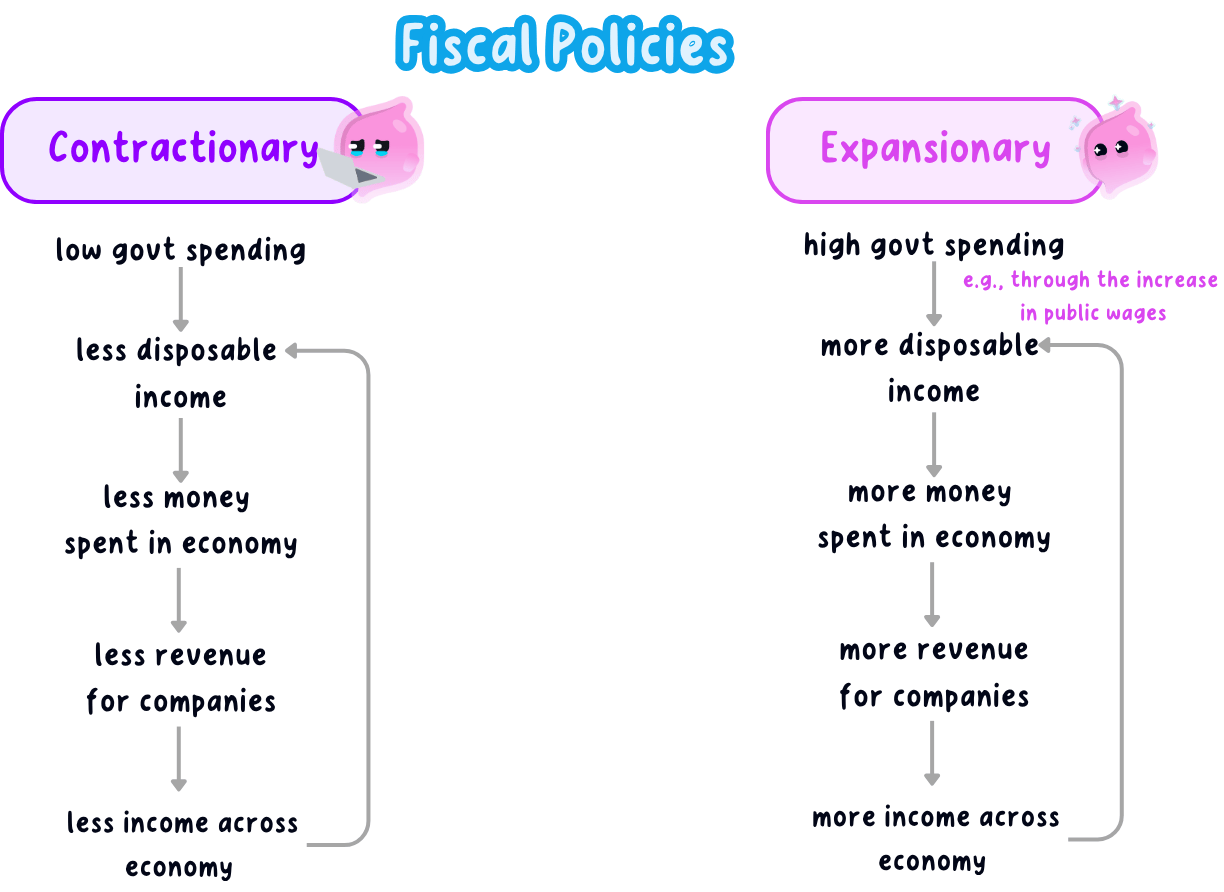
Expansionary policy raises total spending
- Expansionary fiscal policy means cutting taxes or raising government spending, which puts more money into the economy.
- Lower income tax leaves households with more to spend, and higher government spending adds demand directly.
- It is used when growth is weak or unemployment is high, because the aim is to raise output and create jobs.
- The cost is a larger budget deficit, since revenue falls or spending rises while the other side is unchanged.
Example
- A cut in the basic rate of income tax leaves every taxpayer with more take-home pay, and most of it gets spent.
- A programme of road and rail building adds demand at once and raises what the economy can produce later.
- Both are expansionary, but only the second adds to future capacity as well as to present demand.
Contractionary policy lowers total spending
- Contractionary fiscal policy means raising taxes or cutting government spending, which takes money out of the economy.
- It is used when inflation is the problem, because less spending eases the pressure on prices.
- It is also used to bring a deficit down, since either lever moves revenue and spending closer together.
- The cost is slower growth and higher unemployment, which is why it is politically far harder than the expansionary kind.
Common Mistake
- Do not confuse the direction of the policy with the direction of the tax, because a tax rise is contractionary even though the tax itself goes up.
- Do not describe fiscal policy as setting interest rates, since that is monetary policy and a different institution decides it.
Each objective needs a different setting
- Growth and employment call for expansionary policy, because both respond to higher total spending.
- Price stability calls for contractionary policy when inflation is above target, since the aim is to slow spending down.
- A fairer distribution of income is pursued through the design of taxes and benefits rather than through the overall size of the budget.
- The objectives conflict, which is the central difficulty: the setting that raises growth also tends to raise inflation.
How a change in tax or spending actually works through markets and the wider economy is covered in 3.5.5.
Self review
- What is fiscal policy?
- Name the two tools of fiscal policy.
- What is the difference between expansionary and contractionary fiscal policy?
- Which fiscal policy setting would a government use to reduce inflation?
- Why do the government's objectives make fiscal policy difficult to set?
