2.5.1a Functions of money
Barter needs a double coincidence of wants
Barter: the direct swap of one good or service for another without using money.
Double coincidence of wants: the situation where each trader must want exactly what the other person is offering.
- Without money, people must barter, trading goods or services directly for other goods or services.
- A swap only works if there is a double coincidence of wants, so finding a match wastes time and many useful trades never happen.
- Barter has no common measure of value, so working out how many eggs a haircut is worth is difficult.
- Goods used in barter can be hard to store and divide, so a farmer cannot easily save a cow or spend half of it.
- Imagine you own a goat but want a haircut from the barber.
- You can only trade if the barber happens to want a goat that day.
- Money removes this problem because everyone accepts it in exchange.
Money performs four separate functions
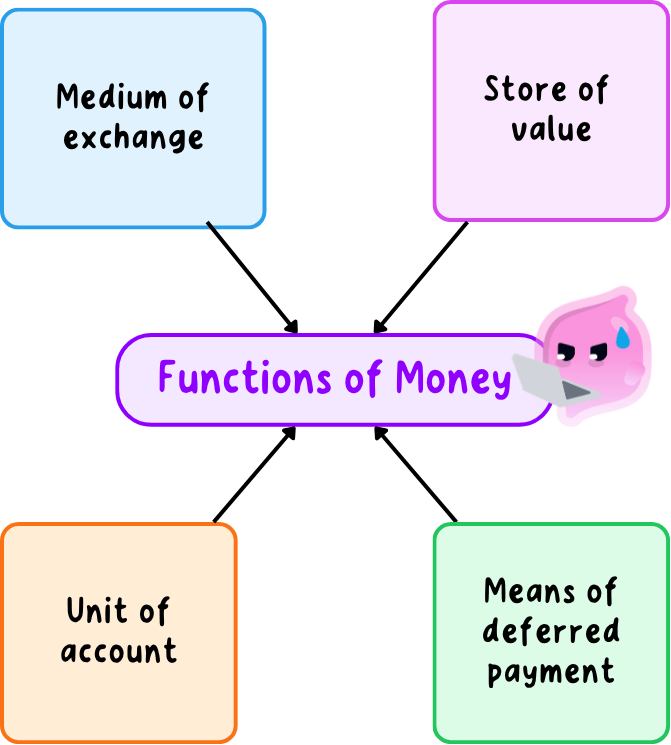
- Medium of exchange: money is accepted by sellers in return for goods and services, so it removes the need for a double coincidence of wants.
- Store of value: money holds its worth over time, so people can save now and spend later.
- Unit of account: money gives a common measure of value, so the price of every good can be compared in pounds and pence.
- Means of deferred payment: money lets people agree to pay in the future, so borrowing, lending and paying in instalments become possible.
- Priya is paid £1,800 a month into her Nationwide current account.
- She uses the unit of account to compare a £1.70 Greggs sausage roll with a £30 supermarket shop, and the medium of exchange to pay for both by contactless card at Tesco.
- She leaves some pay in a savings account as a store of value, and repays a Very.co.uk credit agreement in fixed monthly amounts using money as a means of deferred payment.
Each function solves a problem that barter cannot
- The medium of exchange function ends the search for a double coincidence of wants.
- The unit of account function gives the single measure of value that barter lacks.
- The store of value function lets people hold wealth over time instead of holding goods that may spoil.
- The means of deferred payment function makes credit and future contracts reliable.
- Do not stop at medium of exchange when asked for the functions of money.
- Marks are lost by naming one function instead of all four.
- Do not confuse the unit of account, which measures value, with the medium of exchange, which makes the swap.
Money makes exchange more efficient
- Because sellers accept money, trade is quick and buyers no longer need to find a matching swap.
- This lower cost of trading encourages specialisation, where people focus on one job and buy everything else with the money they earn.
- Specialisation raises output and living standards, so an economy that uses money can produce far more than one relying on barter.
- Check the command word first, as state or name only asks you to list the functions while explain asks you to develop each point.
- Structure an explain answer by naming a function and then showing the exact barter problem it removes.
- A common trap is describing what money is in general instead of naming the four separate functions the question asks for.
- What is meant by the double coincidence of wants?
- Name the four functions of money.
- Which function lets a saver hold wealth for the future?
- Explain one reason why money makes trade more efficient than barter.
2.5.1b Definition of money
Money is more than notes and coins in circulation
Cash: the notes and coins in physical circulation, issued by the Bank of England.
Bank deposits: money that people and firms hold in accounts at banks or building societies, recorded electronically rather than as physical cash.
- Cash makes up only part of the money used in a modern economy such as the UK's.
- Bank deposits can be spent at any time, by card, by transfer or online, so they work as money even though no cash changes hands.
- This is why money is defined more broadly than just notes and coins: it also includes the balances people hold in current and savings accounts.
- When someone pays by contactless card or bank transfer, ownership of a bank deposit moves from the buyer to the seller instead of physical cash being handed over.
- Monzo and Starling are UK banks that operate almost entirely without branches or cash tills.
- Their customers' money exists almost entirely as bank deposits, moved by card and app rather than by handing over notes.
- This shows that a bank balance is money even though it is never held as cash.
Bank deposits work as money too
- People pay for goods and services either by handing over cash, or by transferring money held as a bank deposit.
- When a deposit is used, the bank moves the balance from the buyer's account to the seller's account electronically.
- Banks such as Barclays and NatWest use the Faster Payments system to move deposits between UK accounts within seconds.
- Because deposits can be moved so easily, most spending in a modern economy uses bank money rather than notes and coins.
- The Bank of England has reported that bank deposits make up around 97 per cent of broad money in the UK economy, with cash making up only about 3 per cent, a figure it published for December 2013 that still illustrates how small a share cash represents.
- It is wrong to think money is only the notes and coins you can hold.
- Most money in the UK exists as bank deposits, not as cash.
- A balance shown in a banking app is money just as much as a £10 note.
The modern definition of money is broader than cash: it is cash plus the deposits people and firms hold at banks and building societies.
- What are the two main forms of money in a modern economy?
- Why do bank deposits count as money even though they are not cash?
- Give a named example of a UK bank that operates mainly through deposits rather than cash.
- What happens to a bank deposit when someone pays by contactless card?
2.5.2a Agents in the financial sector
The financial sector moves money from savers to borrowers
Financial sector: the group of banks and other institutions that handle money, including saving, lending and payments.
- Its main job is to channel funds from people with spare money to people who want to borrow.
- Savers put aside money they do not need to spend now and earn interest on it.
- Borrowers use that money to buy homes, start firms or fund spending, and pay interest in return.
- By linking the two sides, the sector turns idle savings into useful investment.
- A saver deposits £5,000 into a Nationwide Building Society savings account.
- Nationwide lends some of this money as a mortgage to a family buying a home.
- The financial sector has linked the saver's spare cash to the family's borrowing needs.
Three main agents make up the financial sector
Commercial bank: a bank owned by shareholders that takes deposits from the public and lends to households and firms, also called a high street bank.
Building society: a financial institution owned by its members rather than by shareholders, specialising in savings accounts and mortgages.
- The central bank is the government's own bank and watches over the whole system, with the Bank of England as the UK's example.
- Commercial banks such as Barclays and Lloyds Bank are the high street names most people bank with day to day.
- Building societies such as Nationwide and Skipton exist alongside them, offering similar accounts and mortgages but under member ownership.
A building society differs from a bank in ownership
- A commercial bank is owned by shareholders, who expect a return in the form of dividends and a rising share price.
- A building society is owned by its members, meaning its own savers and borrowers, so it has no outside shareholders.
- Because a building society has no shareholders to pay, any surplus can be used to offer better rates or lower charges to members instead.
- Nationwide Building Society is the largest building society in the UK, run for the benefit of its members rather than outside investors.
- Do not treat a building society as just another bank, because it is owned by its members and not by shareholders.
- Do not think the central bank runs accounts for ordinary people, because it works with the government and the other banks rather than the public.
Spot the institution by what it mainly does
- Ask who owns the institution: a building society is member owned, a commercial bank is owned by shareholders, and the central bank belongs to the state.
- Ask whether it deals with the public or with the wider system, because only the central bank oversees the other agents rather than serving individual customers.
- In a scenario question, choose the one agent whose role matches the clue rather than listing several to be safe.
- A common trap is muddling the central bank with a commercial bank, so keep clear which one deals with the public.
- What does the financial sector move between savers and borrowers?
- Name the three main agents in the financial sector.
- How is a building society different from a commercial bank in terms of ownership?
- Which agent does not serve the public directly?
2.5.2b The role of the Bank of England
The central bank runs the money system
Central bank: the public body responsible for a country's money and banking system, acting as the government's own bank rather than serving the public directly.
- In the UK this is the Bank of England.
- One of its jobs is issuing currency, meaning it is responsible for the notes and coins in circulation.
- It acts as banker to the government, holding the government's main accounts and helping manage its borrowing.
- It does not offer accounts or loans to the general public.
- Do not picture the central bank as a giant high street bank for the public, because it does not take your deposits.
- Do not confuse Bank Rate, which the Bank of England sets, with the higher rates commercial banks charge their own customers.
It sets Bank Rate through the Monetary Policy Committee
Bank Rate: the interest rate set by the Bank of England that guides all other interest rates across the economy.
Monetary Policy Committee (MPC): the group of nine Bank of England policymakers who meet regularly to set Bank Rate in order to meet the Government's inflation target.
- The MPC meets eight times a year, roughly every six weeks, to decide whether to raise, cut or hold Bank Rate.
- As of 30 August 2026, Bank Rate stands at 3.75 per cent, after being cut from 4.00 per cent on 11 December 2025 and held at every meeting since.
- The MPC's next scheduled decision is 17 September 2026.
- The Bank of England's target is to keep CPI inflation at 2.0 per cent a year, so the MPC raises Bank Rate when inflation risks running too high and cuts it when the economy needs support.
- How a change in Bank Rate then feeds through to spending, borrowing and inflation is covered in the monetary policy topics, so this page focuses on the Bank's own role rather than that chain.
- In June 2026 the MPC voted 7 to 2 to hold Bank Rate at 3.75 per cent.
- The two dissenting members wanted a rise to 4.0 per cent, worried that energy prices were pushing inflation back up.
- This shows the MPC weighing risks and disagreeing about the right response, rather than simply following a fixed rule.
It safeguards the whole financial system in a crisis
- The Bank of England acts as the lender of last resort, lending to banks that cannot borrow money elsewhere.
- This stops a short-term cash shortage at one bank turning into a wider collapse of the banking system.
- The Bank also works more broadly to keep the whole system stable, a role called financial stability.
- A stable system means households and firms can trust that their money and their bank are safe.
- In 2007 the UK bank Northern Rock ran short of cash and could not fund itself.
- Worried customers queued to withdraw their savings in a bank run.
- The Bank of England stepped in as lender of last resort to support it.
Its two roles reinforce each other
- Setting Bank Rate lets the Bank respond to inflation, while acting as lender of last resort lets it respond to a banking crisis.
- Together these two roles are why the Bank of England is often described as the guardian of the UK's monetary and financial system.
The Bank of England influences the economy through Bank Rate, and protects it through financial stability.
- Name the UK's central bank.
- What is Bank Rate, and which committee sets it?
- How many members sit on the Monetary Policy Committee?
- What does lender of last resort mean?
- Give one reason the Bank of England might raise Bank Rate.
2.5.2c The role of high street banks
Commercial banks take in deposits and lend them out
- A commercial bank, also called a high street bank, serves households and firms who need everyday banking.
- Its first job is accepting deposits, keeping customers' money safe in current and savings accounts.
- Its second job is making loans: to firms that need finance for investment, and to households, for example through a mortgage to buy a home.
- Banks make a profit from the gap between the interest they charge borrowers and the interest they pay savers.
- By lending to firms, banks help fund investment in machinery, buildings and stock.
- Lloyds Bank takes in deposits from thousands of small businesses and individual savers.
- It lends some of this money to a small manufacturer that wants to buy a new production line.
- The manufacturer's investment is funded by money the bank first collected from savers.
They also run the payments system we use daily
- Banks provide a payments system that lets money move without cash changing hands.
- This includes debit cards, direct debits and online transfers.
- Banks such as Barclays and NatWest use the Faster Payments system to move money between UK accounts within seconds.
- A reliable payments system lets consumers buy goods quickly and safely, and lets producers pay wages and suppliers and receive money from customers.
- Do not think a bank simply stores savers' money in a vault until they want it back.
- Most of that money is lent out straight away to fund borrowing and investment elsewhere in the economy.
Banks link savers, borrowers and investment together
- Savings accounts let households store money safely and earn interest.
- Loans let firms fund the investment needed to grow, buy equipment or open new sites.
- By connecting savers to borrowers, high street banks turn idle savings into active investment across the economy.
High street banks fund investment by lending out the money that savers deposit with them.
- Name the two main jobs of a commercial bank.
- How do commercial banks make a profit?
- Give one example of the payments system in action.
- How does bank lending help fund investment?
- Why is it wrong to think banks simply store savers' money?
