A monopoly is a single dominant seller
Definition
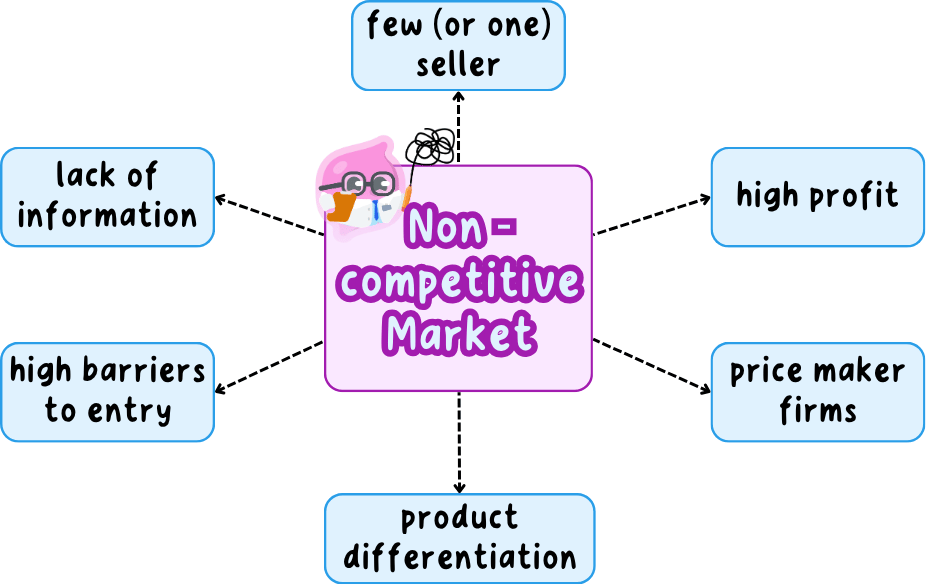
Non-competitive market: a market where one or a few sellers are large enough to influence the price.
Monopoly: a market supplied by a single seller, or one so dominant that buyers have no real alternative.
Price maker: a firm large enough to choose its own price, because losing some sales at a higher price still leaves it better off.
- With no alternative to switch to, a buyer who refuses the price goes without, so the threat that disciplines a competitive seller is missing.
- A monopolist still faces a demand curve, so raising the price loses some sales; what it does not face is a rival taking them.
- Some monopolies exist because duplicating the network would be wasteful, such as one set of water pipes to a house.
An oligopoly is a few large sellers
Definition
Oligopoly: a market dominated by a small number of large sellers, each big enough that its decisions affect the others.
- The defining feature is that the firms watch each other, so each one's pricing decision depends on what it expects the others to do.
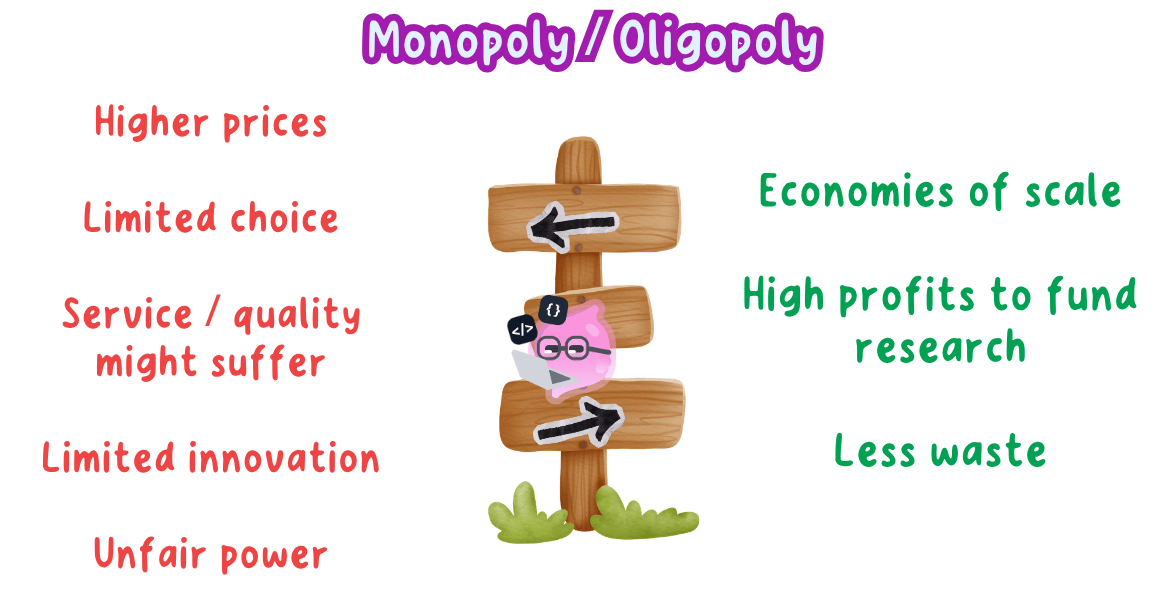
- That interdependence makes price cuts risky, because a cut is matched within days and everyone ends up earning less on the same sales.
- Oligopolists therefore lean on the non-price competition covered in 2.5.2, competing through brands, ranges and loyalty schemes.
Three things separate them from a competitive market
- The number of sellers: many in a competitive market, a few in an oligopoly, one in a monopoly.
- Power over price: a competitive firm is a price taker, while a monopolist or oligopolist has room to set its own price.
- What buyers can do: in a competitive market a buyer switches, and in a non-competitive one there is little or nothing to switch to.
- The consequence runs through all three: less pressure on price, less pressure on cost, and less need to improve.
UK examples of each kind of market
- Naming a real market is what proves you can apply the labels, so learn one clear case of each rather than a list of names.
Case study
- Network Rail owns and runs almost all of Britain's railway track, about 20,000 miles of it, and nobody else can supply it, so it is a monopoly (Source: Network Rail).
- Thames Water is the only company that can supply tap water and sewerage to London and the Thames Valley, delivering 2.6 billion litres of drinking water a day, which makes it a regional monopoly (Source: Thames Water).
- UK mobile is an oligopoly of three national networks, VodafoneThree, EE and Virgin Media O2, after the Vodafone UK and Three UK merger completed on 31 May 2025 (Source: Vodafone Group).
- Grocery is an oligopoly too, with the four largest chains holding 65.2% of the market in the 12 weeks to 9 August 2026 (Source: Worldpanel by Numerator).
Market power is a matter of degree
- Real markets sit between the extremes, so the useful question is how much power a seller has rather than which label fits.
- Market share is the usual measure, and a firm's power grows as its share rises and as switching becomes harder for buyers.
- Because that power can be used against buyers, it is policed: the Competition and Markets Authority acts across the economy, with Ofgem and Ofcom watching energy and communications.
Exam technique
- Say how many sellers there are and what buyers can switch to, because those two facts are what identify the market type.
- Explain the consequence for the price rather than stopping at the label, since naming a market a monopoly earns nothing on its own.
Self review
- Define a monopoly in one sentence.
- What makes an oligopoly different from a monopoly?
- Why do oligopolists avoid cutting prices?
- Name the three things that separate a non-competitive market from a competitive one.
- Give one UK example of a monopoly and one of an oligopoly.
