An interest rate is the price of borrowing
Definition
Interest rate: the price paid to borrow money, or the reward earned for saving it, expressed as a percentage of the amount over a period such as a year.
Saving: the part of income that is not spent, held instead for use later.
- The same number does two jobs at once, because it is a cost to whoever borrows and a reward to whoever saves.
- It is a percentage rather than a fixed sum, so 4% earns £4 on every £100 and £400 on every £10,000.
- Every rate in the economy is priced off the Bank of England's Bank Rate, which is covered in 3.6.1.
Different products carry very different rates
- Risk: the greater the chance a borrower will not repay, the higher the rate a lender charges to cover the losses.
- Security: a loan backed by an asset the lender can seize costs less than one that is not, which is why a mortgage is cheaper than a credit card.
- Term: locking money away for longer usually earns more, since the saver gives up access to it.
- Competition: where lenders compete hard for customers, the rates they offer move closer together.
- The gap between what a bank pays savers and charges borrowers is how it earns its income, as set out in 2.8.2.
Example
- UK rates in July 2026 show the ladder clearly: instant access savings averaged 1.65% and new fixed-term deposits 4.21%, while new mortgages averaged 4.45%, personal loans 9.86% and credit cards 21.45% (Source: Bank of England).
- A mortgage is secured on a house and a credit card on nothing, which is most of why one costs a fifth of the other.
- Instant access pays far less than a fixed term because the saver keeps the right to take the money out at any moment.
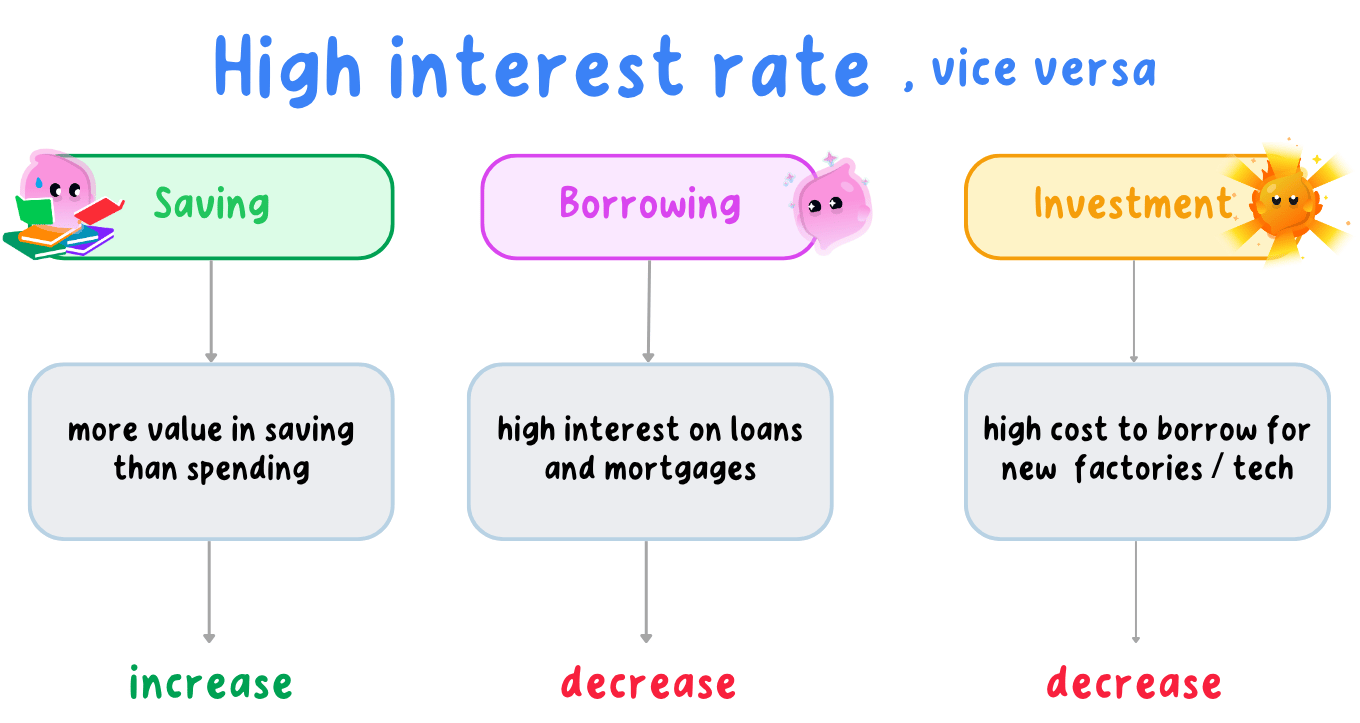
A higher rate rewards saving and deters borrowing
- Saving rises, because holding money back now earns more than it did, and spending today costs the saver the interest given up.
- Borrowing falls, because the repayment on any given loan is larger, so some purchases are dropped and others postponed.
- Households already in debt feel it as higher repayments rather than as a choice, which cuts what is left to spend.
- A lower rate reverses all three, which is why cheap credit is followed by a rise in borrowing and spending.
Common Mistake
- Do not say a higher rate is good news, since it rewards savers and penalises borrowers at the same time.
- Do not assume a better savings rate raises saving much, because a household with nothing spare cannot respond to it.
Investment depends on the rate and the return
- Investment means firms spending on capital such as machinery and buildings, as defined in 3.1.5.
- A firm goes ahead only when the return it expects is greater than the cost of borrowing the money, so the rate acts as a hurdle.
- Raising the rate lifts that hurdle and rules out the projects that were marginal, while lowering it brings them back.
Example
- A firm can borrow £2,000 for a project it expects to earn £150 in profit over the year.
Step 1: find the interest cost at 5%:
£2,000×5%=£100 \pounds2{,}000 \times 5\% = \pounds100 £2,000×5%=£100Step 2: compare it with the expected profit, since £100 is less than £150, so the project goes ahead.
Step 3: now find the cost if the rate rises to 10%:
£2,000×10%=£200 \pounds2{,}000 \times 10\% = \pounds200 £2,000×10%=£200- At £200 the interest now exceeds the £150 profit, so the same project is dropped and investment in the economy falls without anything else changing.
How far the levels move depends on conditions
- It depends on how indebted households already are, because a rate change moves spending sharply where borrowing is widespread and barely at all where it is not.
- It depends on confidence, since a firm expecting weak demand will not borrow to invest however cheap the loan becomes.
- It depends on how quickly the change reaches people, because a borrower on a fixed deal feels nothing until it ends.
- It depends on what else is happening to incomes, as a better savings rate does little while real wages are falling.
Exam technique
- Take saving, borrowing and investment in turn when a question names them, because an answer about only borrowing is a third of the answer.
- Name the reason a rate differs rather than just saying it is higher, since risk, security, term and competition are what the question is testing.
Self review
- What is an interest rate?
- Why does a credit card charge far more than a mortgage?
- Explain why a higher interest rate reduces borrowing.
- A firm borrows £4,000 at 5%. What is the interest cost for one year?
- What rule decides whether a firm goes ahead with an investment project?
