1.2.1a Markets
A market is an opportunity to trade
Market: an opportunity for buyers and sellers to interact in order to establish a price for a good or a service.
- The key word is opportunity, because what makes a market is the chance to trade, not a building or an address.
- Two traders who never meet are in the same market as long as each can reach the other.
- Every market is built from four parts, and removing any one of them leaves no market.
- The buyer is willing and able to pay for the product.
- The seller offers that product in return for money.
- The product is the good or service traded, such as a punnet of strawberries or a train ticket.
- The transaction is one completed exchange of the product for money at an agreed price.
- Markets are counted by the product traded, so everyone trading one product is in one market however far apart they are.
- At Borough Market in Southwark, a shopper hands £2 to a stallholder for a punnet of strawberries.
- The shopper is the buyer, the stallholder the seller, the strawberries the product, and that swap the transaction.
- The hall is dozens of markets rather than one, because the cheese stalls and the fish stalls trade different products.
Online markets count as much as physical ones
- A physical market gives both sides a place to meet, such as Borough Market or a high street car showroom.
- An online market links them through a website or an app instead, such as eBay or Tesco.com.
- Neither is more of a market, because the test is whether buyers and sellers can reach each other.
- Some markets have no home at all, since the UK second-hand car market is spread across dealers, driveways and websites.
- The boundary is set by who can trade with whom, so a market can be one street wide or worldwide.
- A market is not a place with stalls, since an app or a phone call creates the same opportunity.
- A seller need not be a shop, because a household selling a used bike on eBay is also a seller.
Interaction between both sides settles the price
- Neither side fixes the price alone, because a price only becomes real once the other side agrees to it.
- A seller asking more than buyers will pay is left with unsold stock, so the asking price comes down.
- A buyer offering less than sellers will accept goes home with nothing, so the offer comes up.
- The price that survives is the one at which trade actually takes place, which is what establishing a price means.
- An eBay auction makes this visible, because the bidding is the interaction and the winning bid is the price.
- A supermarket does the same quietly, since stock priced too high sits on the shelf until Tesco cuts the price.
- What is a market?
- Name the four parts of every market.
- Give one physical and one online example.
- Why does a market not need to be a single place?
- Who establishes the price in a market?
1.2.1b Allocation of resources
Prices allocate scarce resources without a planner
Allocation of resources: deciding which uses the scarce land, labour, capital and enterprise available are put to, and therefore which wants are met and which are not.
Price mechanism: the process by which prices, arising from the decisions of buyers and sellers, direct resources between those competing uses.
- Allocation is unavoidable because resources are scarce, so every use a resource is put to is another use given up.
- The striking thing about a market is that nobody takes the decision, yet it is taken millions of times a day.
- Each firm and household reacts only to the prices in front of it, and the pattern that results is nobody's plan.
- A price can do this because it is public, so both sides read the same figure without anyone collecting or sending information.
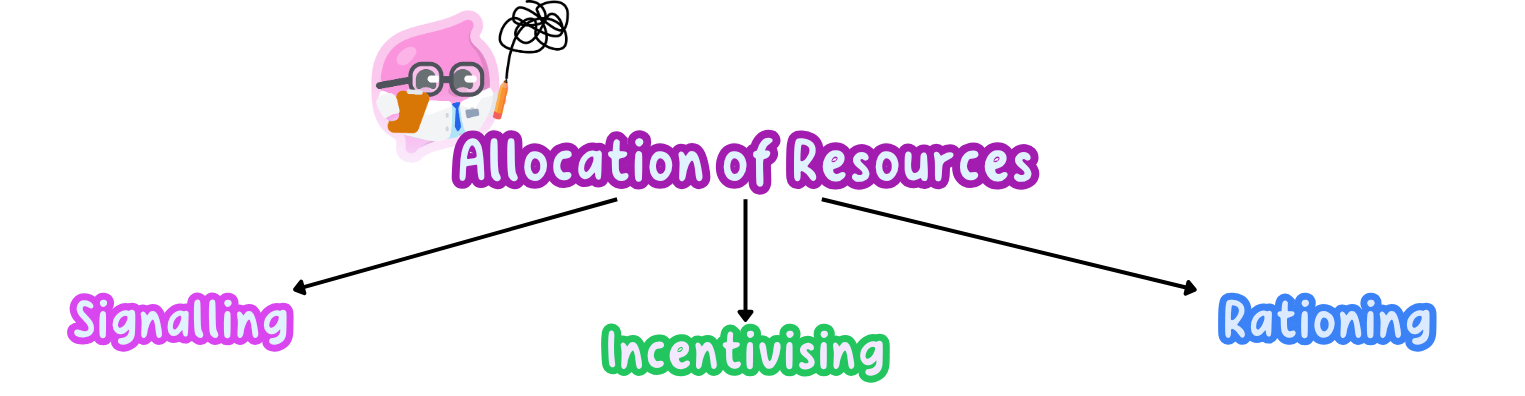
- A price works in three ways, by signalling, by acting as an incentive and by rationing.
- No government department decides how many loaves London needs, yet every borough's shelves are stocked by opening time.
- The prices of wheat, flour and bread are the only messages passing along the chain from the farm to the shopper.
- When shoppers switch to pasta, the falling bread price carries that news back down the chain to the farmer.
Signalling shows where resources are wanted
- Signalling means the price carries information about how scarce something is relative to what buyers want.
- A rising price says buyers want more or that supplying it has become harder, and a falling price says the opposite.
- Avian flu cut UK laying flocks in 2022, and the rising shelf price told every baker, caterer and shopper that eggs had become scarce.
- None of them needed to have heard about the outbreak, because the price alone carried the message.
- The signal also reaches firms in other markets, since they are deciding where to put their money next.
Incentive gives a reason to act
- Incentive means the price offers a reward large enough to make somebody act on the signal.
- A higher price earns extra revenue on every unit sold, so existing firms supply more and new firms enter the market.
- UK haulage firms raised HGV drivers' pay sharply in the 2021 driver shortage, pulling drivers back into the job from other work.
- That is labour, a scarce resource, reallocated by a price rather than by anyone directing it.
- For buyers the incentive runs the other way, because a higher price rewards buying less or switching to a substitute.
- Signalling is not incentive: signalling is the information the price carries, the incentive is the reward for acting on it.
- The price mechanism is not an organisation, since the decisions are taken by buyers and sellers responding to prices.
Rationing shares a limited quantity between buyers
- Rationing means the price itself decides who goes without, rising until the quantity wanted matches the quantity available.
- The rise removes the buyers who will not or cannot pay, so the limited supply reaches those who value it most in money terms.
- Rationing here means allocation by price alone, not coupons or queues.
- Peak-time rail fares between Manchester and London ration a fixed number of seats among commuters who all want the same trains.
- The scarcer the good, the higher the price has to climb before the two quantities match.
- Avian flu forced UK producers to cull millions of laying hens over the winter of 2022, leaving far fewer eggs than shoppers had planned to buy.
- The rising price signalled the shortage to bakeries, cafes and supermarkets at the same moment.
- It gave unaffected producers an incentive to expand flocks, and gave importers a reason to bring eggs in from abroad.
- It rationed the eggs that did exist, as some cafes dropped egg dishes and some shoppers bought fewer boxes.
- Feed, sheds and farm labour moved back into egg production, and prices eased once flocks recovered.
Together they answer what, how and for whom
- What to produce is answered by signalling and incentive together, as resources move into goods whose price has risen against the cost of making them.
- Rising UK sales of electric cars pulled investment into battery capacity and out of diesel engine parts.
- How to produce is answered by the prices of the factors themselves, since firms pick whichever mix of resources is cheapest for the output they want.
- Rising UK wages made self-service checkouts cheaper than extra staff for the big supermarket chains.
- For whom to produce is answered by rationing, so output goes to whoever is willing and able to pay the price.
- The distribution of goods therefore follows the distribution of income, which is why the market answer is not the fair answer.
- The process never stops, because any change in wants, costs or resources moves a price and starts the sequence again.
- Name the function you are using, signalling, incentive or rationing, and apply it to the good in the question.
- Run the chain in order: the change in wants or costs, the price movement, the response, then the resources that move.
- Finish on the resources, because an answer that stops at the price movement has only done half the job.
- What is meant by the allocation of resources?
- Name the three functions of price.
- What does a rising price tell firms in other markets?
- How did higher pay reallocate labour in the 2021 HGV driver shortage?
- On what basis does rationing decide who goes without?
1.2.1c Factor and product markets
Factor and product markets trade different things
Factor market: a market in which the factors of production, land, labour, capital and enterprise, are bought and sold.
Product market: a market in which the finished goods and services made using those factors are bought and sold.
- The two markets sit at opposite ends of the same process, because factors go into production and products come out of it.
- The roles flip between them, so the household that sells labour in one is the buyer in the other.
- This is why saying that firms sell and households buy is only ever half the picture.
- The price carries a different name in each, since a factor earns a reward while a product simply has a price.
- Land earns rent, labour earns a wage, capital earns interest and enterprise earns profit.
- Each factor has a market of its own, so the labour market, commercial premises and machinery are all factor markets.
- Greggs hires bakers and shop assistants in the labour market, rents its high street units, and buys ovens in the market for capital equipment.
- In every one of those markets Greggs is the buyer, and the wages, rent and payments for ovens are the rewards it pays.
- The sausage roll sold over the counter for around £1.30 is the other end of the process, and there Greggs is the seller.
Households and firms swap roles between markets
- Households own the factors of production, so they are the sellers in factor markets and the income they earn there is their reward.
- Firms buy those factors, combine them and sell the output, which makes them buyers in one market and sellers in the other.
- Households then spend the income they earned in factor markets on the output firms offer in product markets.
- That spending becomes the revenue firms use to pay for the next round of factors, so money loops one way and resources the other.
- A Greggs baker paid on Friday is the same person who buys a coffee on Saturday, on both sides of the loop within a day.
- A wage is the price of labour, not the price of a good, so it belongs to a factor market.
- Firms are not sellers only, since a firm buying flour, ovens or staff hours is the buyer there.
- Decide which market you are in from what is traded, not from looking at the firm.
Demand for a factor is derived demand
- Derived demand means a factor is never wanted for its own sake, but only for what it can be used to produce.
- Greggs has no interest in bakers' hours in themselves, and hires them only because customers want sausage rolls.
- When sales of vegan sausage rolls rose, Greggs opened extra production capacity and took on more staff.
- The demand for bakers rose without anything changing about bakers, because what changed was demand for the product.
- The link runs the other way too, so a chain losing customers cuts hours and releases labour and premises for other firms.
- Follow Greggs through both markets in a single week.
- In factor markets it pays wages to bakers and shop staff, rent to landlords, and prices for flour, ovens and delivery vans.
- In the product market it sells sausage rolls, bakes and coffee across more than two thousand UK shops.
- The takings from the counter are what fund Friday's wage bill, so the product market pays for the factor market.
- A quiet week at the counter means fewer hours offered the following week, which is derived demand in reverse.
A change in one market moves the other
- A rise in demand in the product market raises demand in the factor market, and the reward paid to that factor tends to rise with it.
- A rise in a factor price runs the link the other way, because higher wages or rent raise costs and feed into the price of the product.
- Increases in the UK National Living Wage raised staff costs across bakery and coffee chains, and menu prices followed.
- Prices in both markets are established the same way, by buyers and sellers interacting, which is why the same tools explain both.
- What is traded in a factor market?
- What is traded in a product market?
- In which market is a household the seller, and what does it sell?
- Name the reward earned by land, labour, capital and enterprise.
- What does it mean to say demand for a factor is derived?
1.2.2a Primary, secondary and tertiary sectors
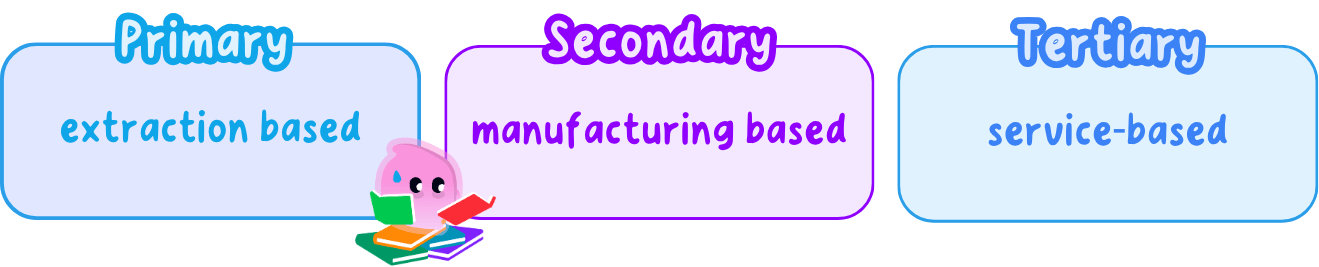
Three sectors split production by stage
Primary sector: the part of the economy that extracts raw materials from nature, such as farming, fishing, forestry, mining and oil and gas drilling.
Secondary sector: the part of the economy that processes, manufactures or constructs raw materials into finished goods, such as steel making, car assembly and housebuilding.
Tertiary sector: the part of the economy that provides services rather than physical goods, such as retailing, healthcare, banking, transport and education.
- Named UK primary sector work includes oil and gas extraction off Aberdeen, arable farming in East Anglia and the Scottish fishing fleet.
- Named UK secondary sector work includes the Nissan car plant in Sunderland, the Tata steelworks at Port Talbot and JCB digger production in Staffordshire.
- Named UK tertiary sector employers include the NHS, Tesco, Barclays and the train operating companies.
- Large firms often work in more than one sector, so classify the activity described rather than the whole company.
- Greggs bakes its own products, which is secondary work, and sells them over the counter, which is tertiary work.
- Each sector adds value to what the one before it produced, so most finished products pass through all three.
- Primary: a rig in the North Sea extracts crude oil from beneath the seabed.
- Secondary: a refinery such as Fawley near Southampton turns that crude oil into petrol, diesel and plastics.
- Tertiary: a tanker driver delivers the fuel and a petrol station sells it to drivers.
- Every penny of the pump price therefore pays for work done in all three sectors, not just the last one.
Tertiary now dominates UK output and employment
- The tertiary sector is by far the largest, producing around four-fifths of UK output and employing a similar share of the workforce.
- Financial services in the City of London, retailing, healthcare, education and tourism are its biggest parts, and services are also a large UK export earner.
- The secondary sector is much smaller, well under a fifth of UK output once manufacturing and construction are added together.
- The primary sector is the smallest of all, a couple of pounds in every hundred of UK output and well under two workers in every hundred.
Deindustrialisation explains the long-run shift
- This long-term shift away from primary and secondary work towards services is called deindustrialisation, and it has been running in the UK since the 1960s.
- Its causes are automation in factories, mechanised farming and mining, cheaper manufactured imports from lower-wage countries, and rising incomes spent increasingly on services.
- UK coal mining once employed over a million people, and coalfields in South Wales, Yorkshire and the North East anchored whole regions.
- Almost every deep pit has since closed, and the last one, Kellingley in North Yorkshire, shut in 2015.
- Over the same decades, financial, retail and business services in London, Manchester and Leeds grew into the largest source of UK jobs.
- The UK still produces plenty of goods by value, but with far fewer workers, because output per worker in industry has risen sharply.
Deindustrialisation has helped some places and hurt others
- The growth of services created large numbers of higher-paid and physically safer jobs in city economies, and made services one of the strongest UK exports.
- Former mining and manufacturing towns lost the single large employer their local economy was built around, and many still have lower pay and higher unemployment than the national average.
- Judgement: deindustrialisation has raised UK output overall, so on balance it has been good for the economy as a whole, but the gains and the losses landed on different places, which is why regional inequality is the main cost to set against it.
- Classify the activity described rather than the whole firm, since large companies operate across several sectors.
- Do not confuse a sector of production with the public or private sector, which is about ownership instead.
- Quote a rough share, such as services being around four-fifths of UK output, when comparing sector sizes.
- Name the three sectors of production and say what each one does.
- Is car assembly primary, secondary or tertiary?
- Which sector is largest in the UK, and roughly what share of output does it produce?
- What is deindustrialisation, and name two causes of it in the UK.
- Why is a sector of production not the same thing as the private sector?
1.2.2b Goods and services
Four features separate a good from a service
Good: a tangible, physical item that can be touched, owned and stored, such as a loaf of bread or a pair of trainers.
Service: an intangible action carried out for a customer, such as a haircut or a bus journey, which cannot be touched, owned or stored.
- Tangibility means a buyer can inspect a good before paying, while a service can only be judged after it has been delivered.
- Storability means a good can be made now and held in stock until someone buys it, whereas an unsold service is lost for good.
- An empty barber's chair at ten in the morning, or an empty seat on a departing train, can never be sold later.
- Ownership transfers when a good is bought, so the item is yours to keep, resell or give away, while a service buys only the benefit of the work done.
- Production and consumption happen at the same moment for a service, so the producer and the customer are usually together.
- A Greggs sausage roll is baked hours before you walk in, but an NHS appointment does not exist until the patient and the doctor are both there.
- Greggs hands over a good: a sausage roll you own, carry away and could eat an hour later.
- A barber provides a service: nothing is handed over, and the cut has to be produced while you sit in the chair.
- The NHS provides services such as a GP consultation, even though it uses goods such as medicines and scanners to deliver them.
- A car dealership does both: it sells cars, which are goods, and it services them, which is a service.
The test is tangibility, not price or importance
- Ask what the buyer is left with once the money is paid, because a physical item they now own is a good and the benefit of an action performed for them is a service.
- The price tag decides nothing, so a 50p pencil and a £30,000 car are both goods, while a £5 car wash and a heart operation are both services.
- Who provides it decides nothing either, because state provision by the NHS and private provision by a dentist are equally services.
- In the UK a purchase chosen at random is more likely to be a service than a good, because services are around four-fifths of UK output.
- Do not classify by cost or importance, since a cheap pencil is a good and life-saving surgery is a service.
- Free at the point of use does not mean a service, because NHS prescription medicine is a physical item you own.
Many purchases bundle a good and a service
- A single transaction often contains both, so split it rather than force it into one category.
- Buying a new car from a UK dealership brings the car itself, a good, with the warranty repairs, servicing and MOT work that follow, which are services.
- Ordering a takeaway brings the meal, a good, with the delivery ride, a service, which firms such as Deliveroo sell on its own.
- A mobile phone contract bundles the handset, a good, with network access, a service, into one monthly payment.
- Bundling is common because the service is what makes the good usable, so firms increasingly compete on the service attached rather than on the item.
- What is the difference between a good and a service?
- Why can a service not be stored in the way a good can?
- What happens to ownership when you buy a good, and when you buy a service?
- Is an NHS operation a good or a service, and why?
- Name one purchase that bundles a good and a service, and identify each part.
1.2.3a Specialisation and the division of labour
Specialisation means doing one thing, not everything
Specialisation: concentrating on producing a narrow range of goods, services or tasks rather than trying to do everything.
Division of labour: specialisation applied inside a workplace, where a process is broken into separate tasks and each worker repeats one of them instead of making the whole product.
- A specialist ends up with far more of one good or skill than they could ever use, and almost none of everything else they need.
- The division of labour needs three things: enough workers to share the tasks, output large enough to keep each one busy, and a way of passing the part-finished product along.
- It is the wider idea of specialisation, not the narrower division of labour, that explains why whole regions and countries concentrate on one industry.
- Adam Smith described a pin factory where one worker doing every stage alone might make a single pin in a day.
- Split into about eighteen operations, from drawing the wire to cutting, pointing and fitting the head, ten workers turned out upwards of 48,000 pins a day, roughly 4,800 each.
- Nothing changed except the way the work was organised.
Specialisation happens at four levels
- Individuals specialise by training for one occupation, so a plumber or a nurse sells one skill and buys in everything else.
- Firms specialise by narrowing what they produce, so a bakery chain concentrates on bread and pastries instead of a full supermarket range.
- Regions specialise when one area concentrates on one industry, as the City of London does in banking, insurance and legal services.
- Clustering works because a pool of trained workers, specialist suppliers and expert customers builds up in the same place.
- Countries specialise in what their resources, climate and workforce suit best, so Saudi Arabia concentrates on oil and the UK on financial services.
- The two terms are not interchangeable: one names the wide idea, the other its form inside a workplace.
- Specialising makes a producer more dependent on other people, not more self-sufficient.
Dividing tasks raises output per worker
- Repeating one task builds skill quickly, so the worker becomes faster, wastes less material and makes fewer mistakes.
- No time is lost switching between tools, benches or parts of the building.
- Each worker can be put on the task they are best suited to, instead of being merely average at all of them.
- Specialised machinery becomes worth buying once one task is repeated all day, and the machine lifts output again.
- So productivity, meaning output per worker, rises: the same wage bill and premises now produce more units, and the cost of each unit falls.
- At the Nissan plant in Sunderland one team fits doors, another fits engines and another sprays the bodywork, so no single worker builds a whole car.
- Organised this way the plant turns out hundreds of thousands of cars a year, far beyond what the same workers could assemble one car at a time.
- The gain shows up as a lower labour cost built into every car, which is what lets the plant compete with factories abroad.
Specialisation only works if producers can exchange
- Exchange is trading your own output for what other people produce, and it is what turns a narrow output into a full standard of living.
- A worker who fits car doors all day cannot eat, wear or live in car doors, so every other good is bought with the wage that specialising earns.
- Money makes exchange run far more smoothly than barter, which needs each side to want exactly what the other is offering.
- Everyone accepts money, so the baker can sell bread to one person and buy shoes from another.
- Specialisation and exchange therefore rise together: the narrower a producer's output, the more trade they need to obtain everything else.
- Keep the two terms apart: a definition of specialisation earns nothing on a division of labour question.
- Link specialisation to exchange, because a mark is often reserved for why the specialist must trade.
- Define specialisation in one sentence.
- How does the division of labour relate to specialisation?
- Name the four levels of specialisation.
- Give two reasons splitting a process raises output per worker.
- Why does specialising make a producer more dependent on exchange?
1.2.3b How and why producers specialise
Individuals specialise by training for one occupation
- A worker picks an occupation and then invests years in it through school, college, an apprenticeship or a degree.
- The qualification matters as much as the skill, because it proves to an employer that the training was completed.
- They do it for the wage, since an employer pays more for a skill that took years to acquire and that few other people hold.
- The scarcer the skill, the stronger that effect, which is why an experienced electrician earns more than someone doing work anyone could pick up in a morning.
- The choice is also a bet, because the training is worth little if demand for that occupation later falls away.
- A plumber who fits bathrooms every day works far faster and more accurately than a homeowner attempting the same job once.
- The job takes hours rather than a weekend, and the plumber can charge for the time saved.
Firms specialise by product range or stage
- Narrowing the product range is the first route, so a bakery chain concentrates on bread and pastries rather than everything a supermarket sells.
- That builds a reputation for one thing, which is worth more than being unremarkable at many.
- Specialising by stage of production is the second, where a firm makes only one component and sells it on to firms that assemble the finished product.
- A UK engineering firm supplying brake parts to several car makers never builds a car, yet its output ends up inside thousands of them.
- Inside the workplace the firm goes further and divides the work between individual workers, which is the division of labour.
- Firms take these routes to raise output per worker, to cut the cost of each unit and to make specialised machinery worth buying.
Countries specialise by resources, climate and skills
- Natural resources drive the first pattern, so Saudi Arabia concentrates on oil because its reserves are large and cheap to extract.
- Climate and geography drive the second, so Spain specialises in tourism, drawing visitors that colder countries cannot attract.
- Skills and institutions drive the third, so the UK specialises in financial and professional services, backed by a trained workforce, the English language and a long-established legal system.
- The UK then imports many of the manufactured goods it no longer makes in volume, paying for them with what those services earn.
- The gain is that each country obtains goods more cheaply by trading for them than by producing everything itself.
- Financial and professional services are roughly a tenth of UK output and employ well over two million people, not only in London.
- The sector is a large net exporter, selling far more of these services abroad than the UK buys in.
- Those export earnings help pay for imports of cars, electronics and clothing the UK does not produce in quantity.
- The risk of specialising this heavily is that a shock to one sector, such as the financial crisis of 2008, hits national output hard.
Country specialisation is relative and shifts
- A country need not be the only producer of a good, since what counts is producing it relatively well compared with the other things it could make.
- Patterns shift as resources, skills and technology change, which is why the UK moved from coal and shipbuilding to services within a single lifetime.
- A country does not specialise only in goods nobody else can make, but in what it produces relatively well.
- Specialisation is never permanent, as the UK's move from heavy industry to services shows.
The motive is the same at every level
- Concentrating on one activity builds skill faster than spreading effort across many, and a more skilled producer works more quickly and spoils less.
- Time otherwise lost switching between different jobs, tools or sites is spent producing instead.
- Higher output spreads the same fixed costs, such as rent, machinery and management, over more units, so the average cost of each unit falls.
- Lower costs then allow either a lower price to win customers or a wider profit margin.
- The logic runs in reverse as a warning: a producer who refuses to specialise carries a higher cost per unit and is undercut by rivals who do.
- Answer both halves of a how and why question: give the method of specialising, then the motive.
- Match the motive to the level named: an individual specialises for a wage, a country in order to trade.
- How does an individual go about specialising?
- Name the two ways a firm can specialise.
- On what basis does a country decide what to specialise in?
- Why does specialising lower the average cost of each unit?
- Give one reason an individual accepts years of training.
1.2.3c Costs and benefits of the division of labour
Benefits: more output, lower unit costs
- Workers
- Repeating one task makes a worker expert at it, so they work faster, waste less material and make fewer mistakes.
- Learning one narrow task takes days rather than the years needed to master a whole trade, so a new starter reaches full pay sooner.
- A worker who becomes genuinely fast at a task others find difficult can command higher pay, because that speed is worth money to the employer.
- Workers can be placed on the task each is best suited to, so nobody spends the day on the part of the job they are worst at.
- Firms
- Output per worker, which is productivity, rises, because skill accumulates and no time is lost moving between tools or benches.
- Lower unit costs follow, since the same wage bill and the same premises now yield far more units.
- Training becomes cheaper as well as quicker, which matters most where staff turnover is high.
- Specialised machinery becomes worth buying once a task is repeated all day, raising output a second time.
- At the Nissan plant in Sunderland the build is split into stages, with one team fitting doors, another engines and another spraying bodywork.
- The plant produces hundreds of thousands of cars a year from a workforce that could never assemble that many one car at a time.
- The extra output comes from the same workers and the same site, so the labour cost carried by each car falls.
Costs: a narrow skill, a fragile process
De-skilling: the loss of a broad range of skills that happens when a worker only ever performs one narrow task instead of the whole job.
Occupational immobility: the difficulty a worker has moving into a different type of job, because the skill they hold does not transfer to it.
- Workers
- Doing the same task all day is boring, and a bored worker is less motivated, less careful and more likely to let quality slip.
- Boredom shows up as higher labour turnover and absence, so the worker rarely settles long enough to be promoted.
- Years on the line build depth in one task rather than breadth, so de-skilling leaves a worker whose task is automated away months out of work while employers hire people with broader experience.
- That occupational immobility also caps pay, since a worker who cannot credibly move elsewhere has little leverage when asking for a rise.
- Firms
- Interdependence makes the process fragile, because one absent worker, one broken machine or one missing component halts the line while everyone else stands idle.
- Quality control is harder, since each worker sees only their own stage, so a fault can travel several stages before anyone notices and the batch has to be reworked.
- Flexibility is lost, because a workforce each trained on one narrow task cannot be moved onto a different product when demand shifts.
- Turnover and absence are a direct cost too, as constant recruiting and retraining eat into the saving from lower unit costs.
- Boredom is not the worker's problem alone: it reaches the firm as turnover, absence and defects.
- The credited point is that output per worker rises, not simply that production rises.
- The gains are not automatic: output must be large enough to keep every specialised worker busy.
The balance depends on the job
- It depends on how repetitive the task is, because splitting a build into six stages costs almost nothing in motivation while splitting it into sixty leaves each worker with seconds of work to repeat all day.
- It depends on the scale of output, because a large plant with long production runs captures the full productivity gain, while a small workshop making one-off items would lose the flexibility it depends on.
- It depends on how reliable the process is, since interdependence only bites where breakdowns and absences are frequent, and spare parts and a few cross-trained workers cover the gaps.
And on how the drawbacks are managed
- It depends on what the firm does about it, since job rotation, teamwork, rest breaks, bonuses and handing the worst repetition to machines recover much of the lost motivation.
- It depends on how easily the worker can retrain, because occupational immobility is the heaviest cost of the system and good training, transferable skills and support after redundancy all reduce it.
- It depends on whose position you take, as the firm collects the lower unit costs while the worker carries the boredom and the risk that their one skill stops being wanted.
Judgement: where output is large the benefits clearly outweigh the costs for the firm, because the productivity gain is far bigger than the turnover and quality problems it creates; for the worker the balance is genuinely mixed, so the right response is to manage the drawbacks through rotation, cross-training and retraining rather than to give up the division of labour.
Automation is where the worker's cost bites
- A narrow, endlessly repeated task is the easiest kind to hand to a machine, so the workers most exposed to de-skilling are also the most exposed to automation.
- Training that builds transferable skills is what turns occupational immobility from a permanent problem into a temporary one.
- Group the answer by party, worker then firm, because those are the two the specification names.
- Name de-skilling and occupational immobility when writing about the cost to the worker.
- Anchor the judgement on scale or repetitiveness, since those decide whether the productivity gain outweighs the boredom.
- State two benefits of the division of labour for a firm.
- State two benefits for a worker.
- What is de-skilling?
- Why does occupational immobility make redundancy more serious?
- Explain why interdependence is a cost to the firm.
