1.6.1a Market failure as misallocation of resources
Market failure sends resources to the wrong places
Market failure: the inability of the market system to allocate resources efficiently, so the quantity produced and consumed is not the quantity that is best for society.
- Prices are the signal that moves resources, because a high price pulls land, labour and capital into a market while a low price pushes them out again.
- Allocating efficiently means those resources finish up producing the goods that give society the greatest benefit from the scarce inputs available.
- The signal is built only from what buyers and sellers themselves pay and receive, so any effect on anybody else never reaches the price.
- The market therefore keeps trading and still clears, but it clears at a quantity that suits the two parties in the deal rather than the whole community.
Misallocation runs both ways: over and under-provision
Misallocation of resources: the outcome of that failure, where land, labour and capital end up producing too much of some goods and too little of others.
- Over-provision happens where part of the harm is left out of the price, so the good looks cheaper than it truly is and too many resources flow into making it.
- Sugary soft drinks were bought in volumes that left the NHS paying for the tooth decay and obesity treatment that the price of a can never covered.
- Driving in central London filled the roads, because the cost of a journey to the driver ignored the delay and the dirty air imposed on everyone else.
- Waste was sent to landfill cheaply while the lost land, the methane and the lorry traffic sat outside the gate price.
- Under-provision happens where part of the benefit spreads to people who do not pay, so buyers value the good at less than society does and too few resources flow into it.
- Vaccination is bought by individuals thinking about their own protection, although each person vaccinated also makes everyone around them less likely to catch the disease.
- Firms under-train their staff because a worker they train can carry that skill to a rival, so the economy ends up with fewer skilled workers than it needs.
- Home insulation is fitted less often than it would be if households counted the lower national energy demand alongside their own smaller bills.
- Market failure does not mean the market has collapsed: it is still trading, just at the wrong quantity.
- Misallocation is not the same as scarcity: scarcity is unavoidable, misallocation is scarce resources put in the wrong place.
- Under-provision does not mean nobody buys the good, only that fewer buy it than society would want.
Cost 1: wasted resources and lower living standards
- Every resource used on an over-provided good is a resource not available for something society values more, which is the opportunity cost of the misallocation.
- Because the inputs are finite, that lost output is never recovered, so the economy produces a smaller bundle of what people actually want.
- Living standards fall as a result, since households end up with more of the goods that harm them and less of the housing, healthcare and skills that would raise their quality of life.
- Under-provision makes this worse, because goods such as vaccination and training would have made every other resource in the economy more productive.
Cost 2: third parties, then taxpayers, foot the bill
- Third parties who never bought or sold the good still pay for it, in dirty air, noise, congestion, illness or a polluted river.
- They receive none of the gain from the transaction, so the burden is placed on them without their agreement and without compensation.
- The bill is then often paid a second time by the taxpayer, because the NHS treats the illness, councils clear the litter and the Environment Agency cleans up the water.
- Goods people genuinely need are left under-provided at the same time, so scarce funding is spent treating damage instead of preventing it.
- Before charging began, road space in central London was free at the point of use, so a driver weighed only their own fuel, time and parking.
- The congestion charge from 2003 and the Ultra Low Emission Zone from 2019 put a price on entering the zone, and Transport for London reported both traffic levels and roadside nitrogen dioxide falling inside it.
- Two scarce resources, road space and clean air, had been over-allocated to driving precisely because nobody was charged for using them up.
- The clean-up costs had been landing on residents through worse health and on the NHS through treating it.
Identify misallocation by asking who pays and gains
- Ask who bears the cost, because if somebody outside the deal is paying, the price is too low and too many resources are flowing in.
- Ask who receives the benefit, because if people outside the deal gain for free, buyers undervalue the good and too few resources flow in.
- Ask what would change if everyone faced the full amount, since the quantity society wants is the one chosen when nothing is hidden from the price.
The size of that hidden gap is measured in 1.6.2a, and the methods a government uses to close it are covered in 1.6.1b.
- What does it mean to say a market allocates resources efficiently?
- Give one UK example of over-provision and one of under-provision.
- Why is lost output an opportunity cost rather than just an inconvenience?
- Name two costs of misallocation that fall outside the market transaction.
- Why does market failure not mean that the market has stopped working?
1.6.1b Government intervention
Intervention works by changing the incentives people face
- A government cannot order households to want different things, so it changes the price, the rules or the supply until private decisions line up with what society wants.
- Where a good is over-provided, intervention makes it dearer, harder to obtain or illegal, so less of it is bought.
- Where a good is under-provided, intervention makes it cheaper, compulsory or free at the point of use, so more of it is consumed.
- The test of every method is the same: does output move closer to the quantity society would choose?
Taxes and subsidies both work through the price
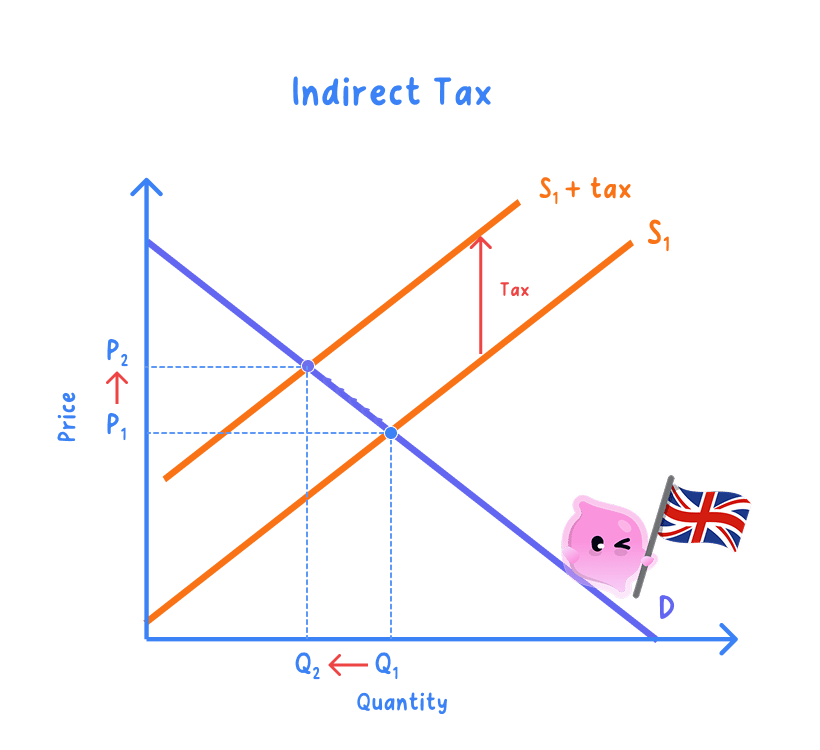
Indirect tax: a tax placed on the sale of a good or service, collected from the seller and passed on to the buyer through a higher price.
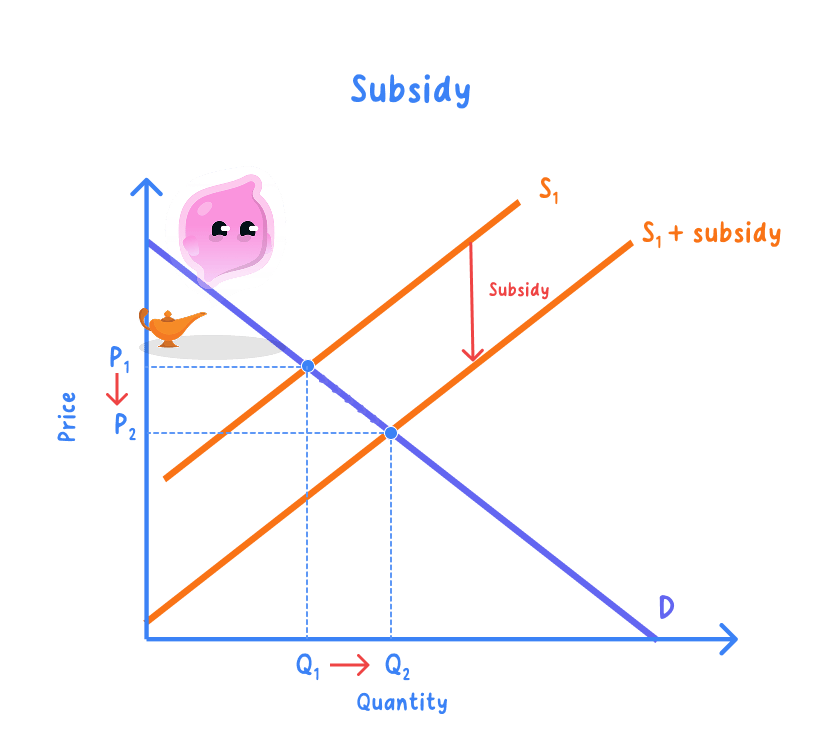
Subsidy: a payment from the government to a producer or consumer that lowers the cost of supplying or buying a good, so more of it is sold at a lower price.
- The two are mirror images on a supply and demand diagram, since a tax adds to the cost of supplying each unit and shifts supply left, while a subsidy cuts that cost and shifts supply right.
- Neither method forbids anything, so anyone who still values the good enough goes on buying it, which is why both are chosen where the aim is to reduce an activity rather than end it.
An indirect tax makes buyers pay for the harm
- The tax raises the price, quantity demanded contracts, fewer units are produced and so less of the associated harm is created.
- The Soft Drinks Industry Levy, introduced in 2018 at 18p a litre above 5g of sugar per 100ml and 24p a litre above 8g, changed producers as much as buyers, because most manufacturers reformulated their drinks to fall below the threshold.
- The landfill tax has risen from around £7 a tonne in 1996 to over £100 a tonne, which made recycling and recovery cheaper than dumping and pulled waste away from landfill sites.
- Tobacco and alcohol duties collected by HMRC work the same way, and the revenue can be used to fund the treatment the harm creates.
Subsidies make beneficial goods cheap enough to buy
- The subsidy lowers the price and quantity demanded extends.
- Bus services outside London are supported by local authority funding, which keeps fares low enough that passengers switch off the roads.
- Government grants towards heat pumps and home insulation cut the up-front cost, so more households install them and national energy demand and emissions both fall.
- Apprenticeship funding pays part of the training bill, which stops firms cutting back on training simply because a trained worker can leave for a rival.
- The Soft Drinks Industry Levy was deliberately banded rather than flat, so a producer could escape it entirely by cutting sugar below 5g per 100ml.
- Most large manufacturers reformulated within two years, so the sugar bought in soft drinks fell even where sales volumes held up.
- That is the clearest lesson of the policy: a tax can correct a misallocation by changing what is produced, not only by pricing buyers out.
Regulation sets limits that prices alone cannot
- Bans remove the activity altogether where the harm is too serious to price, as with the smoking ban in enclosed public places in force across the UK by July 2007, which cut second-hand smoke for staff and customers at a stroke.
- Limits and minimum standards cap the harm rather than the activity, as the London ULEZ does by charging the most polluting vehicles to enter and leaving cleaner ones free.
- Legal requirements on retailers work through a small charge, and the 5p plastic bag charge from 2015, later raised to 10p, cut single-use bag sales at the main supermarkets by more than 95 per cent.
- Licensing and industry regulators police standards where a market would not, so Ofgem and Ofwat set what energy and water suppliers may charge and must deliver, Ofcom regulates telecoms and the CMA acts against firms that abuse their market position.
- Regulation bites hardest where the harm is concentrated and easy to inspect, because a rule with no inspector behind it changes nothing.
State provision and information campaigns fill the gap directly
- State provision means the government supplies the good itself out of taxation, rather than waiting for a market to do it.
- The NHS is free at the point of use, so nobody leaves an illness untreated because they cannot afford the fee.
- State schooling is compulsory as well as free, which removes the choice that would otherwise leave education under-consumed.
- Information and education campaigns change what people want rather than what they can afford, which is why the effect lasts once the campaign stops.
- NHS public health campaigns on smoking, drinking and healthy eating give people the information the seller has no reason to supply.
- Compulsory health warnings and plain packaging on cigarettes, and decades of drink-drive advertising, changed what UK consumers regarded as normal behaviour.
- A subsidy shifts supply, not demand: it cuts the producer's cost, it does not make buyers want the good more.
- A tax on a good with inelastic demand raises revenue, it does not stop the behaviour.
- Intervention is not automatically an improvement: get the size wrong and the government has simply moved the misallocation.
Success depends on how people respond
- It depends on how responsive demand is to price, because tobacco duty barely changes the habit of an addicted smoker and mostly raises revenue, while the sugar levy worked because producers could respond by reformulating.
- It depends on how easily the policy can be enforced, since the ULEZ has a camera on every entry point while the landfill tax pushed some waste into fly-tipping that nobody was watching for.
- It depends on whether a ban pushes trade underground, because outlawing something people still want moves it to illegal sellers, where there is no safety standard, no age check and no tax collected.
- It depends on the time horizon, as a tax or a ban changes behaviour on the day it starts while an education campaign shifts habits over a generation and is far harder to judge in the meantime.
It also depends on cost, and on who pays
- It depends on whether the government can judge the size of the harm, because a tax set too low leaves the misallocation in place while one set too high drives resources out of a market society still wants served.
- It depends on who bears the cost, since an indirect tax takes a larger share of a low income than a high one, so a policy that corrects a misallocation can widen inequality at the same time.
- It depends on the opportunity cost of the money, because every pound spent on a subsidy, an inspectorate or state provision is a pound not spent on the next most valuable public service.
- It depends on whether the government gets it wrong, since poor information, lobbying by affected firms and unintended side effects can leave resources allocated worse than they were before the policy.
Judgement: intervention is worth using where the harm is large, measurable and enforceable, as with the landfill tax and the ULEZ, but no single method is reliably best, because a tax changes the price, regulation sets the limit and information changes what people want in the first place.
In practice, governments combine several methods
- UK smoking policy stacked four of the five methods together, using tobacco duty as the tax, the ban in enclosed public places and plain packaging as regulation, NHS campaigns and the warnings on the packet as information, and free NHS stop smoking services as state provision.
- The methods reinforce each other, because the tax makes the habit expensive while the campaign makes giving it up seem worth doing, and adult smoking rates fell further than any one measure would explain.
- Combining methods also spreads the burden, so the whole cost of correcting the misallocation does not fall on the poorest buyers through the tax alone.
- Decide first whether the question is about cutting consumption or raising revenue: a tax on a good with inelastic demand does the second and hardly the first.
- Name the mechanism, not just the policy: the Soft Drinks Industry Levy worked by pushing manufacturers to reformulate, not simply by making cola dearer.
- When you criticise an indirect tax, say who carries it: it takes a larger share of a low income than of a high one.
- Name the five main methods a government uses to correct a misallocation of resources.
- Explain the chain from an indirect tax to less of the harm being created.
- Why did the Soft Drinks Industry Levy change producers as well as buyers?
- Give one UK example of regulation and one of state provision.
- Why can an indirect tax that corrects a misallocation still widen inequality?
1.6.2a Defining externalities
Externalities are the costs or benefits markets miss
Private cost: the cost of an activity paid by the person or firm carrying it out, such as wages, fuel, materials and rent.
Private benefit: the gain from an activity enjoyed by the person or firm carrying it out, such as a firm's revenue or a consumer's satisfaction.
Social cost: the total cost of an activity to society, which is the private cost plus any cost falling on everybody else.
Social benefit: the total benefit of an activity to society, which is the private benefit plus any benefit enjoyed by everybody else.
Externality: the difference between the social figure and the private figure, which is the cost or benefit of an activity that lands on a third party rather than on the buyer or the seller.
- The two private figures are the only ones a buyer or a seller consults, because they are the only ones that actually land on the person making the decision.
- The two social figures put everybody else back in, so they measure what the activity does to the whole community rather than to the two people trading.
- The relationship is an addition on each side: social cost = private cost + external cost and social benefit = private benefit + external benefit.
- Rearranging either identity gives the externality directly, since it is whatever is left when the private figure is taken away from the social one.
A third party is affected outside the deal
- Every transaction has exactly two parties, the buyer and the seller, and everything the two of them weigh up is private by definition.
- A third party is anybody else who is affected by that transaction without having bought, sold or agreed to it.
- The third party has no way to send a bill for the harm or to charge for the benefit, so nothing about them ever reaches the price.
- That silence is what makes the market's arithmetic incomplete, because the price is adding up a genuine total but not the total that matters to society.
- A haulage firm's private cost of one delivery run is £400 in fuel, wages and wear on the lorry.
- The exhaust fumes, noise and road damage that the run creates are valued at £90 by the people who live along the route.
- Adding the private cost and the external cost gives the social cost:
- The externality is the £90 difference, which the firm never pays and the delivery price never shows.
The same gap can open up on benefits
- Everything above works identically for benefits, with the gap sitting between the social benefit and the private benefit instead of between the two costs.
- A household that insulates its loft counts the lower heating bill, while the country gains lower national energy demand and lower emissions that never enter the household's decision.
- Because the decision counts only the private half, less insulation is fitted than society would have chosen.
- The direction of the gap tells you which way the market went wrong, since a social cost above the private cost means too much was produced, while a social benefit above the private benefit means too little was consumed.
- Social cost is not the harm to others: it is the private cost plus that harm.
- The externality is the difference between the two totals, never a total in its own right.
- Private benefit is not only profit: for a consumer it is the satisfaction they get from the good.
Often private and social figures already match
- Most transactions create no externality, so both identities collapse to equalities and the market price already tells the whole story.
- A haircut, a loaf of bread or a pair of shoes affects only the buyer and the seller, which is why nobody proposes taxing or subsidising them.
- Externalities are therefore about the minority of markets where somebody outside the deal is affected and no price is ever charged for it.
Whether that gap leaves third parties better or worse off, and whether it arises in production or in consumption, is classified in 1.6.2b.
- Write the identity linking social cost, private cost and external cost.
- Who counts as a third party in a transaction?
- A run costs a firm £400 and imposes £90 on residents, so what is the social cost and what is the externality?
- Why does a third party's loss never show up in the market price?
- What does it tell you when social benefit is greater than private benefit?
1.6.2b Positive and negative externalities
Positive externalities help third parties, negative ones harm them
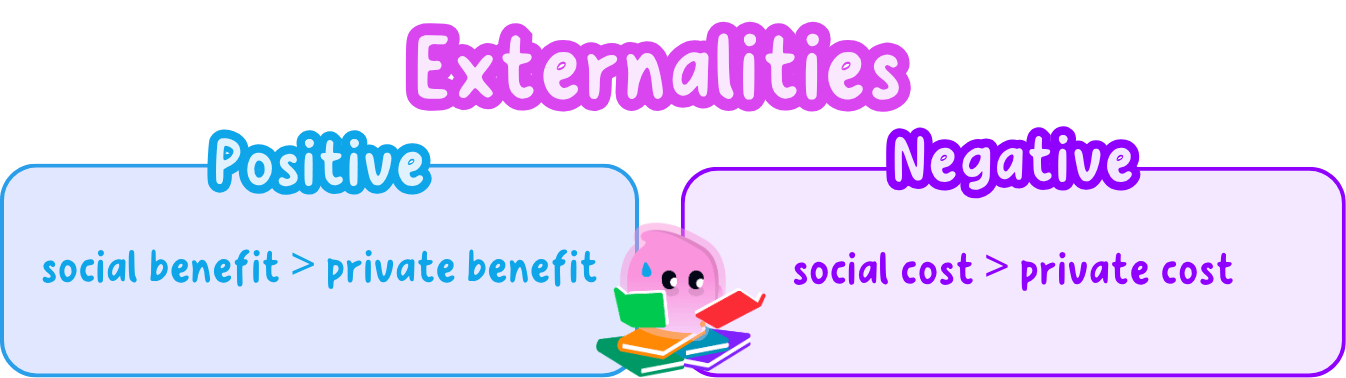
Positive externality: a benefit of an economic activity that is enjoyed by a third party, so the social benefit is greater than the private benefit.
Negative externality: a cost of an economic activity that is borne by a third party, so the social cost is greater than the private cost.
The private and social costs and benefits used here were set out in 1.6.2a, so this article is about which way the gap between them runs.
- The test is a single question: is the third party better off or worse off because the activity happened?
- A negative externality means the market has been under-charging, so too many resources flow in and the good is over-produced or over-consumed.
- A positive externality means the market has been under-rewarding, so too few resources flow in and the good is under-produced or under-consumed.
- The two labels describe the spillover, not the good itself, so one activity can easily create both at the same time.
Four questions identify any externality in an unfamiliar context
- Ask who is inside the deal, naming the buyer and the seller, since everything they gain or pay is private.
- Ask who else is affected, and name that group specifically, such as the residents on the flight path rather than society in general.
- Ask whether they gain or lose, because that one answer settles positive against negative.
- Ask whether they were paid or charged for it, since an effect that has already been compensated is part of the price and is no longer external.
- Take a farm buying pesticide and spraying it on its crop.
- The buyer is the farm and the seller is the chemical supplier, so the price of the pesticide and the value of the larger harvest are both private.
- The beekeeper on the neighbouring land bought nothing and sold nothing, so the beekeeper is the third party.
- The spray kills bees and cuts the honey harvest, so the beekeeper is worse off and was never compensated, which makes this a negative externality of production.
Negative externalities arise in production and consumption
- Production externalities are created by the act of making the good, so the harm exists as soon as the firm produces, whether or not anybody ever uses the output.
- A factory discharging waste into a river harms anglers, swimmers and everybody downstream, and Ofwat and the Environment Agency have taken enforcement action against UK water companies over sewage discharges for exactly this reason.
- A quarry imposes dust, noise and heavy lorry traffic on the village beside it, none of which appears in the price of the stone.
- Consumption externalities are created by the act of using the good, so the harm appears at the moment somebody consumes it rather than at the factory.
- A driver's exhaust is produced when the fuel is burned, harming the pedestrians and cyclists sharing the street, which is what the London ULEZ charges for.
- A smoker's second-hand smoke harmed bar staff and other customers who had bought nothing, until the smoking ban removed it from enclosed public places.
- Litter and late-night noise from drinking fall on residents and on the councils that clear up afterwards.
- The distinction changes the policy, because a production externality is tackled at the factory gate through regulation or a tax on the producer, while a consumption externality has to be tackled at the point of use.
Positive externalities arise from both sides too
- In production, a firm that trains its staff creates skills that stay in the economy when those workers later move to other employers who paid nothing for the training.
- A firm that develops new technology does the same, since rivals and suppliers learn from it without covering any of the research bill.
- In consumption, a person who is vaccinated protects everybody they would otherwise have infected, so third parties gain protection they never paid for.
- A person who stays in education raises their own earnings and also produces a more skilled workforce, higher tax revenue and lower spending on crime and benefits.
- An externality falls on a third party, never on the buyer or the seller inside the deal.
- A cost the firm pays itself, such as wages or a fine, is a private cost, not an external one.
- Label the externality by who is acting, not by the good: a factory polluting is production, a driver's exhaust is consumption.
One activity can create both types at once
- Expanding an airport such as Heathrow gives other firms faster trade links and creates jobs across the region, while imposing noise, emissions and traffic on the villages beneath the flight path.
- Both spillovers land on people outside the transaction, so both are genuine externalities and neither cancels the other out by definition.
- Identifying an activity therefore means naming each spillover and the group it lands on, rather than deciding which single label the activity deserves.
- Say whether the externality arises in production or in consumption: the specification names both, and an answer that only mentions factory pollution misses the consumption half.
- Name the third party specifically, such as residents beside the quarry rather than society in general.
- Finish the link in the same sentence: negative means social cost above private cost and over-production, positive means social benefit above private benefit and under-consumption.
- What single question tells you whether an externality is positive or negative?
- Give one negative externality of production and one of consumption.
- Why is a driver's exhaust a consumption externality rather than a production one?
- Give one positive externality of production and one of consumption.
- Why does a negative externality lead to over-production and a positive one to under-consumption?
