Scarcity forces every economy to make choices
Definition
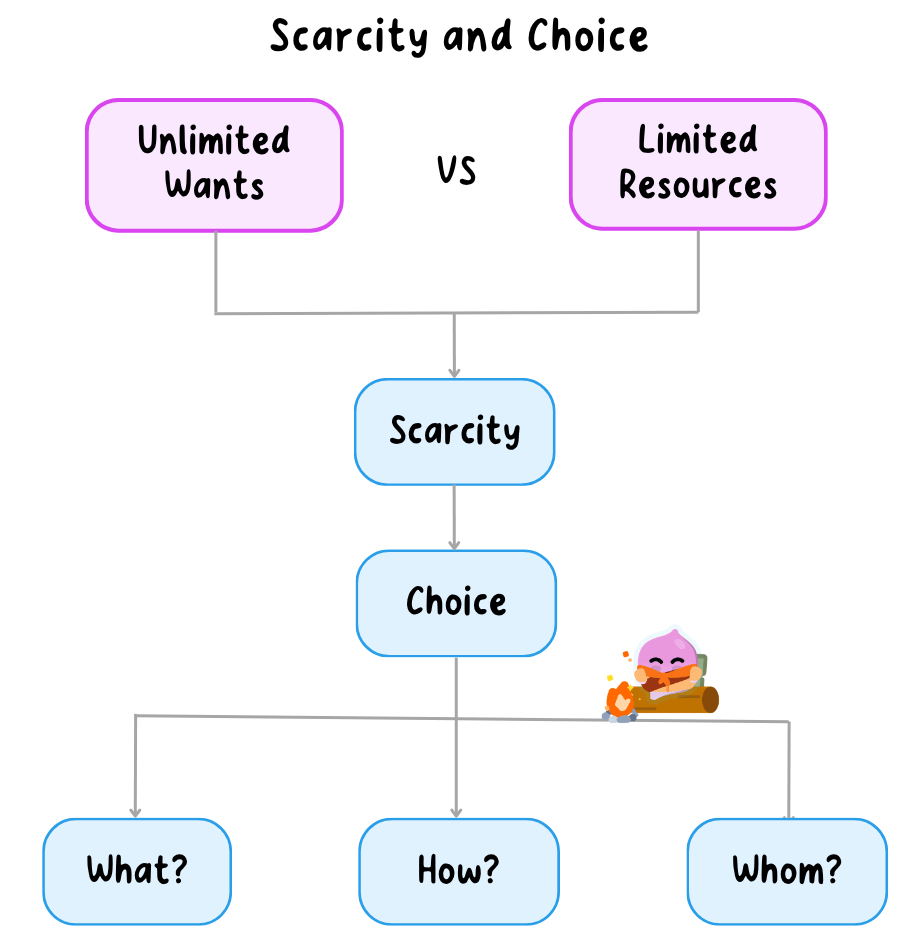
Scarcity: unlimited human wants set against limited resources, which forces every society to choose.
- No economy can produce everything people want, so it must choose how to use its limited factors of production.
- Those choices come down to three basic questions of resource allocation that no economy can avoid.
Example
- A school canteen works to a fixed budget.
- It picks which dishes to cook, whether to use ready meals or cook from scratch, and who gets served first.
- Every economy faces those same three decisions, just on a far bigger scale.
Three questions decide how resources are used
- What to produce: which goods and services to make and in what quantities, since making more of one thing means making less of another.
- How to produce: which method to use, such as more labour or more machinery.
- For whom to produce: how the output is shared out among different people and groups.
Common Mistake
- "How to produce" is the method, labour versus machines, not which goods to make.
- "For whom" is who receives the output, not who pays for the raw materials.
Cadbury answers all three questions
- What to produce: whether to make more Dairy Milk bars or expand its range of protein bars.
- How to produce: whether to automate more of its Bournville factory or employ more staff on the line.
- For whom to produce: whether output goes to UK supermarkets or is exported to shops abroad.
- Every producer, and every economy as a whole, answers these same three questions on a different scale.
Self review
- Why does scarcity force every economy to make choices?
- What are the three basic allocation questions?
- What does the "how to produce" question actually decide?
- What does the "for whom" question actually decide?
- Give a real example of a UK producer making one of the three decisions.