2.4.1a The importance of trade
International trade means buying and selling across borders
International trade: the exchange of goods and services between one country and another.
Export: a good or service made in one country and sold to buyers in another, so money flows into the selling country.
Import: a good or service a country buys in from abroad, so money flows out to the country that supplied it.
- International trade connects a country's economy to the rest of the world, through the goods and services that cross its borders each day.
- Trade covers goods you can touch, such as cars, oil and bananas, and services you cannot touch, such as tourism, banking and insurance.
- The UK's financial and business services, based mainly in the City of London, are among its biggest export earners.
- The UK also exports Scotch whisky and imports goods it does not produce cheaply itself, such as cars, smartphones and bananas.
Countries trade because their resources and conditions differ
- Natural resources are spread unevenly. Some countries have oil, gas, metals or fertile farmland, while others have very little.
- Climate decides what can be grown. Coffee, cocoa and bananas grow well in hot, wet places but not in cold northern countries.
- Skills and technology differ. Some countries have workers and firms that are very good at making cars, medicines or software.
- Costs of production differ. Wages, land and energy are cheaper in some countries, so the same good can be made there for less.
- Because of these differences, each country can supply some things easily and cheaply while finding other things hard or expensive to make.
No single country has every resource, climate and skill it needs, so each ends up strong in some products and weak in others.
Trade lets a country obtain what it cannot make
- No country has all the resources, climate and skills it needs, so trade is how it gets the goods and services it cannot produce at home.
- A cold country cannot grow its own coffee or bananas, so it must import them if people want to buy them.
- A country with no oil of its own must buy fuel from abroad to run its factories and vehicles.
- Even when a country can make something itself, another country may make it more cheaply, so importing it frees resources for other uses.
- It is tempting to think exports are good and imports are bad, but this is wrong.
- Imports are how people get goods their own country cannot make and how firms buy the materials and parts they need.
- Trade is a two-way exchange that helps both sides, not a contest one country wins.
Trade widens choice and lowers prices for shoppers
- Trade gives consumers a much wider variety of goods and services than any one country could produce alone.
- Shoppers can buy fruit out of season, foreign foods and cars, and technology made all over the world.
- Buying from the cheapest producer abroad tends to push prices down, so households can afford more.
- Producers also gain, because selling abroad opens up far more customers than the home market alone.
- Structure each point by naming the reason a country trades and then developing it one step further to show the effect.
- Use any figures or examples given in the question to support your points rather than writing in general terms.
- Avoid the trap of claiming exports are good and imports are bad, since trade is a two-way exchange that benefits both countries.
- What is the difference between an export and an import?
- Give two reasons why the resources or conditions of countries differ.
- Explain why a cold country might import bananas.
- State one way trade benefits consumers.
2.4.1b Advantages of trade and interdependence
Trade makes the UK's economy interdependent with the world
Interdependence: the situation where economies rely on one another, so events in one country affect its trading partners.
- One country's exports are another country's imports, so buyers and sellers in different nations are directly connected.
- Because of these links, a rise in demand in one country can boost exports and jobs in its trading partners, and a slowdown can do the opposite.
- In the first quarter of 2026 the UK ran a surplus of £51.8 billion in trade in services but a deficit of £59.5 billion in trade in goods.
- This shows the UK is interdependent with the world on both sides: it earns from selling services abroad and relies on other countries for many of the goods it buys.
- The overall current account balance this creates is examined in detail as the balance of payments (see 2.2.5).
Trade widens choice and lowers prices for UK shoppers
- Competition from foreign producers helps keep prices low, because UK firms must match cheaper imports.
- Trade gives UK consumers a far wider choice of goods and services, including items that are out of season or impossible to make at home.
- UK shoppers benefit from imported fruit out of season, clothing and electronics that would be far more limited without trade.
- Competition from cheaper imports also helps keep prices down on supermarket shelves.
Bigger export markets let UK firms cut costs
- Selling into markets far larger than the UK alone gives exporters access to many more customers.
- Producing for this larger market lets firms produce on a bigger scale, which usually lowers the average cost of each unit, known as economies of scale.
- Lower costs and bigger export markets support higher output and economic growth for the UK economy.
Rolls-Royce and AstraZeneca sell most of what they make to customers abroad, reaching a scale of production the UK market alone could not support.
Whether interdependence helps the UK depends on the shock
- It depends on how diversified the UK's trading partners and suppliers are, because relying heavily on one partner or one supplier leaves the UK exposed if that partner cuts supply or its economy weakens, while a spread of partners cushions any single shock.
- It depends on whether a shock is temporary or persistent, because a brief global price rise raises costs only briefly, but a lasting rise, such as sustained global energy prices, can feed into inflation for longer, as seen when energy-driven pressures helped push UK CPI inflation up to 2.9 per cent in July 2026.
- It depends on which side of the economy is exposed, because a shock to an import the UK relies on for essentials, such as energy or food, hits consumers directly, while a shock to an export market mainly hits producers and workers in that industry.
- Overall, interdependence usually benefits the UK through wider choice, lower prices and bigger export markets, but its openness to the rest of the world means a shock abroad, especially in energy, can quickly show up at home in higher prices.
- What does interdependence between economies mean?
- Give two advantages of trade for the UK economy.
- What are economies of scale, and how does trade help firms reach them?
- Name one factor that decides how far a global shock affects the UK.
- Give a real UK figure showing the UK trades a surplus in services but a deficit in goods.
2.4.1c UK exports and imports
UK exports lean on services and a few goods
- The UK's biggest export earner is services, especially financial services and business or professional services, much of it centred on the City of London.
- Among goods, the UK's main exports are machinery, vehicles (cars), pharmaceuticals and chemicals, and crude oil and refined fuels.
- Services make up a large and growing share of UK exports relative to goods.
- The UK's financial and professional services sector is one of its largest export earners, alongside cars, pharmaceuticals and refined fuel.
- Scotch whisky is a well-known UK goods export sold around the world.
UK imports span machinery, fuel, food and consumer goods
- The UK's main imports are machinery and transport equipment, fuels, food and drink, and consumer goods.
- Because the UK does not produce enough of these to meet demand, or cannot produce them as cheaply, it buys them in from a wide range of trading partners.
Everyday UK imports include electronics and machinery, imported food such as fruit that cannot be grown in the UK climate, and fuel.
The UK runs a services surplus and goods deficit
Visible trade: the buying and selling of physical goods that can be seen and touched, such as cars, oil or food.
Invisible trade: the buying and selling of services, such as banking, insurance or tourism, where nothing physical crosses the border.
- Trade in physical goods, such as cars or food, is called visible trade; trade in services, such as banking or tourism, is called invisible trade.
- In the first quarter of 2026, the UK ran a deficit of £59.5 billion in trade in goods but a surplus of £51.8 billion in trade in services.
- This goods deficit and services surplus is the UK's long-standing trade pattern, with the services surplus only partly offsetting the larger goods deficit.
How this feeds into the UK's overall current account balance, and what a deficit or surplus means for the economy, is covered under the balance of payments (see 2.2.5).
The USA and EU are the UK's top partners
- The USA is the UK's largest single-country market for exports and also its largest single-country source of imports.
- As of 2023, the most recent year with a full country-by-country breakdown, the UK's top export markets ranked in order were the USA, Germany, Ireland, the Netherlands and France, and its top import sources ranked in order were the USA, Germany, the Netherlands, France and China.
- If the EU is counted as a single bloc rather than as separate countries, it becomes the UK's largest trading partner overall, taking roughly two-fifths of UK exports and supplying around half of UK imports.
- In 2023, the USA bought a larger share of UK exports than any other single country, around a fifth of the total, ahead of Germany, Ireland, the Netherlands and France.
- The exact totals change year to year, but this ranking, with the USA and Germany at the top, has held broadly steady in more recent trade data.
These patterns fit together into the UK's trade position
- A UK economy that exports mainly services and a narrower set of goods, while importing a much wider range of goods, is why it runs a deficit in goods but a surplus in services overall.
- Trade with the USA and the EU, whether counted country by country or as a bloc, dominates the UK's trading relationships.
- Name two categories of UK goods exports and one category of UK services exports.
- Name two categories of UK imports.
- What is the difference between visible and invisible trade?
- Does the UK run a surplus or a deficit in trade in goods? What about trade in services?
- Which single country is the UK's largest export market and largest import source?
2.4.2a How exchange rates are determined
An exchange rate is the price of one currency
Exchange rate: the price of one currency expressed in terms of another currency.
Floating exchange rate: an exchange rate determined by the demand for and supply of the currency on the foreign exchange market, rather than fixed by the government or central bank.
- The pound is a floating currency, so its value against the dollar or the euro changes as trading conditions change.
In August 2026 the pound traded at around 1.35 dollars and 1.17 euros, having been broadly stable to modestly stronger against both currencies over the year.
Appreciation and depreciation describe a rate rising or falling
- If the pound appreciates, each pound buys more foreign currency than before; if it depreciates, each pound buys less.
Appreciation: a rise in the value of a currency against another currency.
Depreciation: a fall in the value of a currency against another currency.
- Do not confuse appreciation and depreciation with inflation.
- They describe a currency's value against other currencies, not the general price level in the economy.
A floating rate is set by demand and supply
- The demand for pounds comes from anyone who needs pounds, such as foreigners buying British exports or placing money in the UK.
- The supply of pounds comes from anyone offering pounds in exchange for other currencies, such as UK residents buying foreign goods or investing abroad.
- The rate settles where the quantity of pounds demanded equals the quantity of pounds supplied.
Think of the pound as a product on sale in a giant market: its price, the exchange rate, settles where the amount buyers want matches the amount sellers offer.
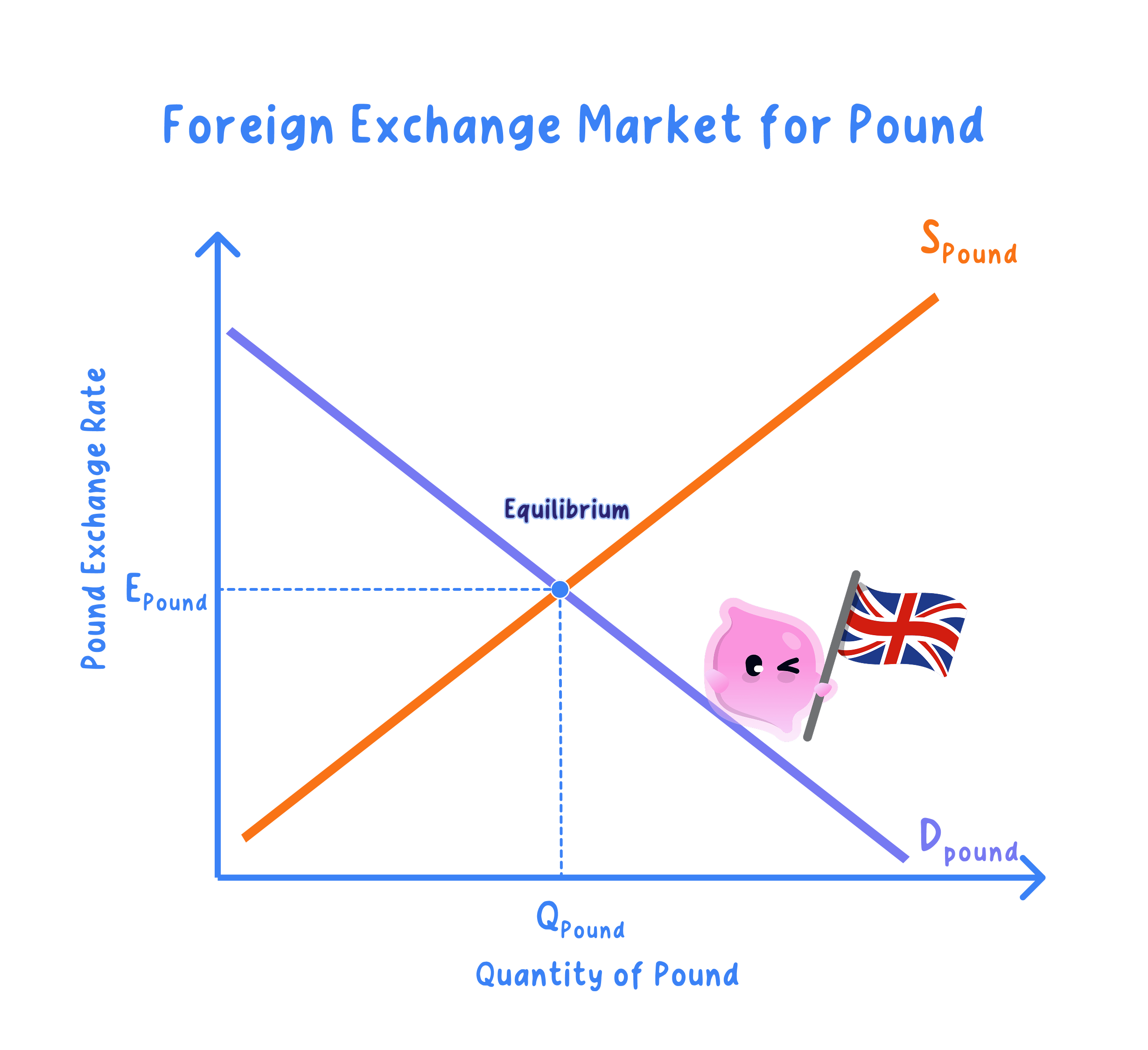
A demand and supply diagram shows the equilibrium rate
- The vertical axis shows the price of the pound in another currency and the horizontal axis shows the quantity of pounds traded; demand slopes down and supply slopes up.
- Equilibrium, and the equilibrium exchange rate, is found where the two curves cross.
- A common mistake is to assume a government simply chooses the exchange rate.
- Under a floating system the rate is set by trading in the market, so it moves as demand and supply change.
Away from equilibrium, the market pushes the rate back
- If the pound is above the equilibrium rate, more pounds are supplied than demanded, creating a surplus that pushes the rate back down.
- If the pound is below the equilibrium rate, demand exceeds supply, creating a shortage that pulls the rate back up.
- Whenever the underlying demand for or supply of the currency changes, for example if more foreigners want to buy British exports, the equilibrium rate settles at a new level.
- In a floating system, what two forces decide the exchange rate?
- What is the difference between an appreciation and a depreciation?
- Name what goes on each axis of the currency demand and supply diagram.
- Explain what happens to the rate if there is a surplus of pounds.
2.4.2b Effects of exchange rate changes
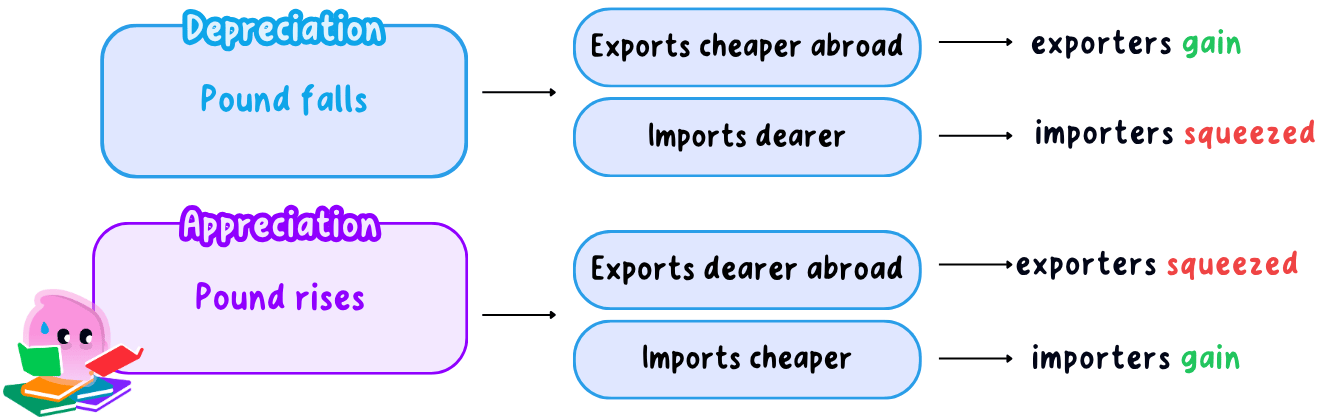
A stronger pound raises export prices for foreign buyers
- After the pound appreciates, foreign buyers need more of their own currency to pay the same price, so UK exports become more expensive abroad.
- Higher prices abroad tend to reduce the quantity of exports that foreign customers buy, especially where those buyers are sensitive to price.
- UK exporters lose competitiveness, because rival firms in other countries now look cheaper by comparison.
- SPICED: Strong Pound, Imports Cheaper, Exports Dearer.
- Reading it left to right gives the direction of both price changes at once.
A stronger pound makes imports cheaper for UK buyers
- Imports become cheaper, because each pound now buys more foreign currency than before.
- Cheaper imports tend to increase the quantity that UK households and firms buy from abroad, and firms that import raw materials face lower costs.
- Importers and consumers gain from wider choice and lower prices, even as exporters lose sales.
- A strong pound is not automatically good for the whole economy.
- An appreciation helps importers and consumers but hurts exporters, who lose sales.
Converting a price shows exactly what appreciation does
- Suppose the pound appreciates from 1.30 to around 1.35 dollars to the pound, close to its rate in August 2026, and trace the effect on one export price and one import price.
- Export: a UK-made good priced at £20,000.
Step 1: at the old rate of 1.30 dollars to the pound, the US price is:
£20,000×1.30=$26,000 \pounds20{,}000 \times 1.30 = \text{\textdollar}26{,}000 £20,000×1.30=$26,000Step 2: at the new, appreciated rate of 1.35 dollars to the pound, the US price is:
£20,000×1.35=$27,000 \pounds20{,}000 \times 1.35 = \text{\textdollar}27{,}000 £20,000×1.35=$27,000- The export price rises by 1,000 dollars for the US buyer, so the good becomes less competitive.
- Import: a US-made good priced at 900 dollars.
Step 1: at the old rate of 1.30 dollars to the pound, the UK price is:
$900÷1.30=£692.31 \text{\textdollar}900 \div 1.30 = \pounds692.31 $900÷1.30=£692.31Step 2: at the new, appreciated rate of 1.35 dollars to the pound, the UK price is:
$900÷1.35=£666.67 \text{\textdollar}900 \div 1.35 = \pounds666.67 $900÷1.35=£666.67- The import price falls by about £25.64 for the UK buyer, so the good becomes more attractive.
Appreciation feeds into the current account and jobs
- Dearer exports and cheaper imports tend to worsen the current account, as export sales fall and import spending rises.
- The size of this effect depends on how strongly buyers respond to the price changes.
- Export industries may cut output and jobs if a strong pound lasts, even while consumers enjoy cheaper imports.
A weaker pound makes exports cheaper abroad
- After the pound depreciates, foreign buyers need less of their own currency to pay the same price, so UK exports become cheaper abroad.
- Lower prices abroad tend to increase the quantity of exports that foreign customers buy, especially where those buyers are sensitive to price.
- UK exporters gain competitiveness, because their goods now look cheaper than foreign rivals.
- WPIDEC: Weak Pound, Imports Dearer, Exports Cheaper.
- The word spells out both price changes in one go, so the direction is never mixed up.
A weaker pound makes imports dearer for UK buyers
- Imports become more expensive, because each pound now buys less foreign currency than before.
- Dearer imports tend to reduce the quantity that UK households and firms buy from abroad, and firms that rely on imported raw materials face higher costs.
- Higher import prices can also add to inflation across the economy.
- A weak pound is not automatically bad for the whole economy.
- A depreciation helps exporters but raises prices for importers and consumers.
Converting a price shows exactly what depreciation does
- Suppose the pound depreciates from 1.20 to around 1.17 euros to the pound, close to its rate in August 2026, and trace the effect on one export price and one import price.
- Export: a UK-made car priced at £20,000.
Step 1: at the old rate of €1.20 to the pound, the EU price is:
£20,000×1.20=24,000 euros \pounds20{,}000 \times 1.20 = 24{,}000\text{ euros} £20,000×1.20=24,000 eurosStep 2: at the new, depreciated rate of €1.17 to the pound, the EU price is:
£20,000×1.17=23,400 euros \pounds20{,}000 \times 1.17 = 23{,}400\text{ euros} £20,000×1.17=23,400 euros- The export price falls by €600 for the EU buyer, so the car becomes more competitive.
- Import: an EU-made good priced at €50.
Step 1: at the old rate of €1.20 to the pound, the UK price is:
50 euros÷1.20=£41.67 50\text{ euros} \div 1.20 = \pounds41.67 50 euros÷1.20=£41.67Step 2: at the new, depreciated rate of €1.17 to the pound, the UK price is:
50 euros÷1.17=£42.74 50\text{ euros} \div 1.17 = \pounds42.74 50 euros÷1.17=£42.74- The import price rises by about £1.07 for the UK buyer, so the good becomes dearer.
Depreciation feeds into the current account and jobs
- Cheaper exports and dearer imports tend to improve the current account, as export sales rise and import spending falls.
- The size of this effect depends on how strongly buyers respond to the price changes.
- Export industries may raise output and jobs if a weak pound lasts, even while consumers face higher import prices.
- Before calculating, decide whether the pound has appreciated or depreciated, since that decides whether you multiply or divide by the exchange rate.
- For a price in foreign currency, multiply the pound price by the rate; for a price in pounds, divide the foreign price by the rate.
- When asked to evaluate the effect of a rate change, weigh which side, consumers, exporters or importers, is affected more heavily rather than just listing that there are winners and losers.
- Explain why exporters lose out but importers gain when the pound appreciates.
- Explain why exporters gain but importers lose out when the pound depreciates.
- A UK export priced at £20,000 sells into the US at a rate of 1.30 dollars to the pound. What does it cost in dollars? What does it cost if the rate rises to 1.35 dollars to the pound?
- What do SPICED and WPIDEC each stand for?
- How does a change in the exchange rate affect the current account?
2.4.3a Free-trade and its arguments
Free trade means countries trade without barriers
Free trade: the buying and selling of goods and services between countries with no barriers such as taxes or limits getting in the way.
Trade barrier: anything a government uses to make trade with other countries harder or more expensive.
- Barriers can take the form of taxes on imports, limits on the quantity allowed in, or rules that foreign firms find hard to meet.
- Under free trade a country removes these barriers so that goods, services and money can move in and out freely.
Free trade lowers prices and widens choice for shoppers
- Lower prices: imports are not taxed at the border, so foreign goods reach shoppers more cheaply.
- Wider choice: people can buy goods that are not made at home, from a much larger range of producers.
- More competition: rival imports push home firms to keep their own prices down and their quality up.
- A UK shopper can buy bananas from the Caribbean, a phone assembled in Asia and cheese from France, often more cheaply than if trade barriers blocked these imports.
- This chain of reasoning matters: cheaper imports lead to lower prices, which raise real incomes and living standards.
Free trade lets firms reach bigger markets and specialise
- Bigger markets: home firms can sell to customers all over the world, not just at home.
- Selling more units lets firms spread their costs and often produce each item more cheaply.
- Greater efficiency: firms face world competition and have to use resources well to survive.
- Gains from specialisation: each country concentrates on what it produces best and trades for the rest, so world output rises.
Protectionism uses barriers to shield industries from imports
Protectionism: government policies used to shield home industries from foreign competition.
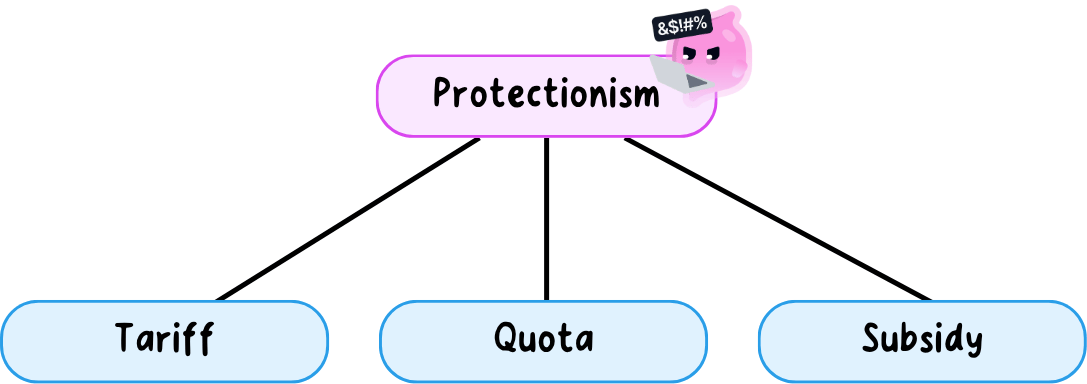
Tariff: a tax on imported goods, which raises the price shoppers pay for them.
Quota: a limit on the quantity of a good that can be imported.
Subsidy: a payment from the government to home producers that lowers their costs so they can compete with cheaper imports.
- A tariff makes an import dearer, so shoppers are more likely to buy the home-produced alternative instead.
- A quota caps how much of a good can be sold from abroad, whatever price it is offered at.
- A subsidy lowers a home producer's own costs, letting it match cheaper imports without taxing or limiting them.
Protecting industries can still carry real costs
- Home producers undercut: cheaper foreign goods can take sales from domestic firms that cannot match the price.
- Job losses: if firms cannot compete they may shrink or close, and workers in those industries can lose their jobs.
- These losses are often concentrated in particular towns or regions, which makes them painful even when the country as a whole gains.
- Infant industries: new industries that are just starting out may struggle to grow if they face full foreign competition before they become efficient.
- Free trade does not mean every firm or worker gains.
- It raises total output and average living standards, but some producers and workers clearly lose out, so do not claim it is good for everyone.
How far free trade's benefits outweigh its costs
- It depends on how much prices fall and choice widens, because a bigger fall in import prices and a wider range of goods available raises the benefit to shoppers.
- It depends on how many jobs are at risk and how easily those workers can retrain, because job losses concentrated in one town with few other employers hurt more than losses spread across a flexible labour market.
- It depends on whether the industry is genuinely uncompetitive or just new, because protecting a permanently inefficient industry wastes resources, while briefly protecting a promising new industry can let it establish itself.
- Most economists judge that free trade raises average living standards, but a strong answer names who gains, who loses and why, rather than treating free trade as good for everyone.
- When a question gives you a specific industry, decide first whether it is genuinely uncompetitive or merely new, since infant industries and permanently struggling ones deserve different judgements.
- Support a benefit or cost with a concrete example, such as tariffs on Chinese steel or a subsidy to a home producer, rather than describing free trade only in the abstract.
- A judgement only earns credit if it says who gains and who loses, not just that free trade is 'good' or 'bad'.
- Can you define free trade and protectionism in one sentence each?
- Can you name a tariff, a quota and a subsidy, and say what each one does?
- Can you give two benefits of free trade for shoppers and two for firms?
- Can you explain why free trade can still harm some home industries?
- Can you reach a balanced judgement on whether free trade is worth its costs?
2.4.3b Free-trade agreements such as the EU
Trading blocs let members trade without barriers
Trading bloc: a group of countries that agree to reduce or remove trade barriers between themselves.
Free-trade agreement: the deal that the members of a bloc sign to make this happen.
- The aim of a bloc is to make trade between members cheaper and easier, so that all the members can buy and sell more.
- Its rules decide how members trade with each other and with countries outside the bloc.
- Trade is freer inside the bloc than with the rest of the world.
- The whole point of joining is that members give each other better access than outsiders get.
A customs union adds one shared external barrier
Free-trade area: a group of countries that removes trade barriers between its members, while each member keeps its own rules for trade with countries outside.
Customs union: a free-trade area that also sets one shared barrier which the whole group applies to outsiders.
Single market: a customs union that also lets goods, services, money and workers move between members almost as freely as within one country.
- Members trade with each other free of tariffs and quotas, but each still sets its own rules for trade with the rest of the world.
- All members apply the same tariff to goods entering from outside the bloc, instead of each setting its own.
- The deeper the integration, the more the members share common rules, and the less control each member keeps over its own trade policy.
- A free-trade area is not the same as a customs union.
- Both free trade inside, but only a customs union also has a single shared barrier facing the outside world.
The EU is a customs union and single market
- The European Union is a trading bloc of European countries that has grown into both a customs union and a single market.
- As a customs union, it applies one common barrier to goods coming in from outside the bloc.
- As a single market, it lets goods, services, money and workers move freely between its member countries.
- Shared rules and standards mean a product made in one member country can usually be sold in any other without extra checks.
- The EU single market covers around 450 million people across its member states.
- A German car maker can sell across the bloc without paying import taxes at each border, and a Spanish worker can take a job in Ireland without needing a work permit.
- This shows free movement of goods, services, capital and labour working in practice.
Countries join blocs to trade more and gain influence
- Cheaper trade with members: firms can sell more and shoppers buy imports at lower prices.
- A larger market: home firms gain far more potential customers, which can help them grow.
- More influence: negotiating as a large group carries more weight than one small country acting alone.
Since 2020 the UK has left the EU bloc
- The UK left the EU in 2020 and has been outside the EU's single market and customs union since the start of 2021.
- This means the UK now sets its own tariffs and negotiates its own trade deals, rather than trading under the EU's shared rules.
- UK-India trade deal: agreed in 2025 and in force since 15 July 2026, it cuts tariffs on UK exports such as whisky and cars sold to India, and lowers some tariffs on Indian goods entering the UK.
- US-UK trade deal: agreed in 2025, it reduced US tariffs on UK cars and aerospace goods, though the final terms covering UK steel exports were still being negotiated as of August 2026.
- Negotiating alone, the UK reaches smaller, one-to-one deals rather than the single large agreement that comes with EU membership, which shows why blocs can offer more combined bargaining power.
- Can you define a trading bloc and a free-trade agreement?
- Can you explain the difference between a free-trade area, a customs union and a single market?
- Can you say why the EU counts as both a customs union and a single market?
- Can you explain why countries choose to join a trading bloc?
- Can you describe the UK's trading position since it left the EU in 2020?
2.4.4a Features and growth of globalisation
Globalisation means the world's economies are more connected
Globalisation: the growing integration and interdependence of the world's economies, linked through trade, investment, finance, technology and the movement of people.
- Globalisation links countries through five main channels.
- Trade in goods and services that flows more freely across borders.
- Investment as firms build factories, offices and shops in other countries.
- Finance as money and capital move quickly between economies.
- Technology that spreads designs, ideas and ways of working worldwide.
- Migration as workers move abroad for jobs and firms send staff overseas.
- As a result, national economies increasingly behave like parts of one large, interdependent market.
Globalisation goes further than simple international trade
- Simple international trade just means one country selling goods to another.
- Globalisation is deeper because production itself is spread across many countries, not just the finished goods.
- A single product can use parts, labour and design from several nations, with firms owning factories and stores abroad rather than only exporting to them.
- Money, people, ideas and technology move across borders too, not just goods, so an event in one country can quickly affect many others.
- Apple designs its iPhones in the United States.
- The parts come from firms in Japan, South Korea, Taiwan and many other countries.
- Assembly has traditionally been concentrated in China, though Apple has been shifting a growing share, including production for the US market, to India, and the finished phones are sold in shops all over the world.
- One everyday product therefore ties together workers and firms on several continents.
A globalised economy shares several key features
- Global supply chains: connect producers in many countries to make a single product.
- Multinational companies: operate across several countries at the same time.
- Large capital flows: move investment and savings between economies.
- Shared technology and communication: link markets together in real time.
- Greater interdependence: ties jobs, prices and growth around the world together.
- Do not treat globalisation as just another word for international trade.
- Trade is only one channel; globalisation also covers investment, finance, technology and the movement of people.
- It is not one country taking over the world either, since the flows run in many directions at once.
Falling trade barriers have let goods flow more freely
- Tariffs and quotas between many countries have been cut sharply as trade agreements and trading blocs have spread.
- Lower barriers mean foreign goods become cheaper and easier to sell, so the volume of goods traded across borders has grown hugely.
- A UK supermarket such as Tesco stocks fruit, vegetables and clothing sourced from dozens of countries.
- Lower tariffs and trade deals let it buy green beans from Kenya and grapes from Chile cheaply.
- Shoppers get fresh produce all year round at low prices because trade barriers have fallen.
Cheaper transport has made shipping goods worldwide affordable
- Container ships carry huge quantities of goods for a very low cost per item, and air freight has become faster and cheaper too.
- Lower transport costs make it worthwhile to produce goods far from where they are sold, since firms can make products wherever costs are lowest and ship them anywhere.
- A giant container ship can carry thousands of containers at once, so the shipping cost per item is tiny.
- That is why a toy made on the other side of the world can still be cheap in a UK shop.
New technology lets markets communicate and trade instantly
- The internet and mobile phones let firms and customers communicate across the globe in seconds.
- New technology makes it easy to manage factories and offices in different countries, so a company can design a product in one country and control production in another.
- Online payments and banking let money move between countries almost instantly, increasing the flow of finance across borders.
- Do not say globalisation was caused by a single factor.
- Falling trade barriers, cheaper transport, new technology and the growth of multinational companies all work together.
- Cheaper transport would matter far less without the technology needed to manage production in another country.
Multinational companies drive globalisation by operating worldwide
Multinational company: a firm that owns and operates factories, offices or stores in two or more countries.
- Well-known multinationals include Apple, Toyota, Unilever and HSBC.
- As these firms grow, they build production and sales operations in many countries rather than only exporting from one.
- Each new overseas location ties another economy more tightly into global supply chains, investment and trade.
- McDonald's is a US-founded firm that now operates in over 100 countries.
- It builds restaurants and supply networks in each new market rather than simply exporting from one country.
- This kind of overseas expansion is one of the clearest drivers of globalisation's growth.
- In one sentence, what does globalisation mean?
- Name the five channels through which economies become more connected.
- Explain one way globalisation is different from simple international trade.
- List the four main factors that have driven the growth of globalisation.
- Give one reason multinational companies contribute to globalisation.
2.4.4b Benefits and drawbacks of globalisation
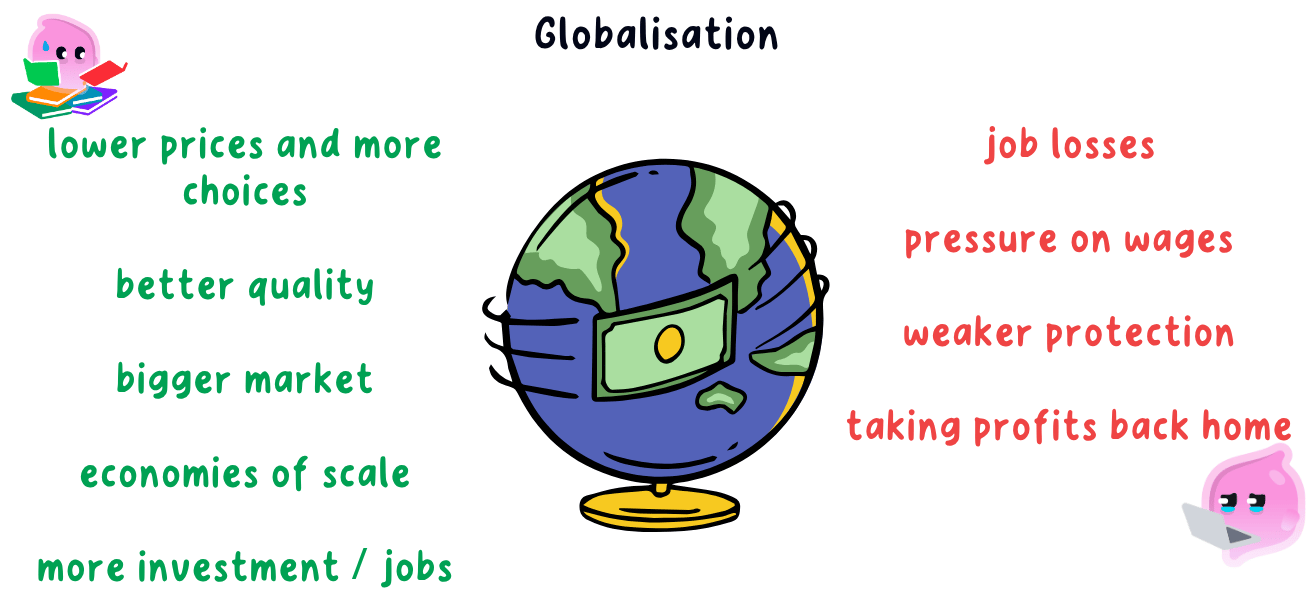
Globalisation cuts prices and widens choice for consumers
- Lower prices: goods can be made wherever costs are lowest, so shoppers in developed countries such as the UK pay less.
- Greater choice: consumers can buy products and foods from all over the world, all year round.
- Better quality: firms have to compete with rivals from many countries, which can raise quality as well as value.
- A UK supermarket such as Sainsbury's sells food, clothes and electronics sourced from dozens of countries.
- Because it buys where costs are lowest, shoppers pay less and get far more choice.
- Fruit that was once seasonal, such as grapes or berries, is now available all year round.
Producers and workers in developed countries can gain too
- Bigger markets: firms can sell to customers across the world, not just at home.
- Economies of scale: producing on a larger global scale lowers the average cost of each unit.
- Investment and jobs: a multinational choosing to build in the UK brings new jobs, wages and often new skills.
- Nissan's factory in Sunderland was built through foreign investment and employs thousands of UK workers.
- It manufactures cars for sale across the UK and beyond, showing producers and workers in a developed country gaining from a globalised market.
- The jobs, wages and supply-chain orders it creates spread through the local economy.
- In 2026 Nissan announced a wider global restructuring that cut jobs elsewhere in Europe, but the company confirmed no redundancies at Sunderland, showing how one plant's fortunes can diverge from those of a struggling parent company.
But developed-country workers can also lose out
- Job losses: production can move to countries with lower costs, so traditional industries in developed economies shrink.
- UK manufacturing and steel-making are examples of industries that have faced this kind of pressure over recent decades.
- Pressure on wages: firms can threaten to move production abroad, which can weaken the bargaining power of workers who stay.
- Not every developed-country worker gains from globalisation at the same time.
- The same global market that creates jobs at a car plant can destroy them at a steel plant.
Less developed countries can gain jobs and investment
- New jobs: multinationals building factories create paid work for people who had few other opportunities.
- Foreign investment: money, machinery and new technology flow into the local economy.
- Rising exports: growing sales abroad can lift national income and reduce poverty over time.
- Bangladesh's garment industry now employs several million workers, most of them producing clothes for export to developed-country retailers.
- Foreign investment and new export orders have been a major source of the country's economic growth over the past three decades.
Wages and conditions there can still be poor
- Low wages: workers in less developed countries are often paid far less than workers doing similar jobs in developed countries.
- Weaker protection: labour laws and enforcement can be weaker, so conditions and workers' rights are not always well protected.
- Profits leaving the country: much of the profit a multinational makes is often sent back to its home country rather than staying in the local economy.
- Never give a one-sided answer on globalisation.
- Lower prices and new jobs must be weighed against lost jobs in developed countries and low pay in less developed ones.
- Top marks come from a balanced judgement, not a list of only good or only bad points.
How far globalisation's benefits outweigh its costs
- It depends on which country you look at, because consumers and growing firms in developed countries such as the UK tend to gain quickly, while some workers in both developed and less developed countries can lose out or be paid poorly.
- It depends on whether jobs and wages in less developed countries improve over time, because a country whose export industries mature and raise pay and conditions gains far more than one stuck with permanently low wages.
- It depends on how mobile the affected workers are, because workers who can retrain or move into new industries lose less than those concentrated in a single declining industry or town.
- On balance, globalisation raises average living standards worldwide, but a strong answer names the specific producers, workers or consumers who gain and who lose, rather than treating it as simply good or bad.
- Use the three groups in the question (producers, workers, consumers) and the three settings (developed countries, less developed countries, the UK) to structure your answer, rather than writing about globalisation in general.
- Anchor a point in a real example, such as Nissan's Sunderland plant for UK gains or low pay in a garment-exporting country for the costs, rather than asserting a benefit or drawback without evidence.
- Give one benefit of globalisation for UK consumers.
- Give one benefit and one drawback for producers and workers in a developed country such as the UK.
- Give one benefit and one drawback for producers and workers in a less developed country.
- Why can the gains from globalisation be shared unevenly between different groups?
- What makes a judgement on globalisation balanced rather than one-sided?
2.4.4c Moral, ethical and sustainability considerations
UK producers trading abroad face ethical questions
- Many UK firms buy from or produce in factories overseas, in countries where wages, laws and standards can be very different from the UK's.
- This raises real moral and ethical questions about how those workers are treated and how the environment is affected.
- A firm choosing where and how to produce is also choosing what standards it is willing to accept.
Labour standards raise concerns for UK producers abroad
- Low wages: workers making goods for UK firms can be paid far less than a UK worker doing similar work.
- Unsafe conditions: factories in some countries have weaker safety laws and enforcement than the UK.
- Child labour: weak protection in some countries can allow children to work in conditions that would be illegal in the UK.
- In 2013, an eight-storey garment factory building in Bangladesh, Rana Plaza, collapsed, killing over a thousand workers who made clothes for well-known Western retailers.
- The disaster led to international pressure for retailers to sign safety agreements covering factories in their supply chains.
- It remains a stark example of why UK producers carry real ethical responsibility for conditions in their overseas supply chains.
Sustainability is also a concern for UK producers abroad
Sustainability: meeting the needs of the present generation without reducing the ability of future generations to meet their own needs.
- Transport emissions: shipping and flying goods across the world adds to carbon emissions.
- Resource use: producing more, further away, can use up raw materials and energy faster.
- Pollution: some overseas production sites have weaker environmental laws, so pollution from factories or extraction can be worse.
- Shell faced decades of criticism over pollution linked to its oil extraction in Nigeria's Niger Delta, and although it sold its onshore Nigerian operations in 2025, clean-up costs and compensation claims linked to the historic pollution continue.
- Cases like this show that environmental sustainability, not just cost, is a real consideration when a firm with UK links decides where and how to produce.
Some UK firms respond with ethical trade schemes
- Fairtrade certification: guarantees producers of goods such as cocoa, tea and bananas a minimum price and better trading terms.
- Ethical sourcing codes: some UK retailers commit to standards on pay, safety and hours for the factories in their supply chain.
- Supply-chain audits: firms or independent inspectors check that overseas suppliers are actually meeting the standards they have signed up to.
Judgement: whether a UK firm adopts higher ethical and sustainability standards often depends on how much its customers care and how much the extra cost affects its prices, since higher standards can raise costs but can also protect a firm's reputation and sales.
Weighing cost against reputation and sustainability
- A firm that ignores ethical and sustainability standards risks damage to its reputation if problems are exposed, which can cost it customers and sales.
- A firm that adopts higher standards can face higher costs, which may raise its prices or lower its profit compared with rivals that do not.
- There is no single right answer, since UK producers must weigh the cost of higher standards against the ethical, environmental and reputational risks of ignoring them.
- Give two reasons UK producers trading abroad might face low labour standards in their supply chains.
- Explain what sustainability means and why it matters for UK producers trading abroad.
- Give one example of an ethical trade scheme and explain what it tries to achieve.
- Why might a UK firm choose to adopt higher ethical standards even if they cost more?
