2.3.1a Fiscal policy and income and expenditure
Fiscal policy uses the budget to change spending
Fiscal policy: the use of government spending and taxation to influence the level of income and expenditure in the economy.
- A government's budget is not only a plan for its own finances: it is also a powerful tool for managing the whole economy.
- It is a demand-side policy, because it works by changing how much is spent in the economy.
- A government can point fiscal policy in one of two directions, known as expansionary and contractionary fiscal policy.
- Income and expenditure are two sides of the same flow, because one person's spending becomes another person's income.
- So a change in total spending also changes total income across the economy.
Expansionary policy raises spending in the economy
Expansionary fiscal policy: raising government spending or cutting taxes so that total spending in the economy rises.
- Higher government spending puts money directly into the economy, for example through the wages of public sector workers who then spend them.
- A tax cut leaves households and firms with more disposable income, so they are able to spend more.
- As spending rises, firms receive more revenue and tend to produce and hire more, which raises incomes across the economy.
- Around £190bn a year of government spending goes on the NHS, and part of that pays for new hospital building programmes, putting money directly into the economy through construction and NHS jobs.
- A cut to the basic rate of income tax would leave working households with more of their pay each month to spend.
Contractionary policy lowers spending in the economy
Contractionary fiscal policy: cutting government spending or raising taxes so that total spending in the economy falls.
- Lower government spending removes money from the economy and reduces the income of those who would have received it.
- A tax rise leaves households and firms with less disposable income, so they spend less.
- As total spending falls, firms receive less revenue and incomes across the economy tend to fall.
- Do not assume expansionary policy always means higher spending, because cutting taxes is also expansionary.
- In the same way, contractionary policy can be a tax rise, not only a spending cut.
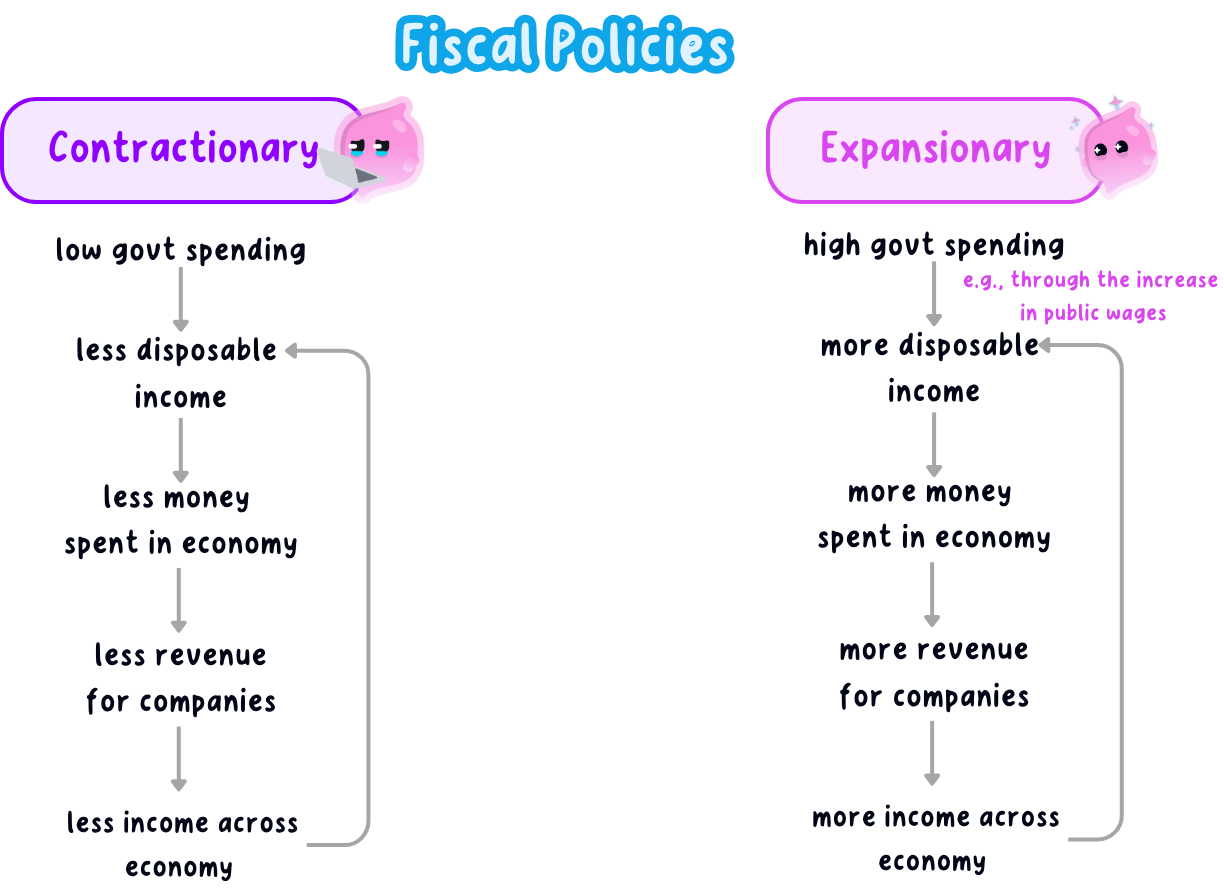
The budget change flows through to incomes
- The link runs from the budget to the flow of spending, and then from spending to incomes.
- A change in spending or taxes changes how much money households and firms have available to spend.
- Their spending becomes income for others, so the effect passes from one group to another around the economy.
- In this way, a single change in the budget can influence income and expenditure across many households and firms.
- Define fiscal policy in one sentence.
- State two ways a government could run an expansionary fiscal policy.
- State two ways a government could run a contractionary fiscal policy.
- Explain how a tax rise reduces income and expenditure in the economy.
- Explain how one household's extra spending becomes another household's income.
2.3.1b Fiscal policy and government objectives
Fiscal policy targets the government's main goals
- Governments use fiscal policy to help meet their main macroeconomic objectives.
- These usually include economic growth, full employment, stable prices and a healthy balance of payments, alongside other goals such as a fairer distribution of income.
- By choosing how much to spend and tax, a government tries to move the economy towards these goals.
- The same two tools, spending and taxation, are used for every objective.
- What changes is the direction and the target, not the tools themselves.
Higher spending or lower tax can lift growth
- To support economic growth, a government can raise spending or cut taxes so that total spending rises.
- Spending on infrastructure such as roads and broadband can also raise the economy's capacity to produce.
- As demand rises, firms often need more workers, which can lower unemployment.
- Spending on education and training can improve skills and support jobs over the longer term.
- The government's construction of the HS2 high speed rail line is a current example of infrastructure spending intended to raise the economy's capacity to produce.
- The government's roughly £89bn annual education budget, including funding for apprenticeships, aims to raise skills and support employment over time.
Higher taxes or lower spending can cool inflation
- To slow rising prices, a government can use contractionary measures such as higher taxes or lower spending.
- Reducing total spending eases the pressure on prices when demand is growing too quickly.
- With UK CPI inflation at 2.9 per cent in July 2026, above the government's 2 per cent target, contractionary fiscal policy is one tool that could in principle help ease price pressure.
- A government must judge the size of the change with care, so that it cools price rises without causing job losses.
- Do not assume more government spending is always good, because extra spending in a busy economy can push prices up.
- Fiscal policy has to fit the state of the economy rather than simply add spending every time.
Redistribution and spending both carry an opportunity cost
- Fiscal policy can make the distribution of income fairer by taxing higher earners more and spending on those with less.
- Welfare and benefit payments, the government's largest single spending area at around £314bn a year, transfer income towards lower income households.
- Every choice has an opportunity cost, because money spent on one programme cannot be used for another.
- Tax raised also has an opportunity cost for households and firms, who could have spent or invested it themselves.
- Name the four main government objectives that fiscal policy can be used to support.
- Explain how a tax cut could support growth and employment.
- Give one opportunity cost of higher government spending on welfare payments.
- Give one reason a policy that boosts growth could also add to inflation.
- Explain what is meant by an opportunity cost, using an example from this topic.
2.3.1c The government budget
The budget compares revenue with government spending
- The government budget is the plan of how much money the government expects to raise and how much it expects to spend.
- The budget position is found by taking revenue minus spending.
- The answer to that sum tells you whether the budget is balanced, in deficit or in surplus.
The budget can be balanced, in deficit or surplus
Balanced budget: government revenue is equal to government spending, so revenue minus spending comes to zero.
Budget deficit: government spending is greater than revenue, so the sum comes out negative and the government must borrow to cover the gap.
Budget surplus: government revenue is greater than spending, so the sum comes out positive and the government has money left over.
- A worked example below shows how to apply revenue minus spending and identify whether the result is a deficit or a surplus.
- In 2024 to 25, the latest confirmed UK outturn figures, government revenue was £1,148.7bn and government spending was £1,276.2bn.
Step 1: write down the revenue and the spending:
Revenue (2024 to 25)=£1,148.7bn \text{Revenue (2024 to 25)} = \pounds 1{,}148.7\text{bn} Revenue (2024 to 25)=£1,148.7bn Spending (2024 to 25)=£1,276.2bn \text{Spending (2024 to 25)} = \pounds 1{,}276.2\text{bn} Spending (2024 to 25)=£1,276.2bnStep 2: subtract spending from revenue to find the budget position:
Budget position=1,148.7−1,276.2=−£127.5bn \text{Budget position} = 1{,}148.7 - 1{,}276.2 = -\pounds 127.5\text{bn} Budget position=1,148.7−1,276.2=−£127.5bn- The answer is negative, so 2024 to 25 was a budget deficit of about £127.5bn.
Deficits add to debt, surpluses can repay it
- When there is a budget deficit, the government must borrow to cover the gap between spending and revenue.
National debt: the total amount the government owes, built up from all its past years of borrowing added together.
- Each year of borrowing adds to that debt, so a deficit today makes the debt bigger tomorrow.
- A budget surplus can be used to repay some of that debt, so the total owed falls.
- To see the scale, the OBR forecasts UK national debt at around 96 to 97 per cent of national income in 2026 to 27, built up from years of deficits.
- Do not mix up the deficit and the debt.
- The deficit is a yearly flow, the gap between revenue and spending in one year, while the debt is the stock, the total built up from all the years of borrowing added together.
How far a budget deficit matters depends on context
- It depends on the size of the deficit relative to national income, because a small, manageable deficit such as the roughly 4 per cent of GDP forecast for 2026 to 27 is easier to sustain than a deficit reaching double figures.
- It depends on what the borrowing is spent on, because deficit spending on investment such as infrastructure or education can raise future growth and future tax revenue, while borrowing to cover day-to-day costs simply adds to debt without building future capacity.
- It depends on whether the deficit is temporary or persistent, because a one-off deficit during a downturn or emergency is far less concerning than a deficit that keeps recurring year after year.
- It depends on the cost of servicing the resulting debt, because the government already spends around £105bn a year in interest on its debt, and a bigger debt pile means a bigger interest bill that crowds out spending on public services.
- On balance, a budget deficit is not automatically a problem: whether it matters depends on its size, its purpose and how long it persists, rather than the headline number alone.
- Show the calculation revenue minus spending explicitly and state whether the result is positive or negative before naming it a surplus or a deficit.
- Keep deficit and debt as separate, exact terms, since they are tested as distinct concepts: the deficit is one year's flow, the debt is the accumulated stock.
- When asked to evaluate a deficit, do not simply call it bad. Weigh what the borrowing was spent on against the size of the economy.
- Write the sum used to find the budget position.
- If revenue is £700bn and spending is £760bn, what is the budget position?
- What is the difference between a budget deficit and a budget surplus?
- Explain the difference between the deficit and the debt.
- Give one reason a budget deficit might not be a serious problem.
2.3.2a The meaning of monetary policy
Monetary policy steers the economy through money
- Alongside fiscal policy, a country's central bank has its own set of tools for managing the economy.
Monetary policy: the decisions a central bank takes to influence the cost of borrowing and the amount of money in the economy.
- Its two main levers are interest rates, the price of money, and the money supply, the quantity of money circulating in the economy.
Money supply: the total amount of money circulating in the economy.
The Monetary Policy Committee sets the base rate
- In the UK, monetary policy is run by the Bank of England, the country's central bank.
Base rate: the Bank of England's key interest rate, which commercial banks use as a benchmark for their own rates.
- The Monetary Policy Committee (MPC), the group of Bank officials and outside experts who meet regularly to set the base rate, meets eight times a year and is made up of five Bank insiders and four outside experts.
- The Bank is operationally independent, so these decisions are made separately from day to day politics, even though the government sets the inflation target it aims for.
- A common mistake is to say the government sets interest rates.
- In the UK the Bank of England's Monetary Policy Committee makes the decision, not ministers.
Bank Rate changes reach loans and savings quickly
- Commercial banks base their own rates on the base rate, so a change there feeds through the whole banking system.
- A lower base rate makes borrowing cheaper and saving less rewarding, while a higher base rate does the reverse.
- The Bank of England cut its base rate to 3.75 per cent in December 2025 and has held it there through 2026, including at its meeting on 30 July 2026.
- Exactly how a rate change alters households' and firms' decisions to borrow, spend or save is covered elsewhere; the point to hold onto here is that the change starts with the Bank of England.
- Define monetary policy in one sentence.
- Name the two main levers of monetary policy.
- Name the committee that sets the base rate in the UK, and state how many members it has.
- Describe briefly how a change in the base rate reaches the rates households pay.
2.3.2b Uses of monetary policy
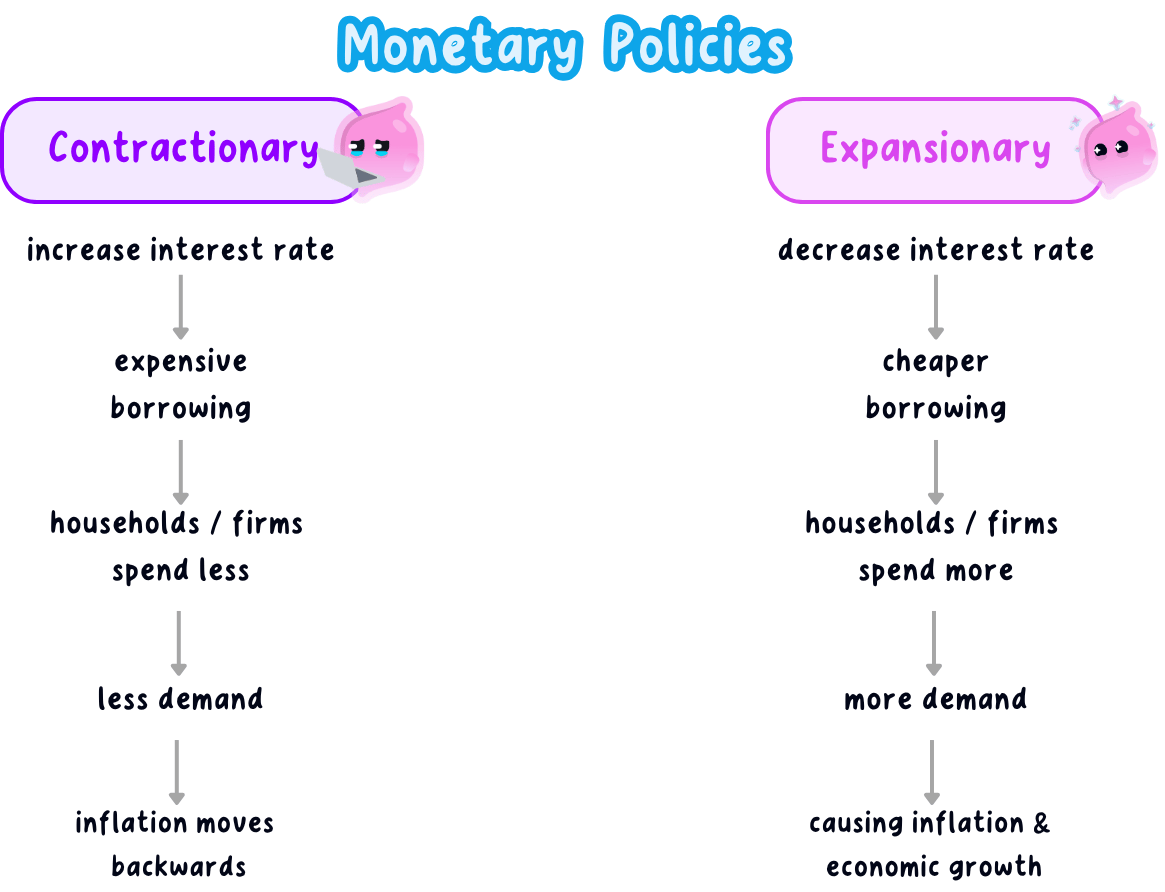
Monetary policy first targets controlling inflation
- The Bank of England's first job is to use monetary policy to control inflation, keeping it close to the government's target.
- When inflation rises above target, the Bank tends to raise the base rate.
- More expensive borrowing leads households and firms to borrow and spend less.
- Higher rewards for saving encourage people to save rather than spend.
- With weaker demand, the upward pressure on prices eases and inflation moves back towards the target.
- In July 2026, CPI inflation rose to 2.9 per cent, above the Bank of England's 2 per cent target.
- At its June 2026 meeting, the Monetary Policy Committee held the base rate at 3.75 per cent by a 7 to 2 vote, with the minority wanting a rise to 4.00 per cent because of the risk from rising energy-driven prices.
Monetary policy also supports growth and jobs
- When a central bank instead wants faster growth and more employment, it cuts the base rate.
- Cheaper borrowing encourages households to raise spending and firms to raise investment.
- Lower rewards for saving nudge people to spend rather than save, which supports demand and jobs.
- Between August 2024 and December 2025, the Bank of England cut the base rate six times in a row, from 5.25 per cent down to 3.75 per cent, partly to support growth and jobs as inflation fell.
- This shows the Bank moving the base rate down when it wants to boost demand rather than curb it.
Monetary policy can affect trade through the exchange rate
- Changing the base rate can also move the exchange rate, the value of the pound against other currencies.
- A higher rate tends to attract money into the country and raise the pound's value, while a lower rate can do the reverse.
- A stronger pound makes UK exports dearer abroad and imports cheaper at home, which can widen a trade deficit.
- The UK already runs a trade in goods deficit of around £59.5bn, 7.6 per cent of GDP, in the first quarter of 2026, so exchange rate effects on trade are a live policy concern.
- It is wrong to think a higher interest rate is good news for everyone.
- A higher rate rewards savers but makes life harder for borrowers, such as families with a mortgage, and can also hurt exporters through a stronger pound.
How far rate changes deliver objectives depends on lags
- It depends on time lags, because interest rate changes take many months to feed through the economy, so the Bank may end up acting on out of date information.
- It depends on confidence, because even a low interest rate may fail to lift spending if households and firms feel too uncertain to borrow.
- It depends on global factors, because a change in the base rate cannot offset a shock such as a global rise in energy prices.
- It depends on who is affected, because a rate rise rewards savers but makes life harder for mortgaged borrowers, so the impact is uneven across groups.
- On balance, higher or lower interest rates can move the economy in the intended direction, but time lags, confidence and events elsewhere in the world all limit how reliably and how quickly they deliver the objective.
- How does raising the base rate help control inflation?
- How does cutting the base rate support growth and jobs?
- Explain how a change in the base rate can affect the exchange rate.
- Give one reason why an interest rate change might not fully achieve its objective.
- Reach a judgement: how reliable is monetary policy at delivering the government's objectives?
2.3.3a Supply-side policies and their trade-offs
Supply-side policy aims to raise the economy's long-run capacity
Supply-side policy: a set of government measures designed to raise an economy's productive capacity and efficiency over the long run.
- The aim is to raise productive capacity, the maximum output the economy can produce when resources are used fully and efficiently, not to raise spending today.
- This differs from demand-side policy, which changes total spending in the economy to affect output and jobs in the short run.
- Because it changes the economy's underlying structure, supply-side policy is judged over years rather than weeks or months.
- Supply-side policy does not give the economy an instant boost, since most measures take years to have an effect.
- It is not a substitute for monetary or fiscal policy when a sudden downturn needs a quick response.
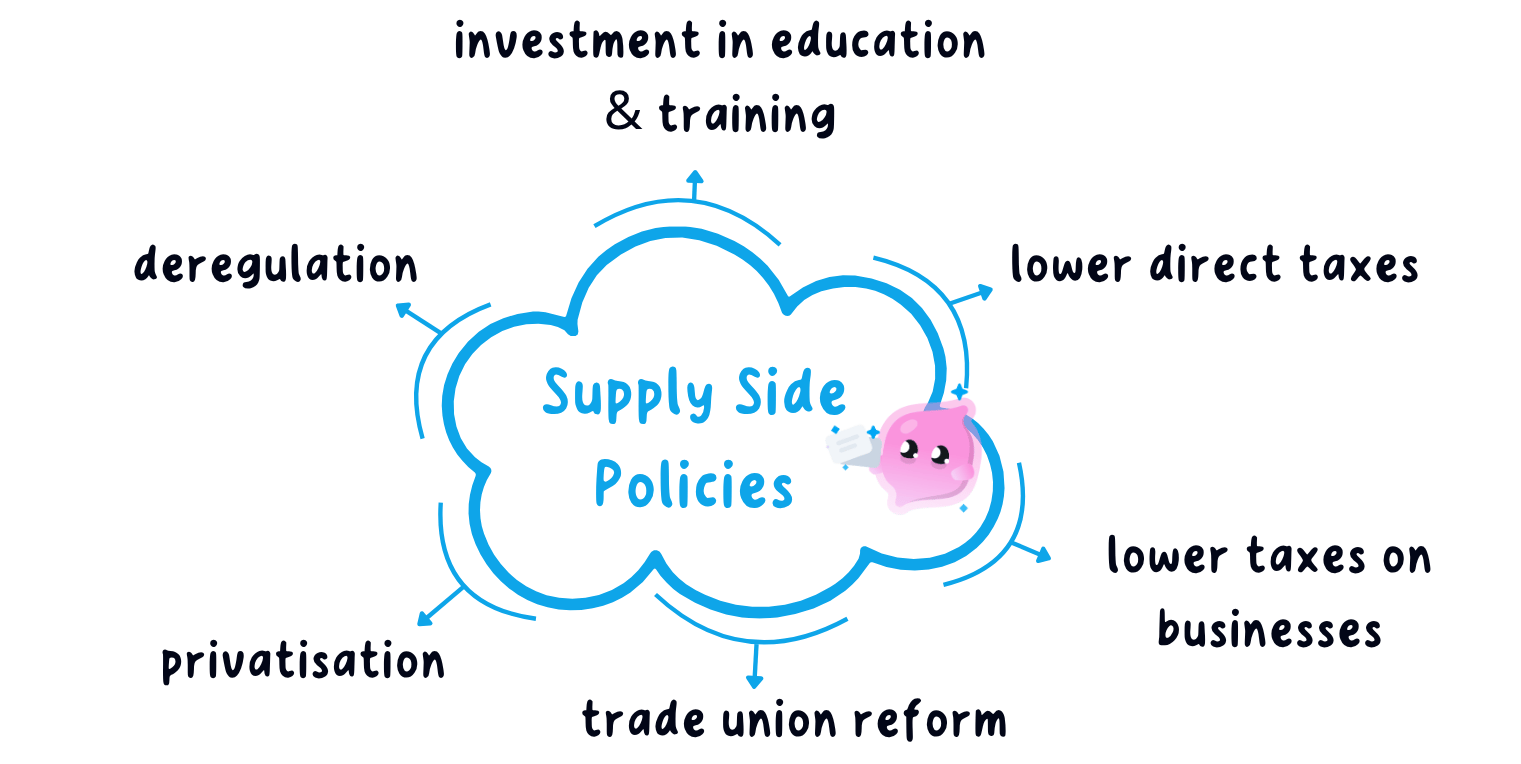
Policies target different parts of the supply side
Education and training raises skills to lift productivity
- Education and training: government spending to improve workers' skills and knowledge, for example funding apprenticeships, T-levels and adult retraining.
- Advantage: better-skilled workers produce more per hour, which raises productivity and can lower structural unemployment as skills match the jobs on offer more closely.
- Disadvantage: training is expensive and funded from tax revenue, and it can take years before newly skilled workers enter the workforce.
- Large UK employers fund apprenticeships through the Growth and Skills Levy, formerly called the apprenticeship levy, which was renamed in April 2026 but still charges 0.5 per cent of an employer's pay bill above £3m.
- T-level courses, introduced from 2020, combine classroom study with an industry placement to build technical skills.
Lower direct taxes aim to strengthen incentives to work
- Lower direct taxes: cutting taxes paid directly on income, such as income tax or National Insurance, so workers keep more of what they earn.
- Advantage: a bigger take-home wage can encourage more people to work, to work longer hours, or to delay retirement.
- Disadvantage: cutting direct taxes reduces the tax revenue the government has available for public services.
- A worked example shows the effect using the 2026/27 income tax personal allowance of £12,570 and the 20 per cent basic rate.
Step 1: find the taxable income of a worker earning £20,570 a year:
£20,570−£12,570=£8,000 \pounds20{,}570 - \pounds12{,}570 = \pounds8{,}000 £20,570−£12,570=£8,000Step 2: apply the 20 per cent basic rate to the taxable income:
£8,000×0.20=£1,600 tax \pounds8{,}000 \times 0.20 = \pounds1{,}600 \text{ tax} £8,000×0.20=£1,600 taxStep 3: raise the tax-free personal allowance by £1,000, to £13,570, and recompute the tax:
£20,570−£13,570=£7,000 \pounds20{,}570 - \pounds13{,}570 = \pounds7{,}000 £20,570−£13,570=£7,000 £7,000×0.20=£1,400 tax \pounds7{,}000 \times 0.20 = \pounds1{,}400 \text{ tax} £7,000×0.20=£1,400 taxStep 4: compare the tax paid before and after the tax cut:
£1,600−£1,400=£200 \pounds1{,}600 - \pounds1{,}400 = \pounds200 £1,600−£1,400=£200- For this worker, the £1,000 rise in the personal allowance is worth an extra £200 a year in take-home pay, the same £200 the government gives up in revenue.
Lower taxes on business profits aim to boost investment
- Lower taxes on business profits: cutting corporation tax, the tax UK companies pay on their profits.
- In the 2026/27 tax year the main rate is 25 per cent on profits over £250,000, while a small profits rate of 19 per cent applies to profits of £50,000 or less, with marginal relief tapering the rate in between.
- Advantage: firms keep more of their profit, which can be reinvested in new machinery, technology or premises, raising the capital available to each worker.
- Disadvantage: the tax cut costs the government revenue, and there is no guarantee firms will actually invest the extra profit rather than pay it out to shareholders.
Trade union reform aims to flex the labour market
- Trade union reform: laws that limit the power of trade unions, for example by requiring a minimum turnout before a strike can go ahead.
- The Trade Union Act 2016 requires at least 50 per cent of eligible union members to vote in a strike ballot before the strike is legal, and this threshold was still in force in 2026.
- Advantage: fewer disruptive strikes can lower costs for firms and encourage investment and employment.
- Disadvantage: weaker unions reduce workers' bargaining power, which can hold down wages and weaken protection against poor working conditions.
Privatisation and deregulation expose firms to competition
Privatisation: transferring a firm or service from government ownership into the private sector.
Deregulation: removing or loosening government rules that restrict how a market operates.
- Advantage: a privatised firm faces competition and the profit motive, which can push it to cut costs and become more efficient, while easing the burden on government finances.
- Disadvantage: a privatised firm can become a private monopoly and raise prices if real competition does not follow.
- Advantage: fewer rules make it cheaper and easier for new firms to enter a market, increasing competition and choice.
- Disadvantage: weaker rules can allow negative externalities, such as pollution or unsafe working conditions, to go unchecked.
- The privatisation of Royal Mail in 2013 sold the UK's postal service into private ownership.
- Bus services outside London were deregulated in 1986, opening routes to competition between private operators.
How far supply-side policies succeed depends on design
- It depends on how well targeted the policy is, because training aimed at a genuine skills gap raises productivity far more than a scheme few workers use.
- It depends on how the policy is funded, because money spent on tax cuts or training has an opportunity cost, since it could have been spent on the NHS, education or reducing debt instead.
- It depends on whether firms and workers actually respond, because a tax cut for business only raises investment if firms choose to spend the extra profit rather than save it.
- It depends on how much time is allowed, because most measures take years to show results, so a policy judged too soon can look as if it has failed.
- Overall, supply-side policies can raise the economy's long-run potential, but their success is uncertain and depends heavily on design, funding and patience.
- Name a specific measure, such as education and training or trade union reform, rather than writing that "the government helped the economy".
- Give one clear advantage and one clear disadvantage for the named measure, stating who gains and who loses.
- Do not evaluate supply-side policy as if it works instantly, since its effects build up over years.
- Define supply-side policy in one sentence.
- Name the five supply-side policies specified by AQA.
- Give one advantage and one disadvantage of trade union reform.
- Explain why lowering corporation tax does not guarantee higher business investment.
- Why is supply-side policy poorly suited to fixing a sudden recession?
2.3.3b Using supply-side policies
Higher productive capacity supports faster economic growth
- By raising productive capacity, supply-side policy allows total output to rise over the long run, supporting the government's objective of economic growth.
- As capacity grows, the economy can expand for longer without quickly running short of resources.
- Investment in education and training adds to the economy's productive capacity by raising the skills of the workforce.
Skills and flexibility policies can lower structural unemployment
- Education and training that better matches workers' skills to the jobs on offer can reduce structural unemployment, where people are jobless because their skills do not fit the available work.
- Trade union reform and deregulation can make it easier for firms to take on staff, since more flexible pay and conditions let employers adjust rather than avoid hiring.
- A more productive and flexible workforce makes it easier for firms to expand and take on more employees.
- A country invests heavily in retraining unemployed workers.
- Those workers gain the skills that employers are actually looking for.
- Over time, more of them find lasting jobs and total output rises.
Higher productivity helps keep inflation low
- When supply-side policy raises productivity, firms can produce each unit of output at a lower cost, which helps keep inflation low.
- A greater ability to produce lets output grow to meet rising demand without prices being pushed up as quickly.
Lower costs can improve competitiveness and exports
- Lower costs and higher quality can make UK goods more attractive at home and abroad, improving the country's international competitiveness.
- More competitive firms can win overseas customers, raising exports and helping the government's balance of payments objective.
- Lower taxes on business profits can fund the investment in machinery and technology that makes exporting firms more competitive.
- Nissan's car plant in Sunderland is one of the most productive car factories in Europe.
- Its efficiency helps a UK-built car compete on cost against vehicles made overseas.
Supply-side policy meets objectives only slowly
- Many measures are expensive, and spending on training or tax cuts has an opportunity cost, since the money could be used elsewhere.
- Benefits usually take years to appear, so supply-side policy cannot quickly fix a sudden recession or a sharp rise in unemployment.
- Success is uncertain: a tax cut for business does not guarantee that firms will actually invest, and training does not guarantee workers gain the right skills.
- Because effects are gradual, supply-side policy is normally used alongside monetary and fiscal policy rather than on its own.
- Supply-side policy works on the economy's long-run capacity, not on short-run demand.
- It cannot quickly fix a recession or a sudden rise in unemployment on its own.
How far supply-side policy meets objectives depends on timing
- It depends on the state of the economy, because supply-side measures are of little use in a sudden downturn that needs an immediate response.
- It depends on how well the measure matches the objective, because training helps most with structural unemployment but does little to directly control inflation.
- It depends on how long the policy is given, because judging a slow-acting measure after only a year or two can wrongly make it look as if it has failed.
- Overall, supply-side policy can move the economy closer to its objectives over time, but it works too slowly to be relied on alone.
- Explain how supply-side policy can support economic growth.
- How can supply-side measures reduce structural unemployment?
- Why can higher productivity help keep inflation low?
- Give one reason supply-side policy cannot quickly fix a sudden recession.
- Explain why judging a supply-side measure too soon can be misleading.
2.3.4 Policies to correct positive and negative externalities
Government policy applies existing tools to externalities
- Positive and negative externalities are defined in 1.6.2a and 1.6.2b, and general methods of government intervention are covered in 1.6.1b; this article applies those methods to correcting externalities, whether they arise from production or consumption.
Internalising an externality: making a producer or consumer bear the full social cost or benefit of their choice, so the price they face reflects the effect on third parties.
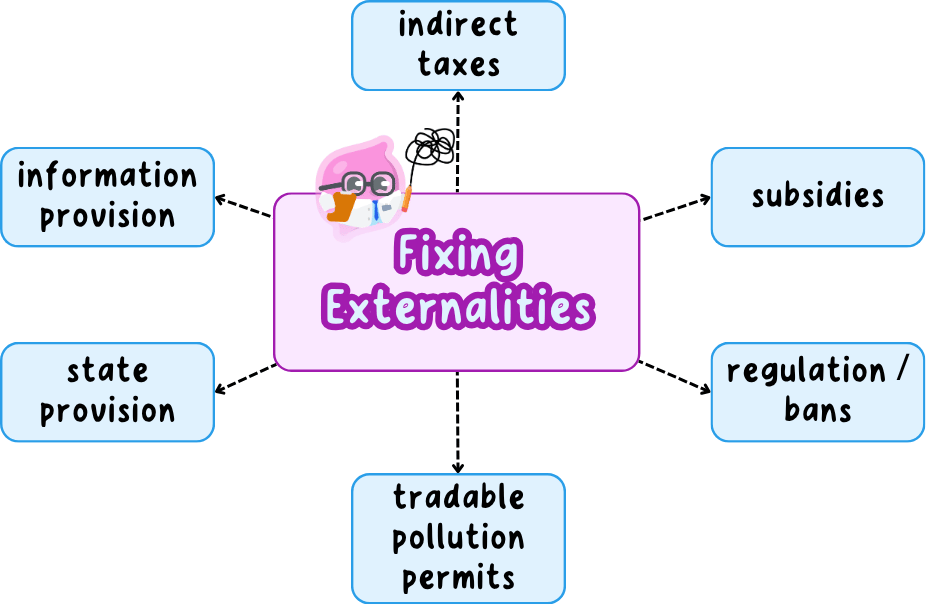
Taxing a good changes its price and quantity
- A tax on a good with a negative externality raises its price by shifting the supply curve left, cutting the quantity bought and sold.
- Because the tax makes the harmful activity more expensive, less of it takes place once the price includes some of the external cost.
- How direct and indirect taxes differ is covered in 2.1.2b; the taxes used against externalities are indirect, added to the price of the good itself.
- The UK's Plastic Packaging Tax, introduced in 2022, charges £228.82 per tonne from April 2026 on plastic packaging manufactured in or imported into the UK that contains less than 30 per cent recycled plastic, giving producers a reason to use more recycled material.
- London's Ultra Low Emission Zone charges older, more polluting vehicles a daily fee to enter the city, giving drivers a direct financial reason to choose cleaner vehicles.
Subsidies make beneficial goods cheaper to encourage them
- A subsidy on a good with a positive externality lowers its price by shifting the supply curve right, raising the quantity bought and sold.
- Because the lower price makes the beneficial activity cheaper, more of it takes place than the market alone would provide.
- The UK's Contracts for Difference scheme subsidises renewable electricity generation such as offshore wind, encouraging cleaner production; the Boiler Upgrade Scheme pays households a £7,500 grant towards a heat pump, rising to £9,000 for homes replacing an oil or LPG boiler, while separate grants towards insulating homes lower the cost of a more energy-efficient choice.
- A subsidy is best thought of as a negative tax: money paid out to lower a price, rather than money taken in to raise one.
- A subsidy is a payment to encourage an activity, not a type of tax.
- A subsidy is money paid out to lower a price; a tax is money taken in to raise one.
- Never describe a subsidy as a tax in the exam.
Regulation and bans limit harmful activities directly
- Regulation sets rules or limits on an activity with a negative externality, while a ban stops the activity outright; both work directly, rather than through price.
- Smoking in enclosed public places has been banned across the UK since 2007, protecting others from second-hand smoke.
- England banned the supply of single-use plastic plates and cutlery in October 2023 to cut plastic pollution.
Tradable permits cap total production pollution
- Tradable pollution permits set a total limit on emissions and let firms buy or sell permits between themselves.
- A firm that cuts its emissions can sell spare permits, while a firm that pollutes more must buy extra ones, so total emissions stay capped.
- The UK Emissions Trading Scheme caps emissions from heavy industry and power stations and lets firms trade permits.
- A firm facing a shortage of permits faces an extra cost that encourages it to cut emissions or invest in cleaner technology.
State provision and information change behaviour without price
- State provision of a good with a positive externality, such as state education or NHS healthcare, raises consumption above what the market alone would supply.
- Information provision closes the information gap behind many externalities by giving people facts to make better decisions.
- Campaigns such as anti-smoking adverts and healthy-eating guidance aim to cut demand for goods with negative externalities, while labels such as calorie counts help consumers weigh the true costs and benefits.
- Better information can also raise demand for goods with positive externalities, such as vaccination.
- Read whether the command word is explain or evaluate, since evaluate expects you to weigh the tools against each other and reach a judgement rather than just describe them.
- State whether the externality is in production or consumption before choosing a tool, since a tax on a producer is not the same as a ban on a consumer's purchase.
- Avoid the common trap of calling a subsidy a tax, or listing tools without saying how each one changes the price or the activity.
- Name four policies a government can use to correct externalities.
- Explain how an indirect tax changes the price and quantity of a good with a negative externality.
- State the difference between a subsidy and a tax.
- How do tradable pollution permits limit total emissions?
- Give one example of a policy that corrects a positive externality in consumption.
