Question 14
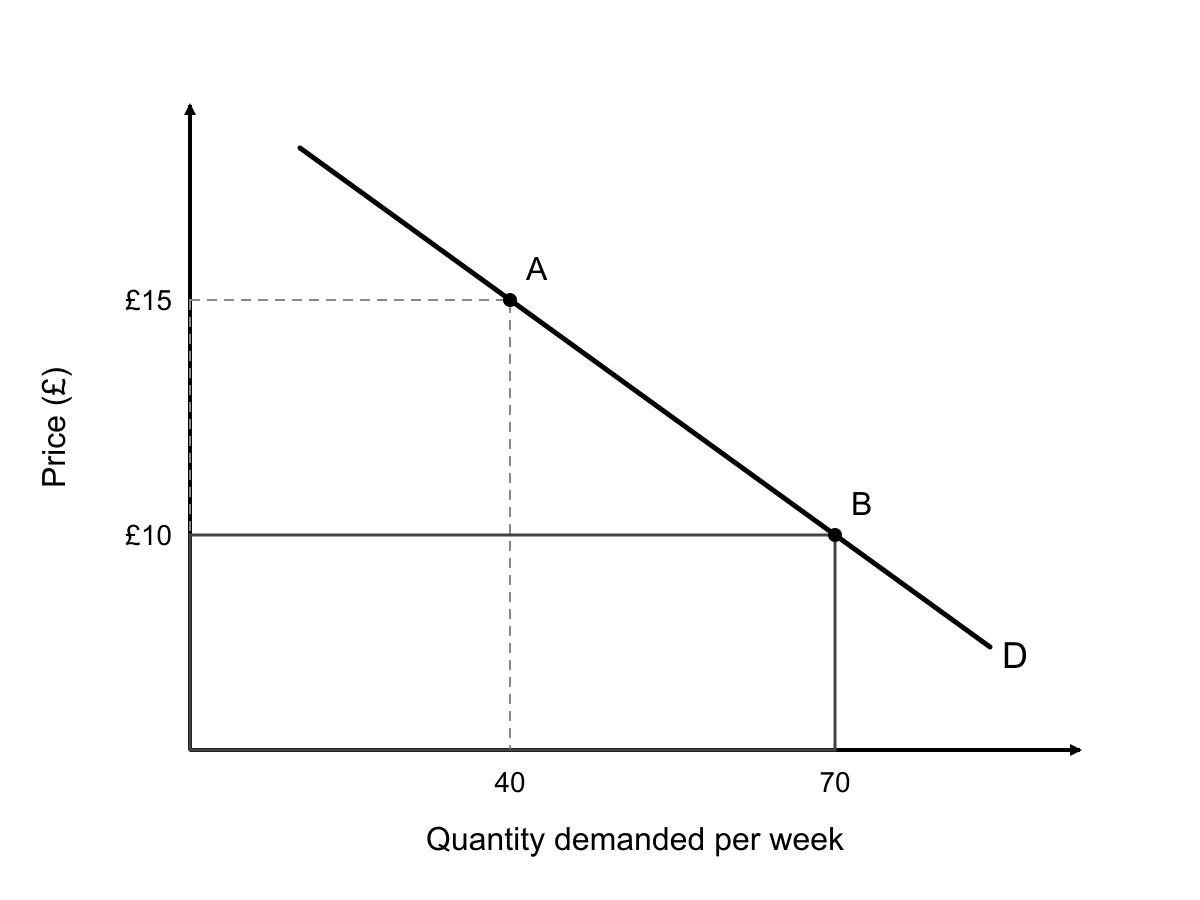 Price falls from £15 at A to £10 at B, while weekly quantity demanded rises from 40 to 70. Which conclusion is correct?
Demand is price elastic and total revenue falls from £700 to £600
Demand is price elastic and total revenue rises from £600 to £700
Demand is price inelastic and total revenue rises from £400 to £1,050
Demand is unitary price elastic and total revenue remains £600
1.3 How prices are determined Questions
236 exam-style questions on AQA GCSE Economics 1.3 How prices are determined, covering 1.3.1a Demand and the factors that influence it, 1.3.1b The demand curve, 1.3.2a Supply and the factors that influence it, 1.3.2b The supply curve, 1.3.3a Determining equilibrium price, 1.3.3b Applying diagrams and showing revenue, 1.3.4a Complements and substitutes, 1.3.4b Effects of changes on related markets, 1.3.5a Price elasticity of demand, 1.3.5b Factors affecting price elasticity of demand, 1.3.5c Measuring PED and its implications, 1.3.6a Price elasticity of supply, 1.3.6b Factors affecting price elasticity of supply, and 1.3.6c Measuring PES and its implications. Each one has a worked solution and a mark scheme showing where the marks go.