Barter needs a double coincidence of wants
Definition
Barter: the direct swap of one good or service for another without using money.
Double coincidence of wants: the situation where each trader must want exactly what the other person is offering.
- Without money, people must barter, trading goods or services directly for other goods or services.
- A swap only works if there is a double coincidence of wants, so finding a match wastes time and many useful trades never happen.
- Barter has no common measure of value, so working out how many eggs a haircut is worth is difficult.
- Goods used in barter can be hard to store and divide, so a farmer cannot easily save a cow or spend half of it.
Example
- Imagine you own a goat but want a haircut from the barber.
- You can only trade if the barber happens to want a goat that day.
- Money removes this problem because everyone accepts it in exchange.
Money performs four separate functions
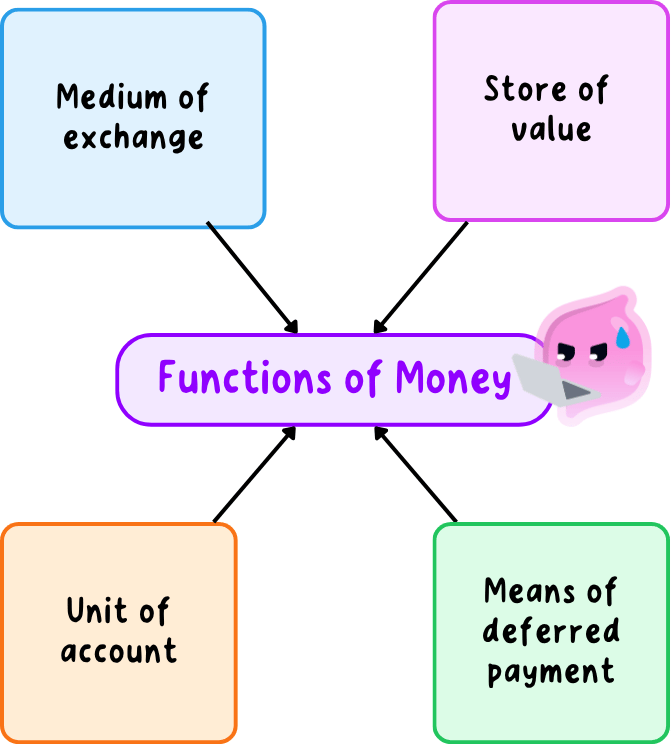
- Medium of exchange: money is accepted by sellers in return for goods and services, so it removes the need for a double coincidence of wants.
- Store of value: money holds its worth over time, so people can save now and spend later.
- Unit of account: money gives a common measure of value, so the price of every good can be compared in pounds and pence.
- Means of deferred payment: money lets people agree to pay in the future, so borrowing, lending and paying in instalments become possible.
Example
- Priya is paid £1,800 a month into her Nationwide current account.
- She uses the unit of account to compare a £1.70 Greggs sausage roll with a £30 supermarket shop, and the medium of exchange to pay for both by contactless card at Tesco.
- She leaves some pay in a savings account as a store of value, and repays a Very.co.uk credit agreement in fixed monthly amounts using money as a means of deferred payment.
Each function solves a problem that barter cannot
- The medium of exchange function ends the search for a double coincidence of wants.
- The unit of account function gives the single measure of value that barter lacks.
- The store of value function lets people hold wealth over time instead of holding goods that may spoil.
- The means of deferred payment function makes credit and future contracts reliable.
Common Mistake
- Do not stop at medium of exchange when asked for the functions of money.
- Marks are lost by naming one function instead of all four.
- Do not confuse the unit of account, which measures value, with the medium of exchange, which makes the swap.
Money makes exchange more efficient
- Because sellers accept money, trade is quick and buyers no longer need to find a matching swap.
- This lower cost of trading encourages specialisation, where people focus on one job and buy everything else with the money they earn.
- Specialisation raises output and living standards, so an economy that uses money can produce far more than one relying on barter.
Exam technique
- Check the command word first, as state or name only asks you to list the functions while explain asks you to develop each point.
- Structure an explain answer by naming a function and then showing the exact barter problem it removes.
- A common trap is describing what money is in general instead of naming the four separate functions the question asks for.
Self review
- What is meant by the double coincidence of wants?
- Name the four functions of money.
- Which function lets a saver hold wealth for the future?
- Explain one reason why money makes trade more efficient than barter.