Fiscal policy uses the budget to change spending
Definition
Fiscal policy: the use of government spending and taxation to influence the level of income and expenditure in the economy.
- A government's budget is not only a plan for its own finances: it is also a powerful tool for managing the whole economy.
- It is a demand-side policy, because it works by changing how much is spent in the economy.
- A government can point fiscal policy in one of two directions, known as expansionary and contractionary fiscal policy.
Note
- Income and expenditure are two sides of the same flow, because one person's spending becomes another person's income.
- So a change in total spending also changes total income across the economy.
Expansionary policy raises spending in the economy
Definition
Expansionary fiscal policy: raising government spending or cutting taxes so that total spending in the economy rises.
- Higher government spending puts money directly into the economy, for example through the wages of public sector workers who then spend them.
- A tax cut leaves households and firms with more disposable income, so they are able to spend more.
- As spending rises, firms receive more revenue and tend to produce and hire more, which raises incomes across the economy.
Example
- Around £190bn a year of government spending goes on the NHS, and part of that pays for new hospital building programmes, putting money directly into the economy through construction and NHS jobs.
- A cut to the basic rate of income tax would leave working households with more of their pay each month to spend.
Contractionary policy lowers spending in the economy
Definition
Contractionary fiscal policy: cutting government spending or raising taxes so that total spending in the economy falls.
- Lower government spending removes money from the economy and reduces the income of those who would have received it.
- A tax rise leaves households and firms with less disposable income, so they spend less.
- As total spending falls, firms receive less revenue and incomes across the economy tend to fall.
Common Mistake
- Do not assume expansionary policy always means higher spending, because cutting taxes is also expansionary.
- In the same way, contractionary policy can be a tax rise, not only a spending cut.
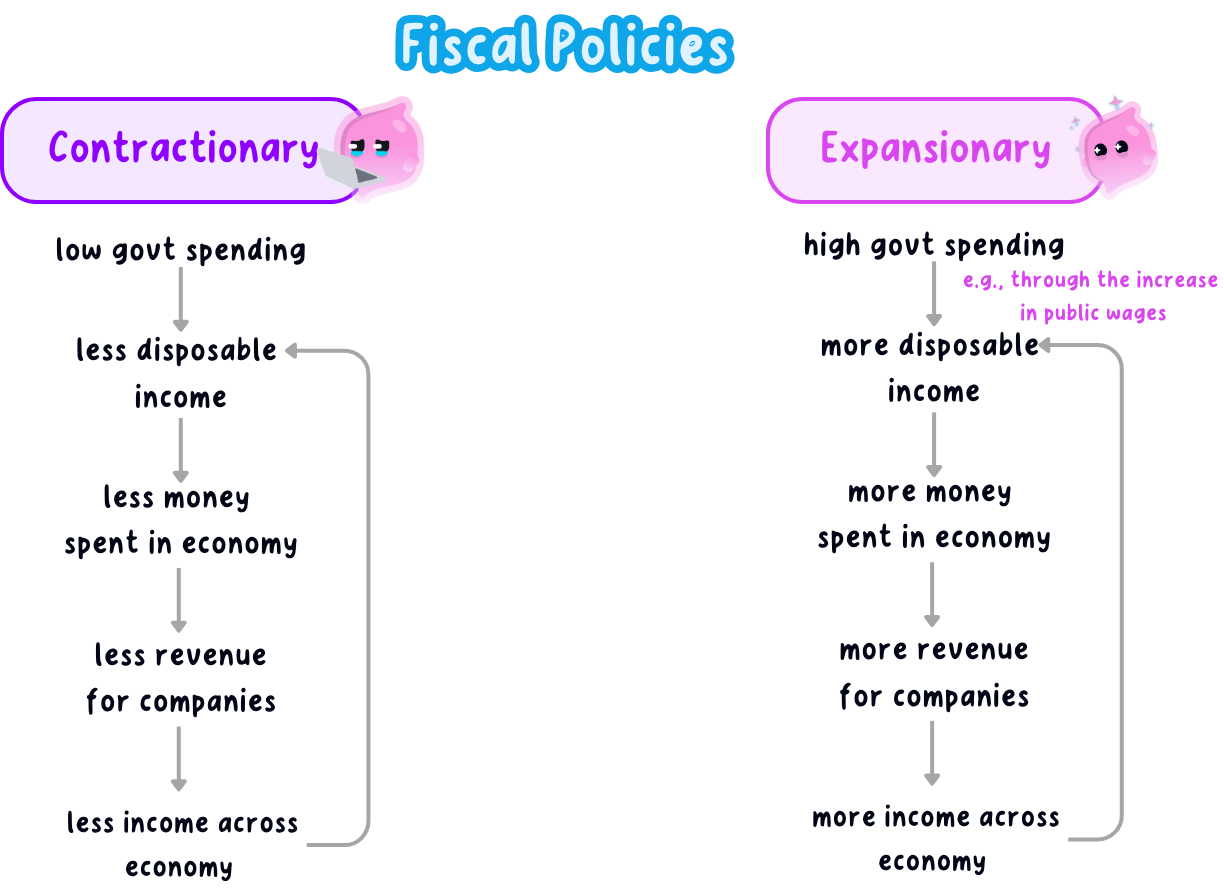
The budget change flows through to incomes
- The link runs from the budget to the flow of spending, and then from spending to incomes.
- A change in spending or taxes changes how much money households and firms have available to spend.
- Their spending becomes income for others, so the effect passes from one group to another around the economy.
- In this way, a single change in the budget can influence income and expenditure across many households and firms.
Self review
- Define fiscal policy in one sentence.
- State two ways a government could run an expansionary fiscal policy.
- State two ways a government could run a contractionary fiscal policy.
- Explain how a tax rise reduces income and expenditure in the economy.
- Explain how one household's extra spending becomes another household's income.