1.1.1a Needs and wants
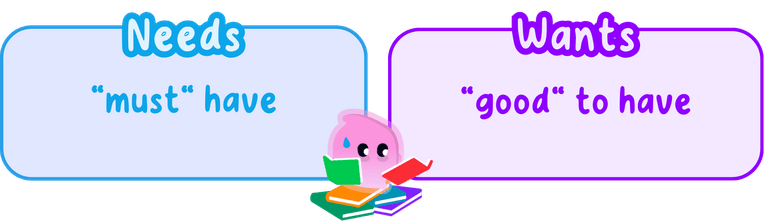
A need is essential, a want is not
Need: a good or service that is essential for survival, such as food, clean water, shelter, warmth and basic clothing.
Want: a desire for a good or service that is not essential for survival, such as a holiday, a games console or a Greggs sausage roll.
- Everyone shares the same short list of needs, but wants vary with taste, income and advertising.
- One need can be met in many ways, and the choice between them is a want: you need to eat, but you want a takeaway rather than plain rice.
- When money is tight, households cut wants before needs, because survival depends on needs.
- The 2022 to 2023 cost-of-living crisis pushed Ofgem's energy price cap sharply higher.
- UK households kept heating their homes, a need, while cutting streaming subscriptions and takeaways, both wants.
- A student with £5 faces the same choice: plain pasta meets the need to eat, a meal deal adds taste and convenience.
- When budgets tighten, wants are always cut first.
Human wants are effectively unlimited
- Human wants are effectively unlimited, because satisfying one want creates the next.
- Buying a phone soon creates wants for a case, apps and the next model.
- Higher incomes expand wants rather than use them up, so even the rich cannot satisfy them all.
- Needs behave differently, because the list stays short however rich a person becomes.
- Calling something a need does not make it one. Test whether survival depends on it.
- "I need the new iPhone" describes a strong want, not a need.
Wants change as society gets richer
- Wants are not fixed, because technology, fashion and living standards keep changing.
- Nobody wanted a smartphone in 1990 because it did not exist, yet today it is one of the most common wants.
- As a country grows richer, yesterday's luxuries such as foreign holidays and fast broadband become everyday wants.
- Needs shift too, but far more slowly: an internet connection is now close to essential for schoolwork and job applications.
- Because wants keep growing, the pressure they put on limited resources never goes away.
- Define by contrast: a need is essential for survival, a want is not, then give one example of each.
- For "why are wants unlimited", show the chain: one want satisfied creates the next.
- To show wants changing, pair a then and a now, such as broadband, not a general claim.
- What is the difference between a need and a want?
- Give one example of a need and one of a want.
- Why are human wants described as unlimited?
- Give one reason wants change over time.
- Why do households cut wants before needs when money is tight?
1.1.1b The central purpose of economic activity
Economic activity exists to satisfy needs and wants
Economic activity: the production, exchange and consumption of goods and services.
- Its central purpose is to produce the goods and services that satisfy people's needs and wants.
- Production turns scarce resources into useful output.
- Exchange moves that output to the people who want it, usually by buying and selling.
- Consumption completes the process, because a good only satisfies a want once somebody uses it.
- Warburtons buys flour, energy and labour for its bakeries.
- It turns them into bread, sells it through shops, and a household eats it.
- Only at that last step is the need to eat actually satisfied.
- Every other firm does the same job for some other need or want.
Profit is a motive, not the purpose
- Firms such as Warburtons produce for profit, and the chance of profit tells them what is worth making.
- Profit is how production gets organised, not why an economy produces at all.
- Do not answer that economic activity exists to make money.
- Money is a means. The purpose is producing goods and services that satisfy needs and wants.
Scarcity means some wants go unsatisfied
- Resources are scarce and wants are unlimited, so no economy can satisfy every want at once.
- Producing to meet wants therefore always means choosing what to make, how to make it and who receives it.
- Answering those three questions well is what makes scarce resources go furthest, and the next topic takes each in turn.
- What is the central purpose of economic activity?
- What are the three parts of economic activity?
- Why does a good only satisfy a want at the consumption stage?
- Why is profit not the same as the purpose of economic activity?
- Why can no economy satisfy every want?
1.1.1c Key economic decisions
Scarcity forces every economy to make choices
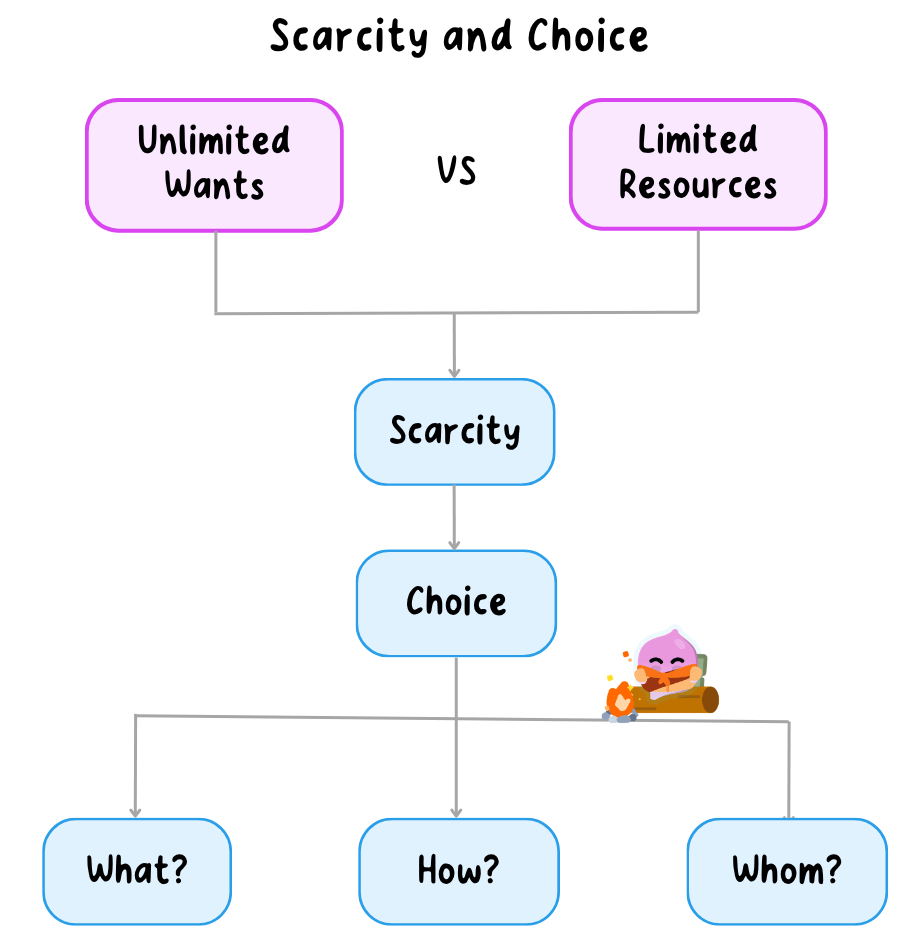
Scarcity: unlimited human wants set against limited resources, which forces every society to choose.
- No economy can produce everything people want, so it must choose how to use its limited factors of production.
- Those choices come down to three basic questions of resource allocation that no economy can avoid.
- A school canteen works to a fixed budget.
- It picks which dishes to cook, whether to use ready meals or cook from scratch, and who gets served first.
- Every economy faces those same three decisions, just on a far bigger scale.
Three questions decide how resources are used
- What to produce: which goods and services to make and in what quantities, since making more of one thing means making less of another.
- How to produce: which method to use, such as more labour or more machinery.
- For whom to produce: how the output is shared out among different people and groups.
- "How to produce" is the method, labour versus machines, not which goods to make.
- "For whom" is who receives the output, not who pays for the raw materials.
Cadbury answers all three questions
- What to produce: whether to make more Dairy Milk bars or expand its range of protein bars.
- How to produce: whether to automate more of its Bournville factory or employ more staff on the line.
- For whom to produce: whether output goes to UK supermarkets or is exported to shops abroad.
- Every producer, and every economy as a whole, answers these same three questions on a different scale.
- Why does scarcity force every economy to make choices?
- What are the three basic allocation questions?
- What does the "how to produce" question actually decide?
- What does the "for whom" question actually decide?
- Give a real example of a UK producer making one of the three decisions.
1.1.1d The main economic groups
Three groups drive all economic activity
Consumers: the people who buy and use goods and services.
Producers: the firms and individuals who make goods and services.
Government: the body that raises taxes, provides public services and sets the rules consumers and producers follow.
- Every economic decision in the UK is made by one of these three groups.
- The same person can belong to more than one group, since a plumber is a producer at work and a consumer in the supermarket.
- One loaf of bread involves all three groups.
- Greggs bakes and sells it, a shopper buys and eats it, and the government taxes the sale and sets the food safety rules.
- Each group touches the same loaf for a different reason.
Each group pursues a different aim
- Consumers aim for the most satisfaction they can get from a limited income, which is why they compare prices.
- Producers aim to make a profit, which is why they supply the goods consumers will pay most for.
- The government aims to serve society as a whole, which is why it funds services such as the NHS that a profit-seeking firm would not provide to everyone.
- These aims pull against each other, since the price rise that boosts a producer's profit leaves consumers with less satisfaction from the same income.
- The government is not just another firm. Its aim is society's wellbeing, not profit.
- Producers are not only big companies. A market stall or a self-employed plumber is a producer too.
The three groups depend on one another
- The three groups are interdependent, meaning each relies on the others to play its part.
- Consumers rely on producers for the goods and services they buy.
- Producers rely on consumers to buy what they make, so if buying stops, producing stops.
Government links the other two
- The government relies on both groups for tax revenue, such as VAT and income tax, to fund its spending.
- Producers rely on the government for regulation, for taxes or subsidies on their output, and for infrastructure such as roads.
- Consumers rely on the government for public services such as the NHS and state schools.
- Because the groups interact constantly, a decision by one affects the other two.
- Name the three main economic groups.
- What does each group mainly aim to achieve?
- What does it mean that the groups are interdependent?
- Give one way the government interacts with producers.
- Give one way the government interacts with consumers.
1.1.2a The nature of an economic resource
Economic resources are scarce inputs
Economic resource: a scarce input used to produce goods and services, also known as a factor of production.
- It is called a resource because an economy can draw on it, and a factor of production because it is combined with others to create output.
- A resource is wanted for what it can make, so a bakery oven matters because of the bread it produces, not as an object.
- Firms combine these inputs to create output, the goods and services people buy.
- Greggs turns flour, its ovens and its bakery staff into the pasties and sandwiches it sells.
- Every one of those inputs is an economic resource.
Scarcity is what makes it economic
- Economic resources are scarce, meaning the quantity available is limited while the wants they could satisfy are unlimited.
- Scarcity gives a resource alternative uses, so a field can grow wheat or carry houses, but not both at once.
- Using it one way therefore means giving up what it could have produced instead, which creates an opportunity cost.
- A truly unlimited input would not be an economic resource, because using it would cost nothing and deny nobody.
- An economic resource is not just money or raw materials.
- It is any input used in production, including people's work and the machines they use.
Resources are grouped into four categories
- Economies use a huge variety of inputs, so economists sort them into a few categories to keep analysis manageable.
- Those categories are the four factors of production, set out with the reward each one earns in the next article.
- What is an economic resource?
- What other name do economists give it?
- Why are economic resources described as scarce?
- Why does using a scarce resource create an opportunity cost?
- Why would a truly unlimited input not count as an economic resource?
1.1.2b The four factors of production
Land, labour, capital and enterprise make output
Land: all the natural resources used in production, such as farmland, forests, minerals, rivers and the sea.
Labour: the physical and mental human effort that people put into producing goods and services.
Capital: the man-made goods used to produce other goods and services, such as machinery, tools, vehicles and buildings.
Enterprise: the willingness of an entrepreneur to take risks and organise the other three factors into production.
- Every business uses all four at once, so the skill is placing each named input in the right category.
- Nobody produced land, and its supply is close to fixed, which is why a shop unit on Oxford Street costs far more than one in a market town.
- What a firm gets from labour depends on the education, training and experience of its workers, not just the hours they work.
- A firm builds up its capital through investment, giving up output today to buy equipment that raises output in future years.
- The entrepreneur who supplies enterprise carries the risk, because a business can fail and leave its owner with nothing.
- That risk is why enterprise is a separate factor rather than another kind of labour.
- At a Greggs shop, the site the shop stands on is land.
- The bakers and counter staff are labour.
- The ovens, chillers, tills and delivery vans are capital.
- The franchisee who put up the money and would lose out if the shop failed supplies enterprise.
Each factor earns a different reward
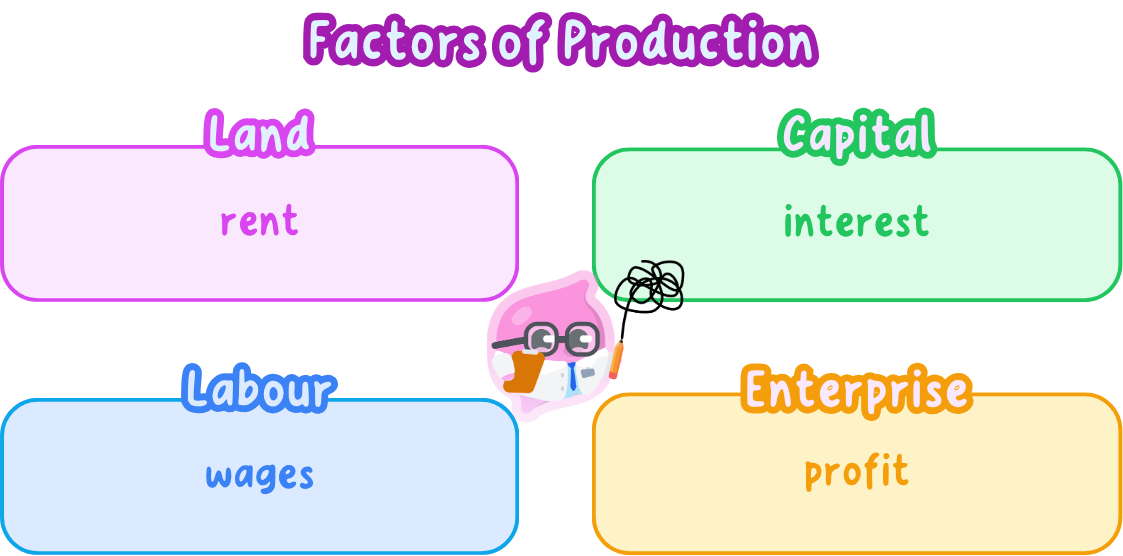
- Land earns rent, the payment for the use of a site or natural resource, such as the monthly rent a coffee shop pays for a unit in a Manchester shopping centre.
- Labour earns wages, the pay a worker receives for their time, such as the hourly rate a Tesco shop assistant gets for a shift.
- In the UK the National Living Wage sets a legal floor under that hourly rate for eligible workers.
- Capital earns interest, the payment for the funds tied up in equipment, such as the interest a haulage firm pays on the loan that bought its lorries.
- Enterprise earns profit, whatever is left for the owner once every other cost is paid, such as the sum a barber keeps after settling the shop rent and the staff wages.
- Profit is the only reward not agreed in advance, which is exactly why it rewards risk.
- These four rewards are also the four kinds of income a UK household can earn, so what a firm pays out as a cost arrives elsewhere as somebody's income.
- Capital means machinery, equipment, vehicles and buildings, never money.
- The £30,000 a bakery borrows is finance, and only the oven it buys is capital.
- Cash produces nothing by itself, so calling it a factor of production loses the mark.
Spot each factor in a real business
- Work through a case study input by input, quoting the detail as well as naming the factor.
- A natural resource that has been processed becomes capital, so trees in a forest are land while planks in a joiner's workshop are capital.
- The owner of a small business usually supplies two factors, working in it as labour and carrying the risk as enterprise.
- A farmer's tractor is capital even though it never leaves the land, because the test is what the input is, not where it is used.
- Remove any one of the four and output stops, which is why all four are treated as necessary rather than ranked.
- Name the factors as land, labour, capital and enterprise, not everyday words such as staff or tools.
- Pair each factor with its reward: land rent, labour wages, capital interest, enterprise profit.
- Name the four factors of production.
- What is the reward earned by land?
- Give one example of capital in a bakery.
- Which factor earns profit, and why is that reward not agreed in advance?
- Is the money a firm borrows to buy a machine capital?
1.1.3a The basic economic problem and making choices
Scarcity forces every economy to choose
The basic economic problem: unlimited human wants set against limited economic resources.
Scarcity: the condition of not having enough resources to satisfy every want.
- Because the two never match, somebody must decide which wants are met and which go unmet.
- That need to choose is what makes economics a subject, since unlimited resources would need no choices at all.
- Every choice means giving up another, an idea called opportunity cost, covered in the next article.
- The NHS has a fixed budget each year but an almost endless list of treatments it could fund.
- It cannot pay for every drug, nurse and hospital that patients might want.
- Limited resources force it to choose what to provide, which is the basic economic problem in action.
Scarcity is not the same as a shortage
- A shortage is temporary: demand is greater than supply at the current price.
- Scarcity is permanent, because resources are always limited relative to unlimited wants.
Every decision maker faces the same problem
- Consumers choose what to buy with a limited income, so new trainers may mean going without a concert ticket.
- Workers choose how to use limited time and skills, such as taking a Saturday shift instead of a day off.
- Producers choose what to make with limited resources, so a car factory's line cannot build vans at the same time.
- Governments choose how to spend limited tax revenue, so more for the NHS can mean less for defence or schools.
- Scarcity is the condition that resources are finite.
- The economic problem is the need to choose that scarcity creates.
- Neither ever goes away, because even the richest government cannot have everything at once.
Weigh the benefit against what you give up
- Every choice weighs an expected benefit against a cost, and that cost includes the next best alternative given up, not just the money paid.
- A choice is worth making only when the benefit is greater than what is sacrificed to get it.
- Whose benefits and whose costs are counted changes the answer, which is why decisions involve trade-offs between groups.
- Timing matters too, since a benefit that recurs every year can outweigh a cost paid only once.
Leeds City Council weighs a £5 million choice
- Leeds City Council has £5 million to spend and must choose between a new leisure centre and resurfacing its most damaged roads.
- The leisure centre would improve residents' health and bring in membership income.
- Choosing it leaves the roads damaged and raises the vehicle damage claims made against the council.
- The health and membership benefits recur every year while the claims are a one-off cost, so the council can reasonably build the centre even though drivers lose out in the short term.
- Change one fact, such as the roads being unsafe rather than merely bumpy, and the judgement flips, which is why the reasoning matters more than the answer.
- What is the basic economic problem?
- Why does scarcity force every decision maker to choose?
- What is the difference between scarcity and a shortage?
- When weighing up a choice, what two things should be compared?
- Why could Leeds City Council justify building the leisure centre?
1.1.3b Opportunity cost
Only the next best alternative counts
Opportunity cost: the value of the next best alternative given up when a choice is made, counting only the single best option forgone rather than everything that was turned down.
- It arises from scarcity, so using money, time or materials one way rules out every other use at that moment.
- To find it, list the options realistically available, rank them, then name the one at the top of the rejected list.
- Only that one counts, however many were rejected, because the chooser could have taken just one of them instead.
- The idea judges a decision by what it displaces, which is why economists call every choice a trade-off.
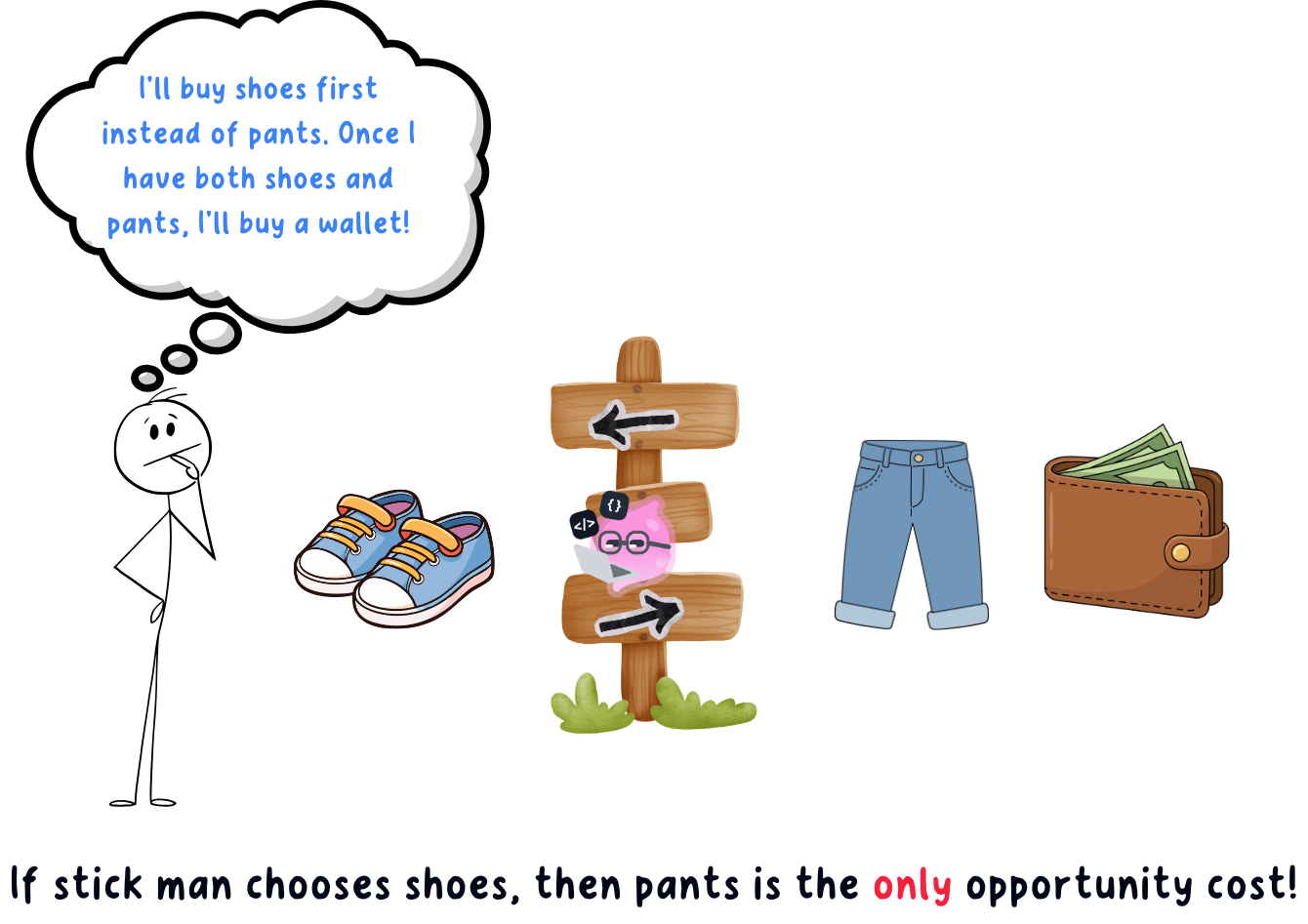
- You have £8 and a single lunch break, and three things you could do with it.
- Ranked, they are the meal deal you want most, then a paperback, then topping up your bus card.
- You buy the meal deal, so the opportunity cost is the paperback alone.
- The bus card never counts, because you would not have chosen it even without the meal deal.
Consumers, firms and government all face it
- A consumer who spends £45 on trainers at JD Sports gives up the concert ticket that was the next best use of that £45.
- A worker who takes a Saturday shift at Tesco gives up the revision time that was the next best use of the day.
- A producer such as a bakery that runs its ovens on sourdough all morning gives up the sausage rolls those ovens could have baked.
- The government that puts an extra £1 billion into the NHS gives up the next best public use of that money, such as new school buildings.
- Government choices show the idea most sharply, because a Budget fixes the total before any of it is allocated.
- The price on the receipt is not the opportunity cost.
- The £45 spent on trainers is the money cost; the concert ticket it would have bought is the opportunity cost.
Opportunity cost is not always a money cost
- Time is scarce too, so an hour spent one way carries an opportunity cost even when nothing is bought or sold.
- Land and equipment can each do only one job at a time, so a farmer who sows a field with wheat gives up the barley it could have grown that season.
- Where the sacrifice has no price tag, ask what the resource would otherwise have produced, and describe that.
- A free good such as the air you breathe is the one case with no opportunity cost, because using it leaves nobody else with less.
- That is a quick test of understanding: if a choice really costs nothing, the resource was not scarce.
- Write next best alternative forgone, because the definition mark usually sits on next best.
- Never list two or three sacrificed options, since only the single highest ranked one counts.
- Where time or land is given up rather than cash, state the alternative use, not the spending.
- Define opportunity cost in one sentence.
- Why does scarcity make opportunity cost unavoidable?
- If four options are rejected, how many count as the opportunity cost?
- State the opportunity cost of spending £1 billion more on the NHS.
- Give one opportunity cost that does not involve money.
