1.5.1a The range of market structures
Market structure describes the market, not the firm
Market structure: the way a market is organised, described by how many firms sell in it, how alike the things they sell are, and how easily a new firm can join.
- You classify a market, not a firm, so the subject is UK grocery selling or the supply of piped water rather than Tesco or Thames Water.
- The market has to be drawn before it can be placed, because the bread sellers in one town are a different market from the bread sellers in the whole UK.
- Structure is a continuum, so a market can be more competitive than one neighbour and less competitive than another without needing a box of its own.
- Where a market sits decides how much freedom a seller has over price, and every later point in this topic follows from that.
Structure is inherited rather than chosen. No firm decides whether its market has four sellers or four hundred; it finds the structure already there and has to behave accordingly.
UK markets span from tiny sellers to one supplier
- At the most competitive end almost anyone can start, so a British town supports dozens of window cleaners, gardeners and private tutors, none holding a share worth naming.
- A step along are markets with very many sellers whose products differ slightly, so hairdressers, cafes and takeaways keep a little loyalty from their regulars while still losing customers to a rival who is cheaper or nearer.
- Further along, a handful of large firms supply most of the output, as the big four supermarkets do in UK groceries and EE, O2, Vodafone and Three do in mobile networks.
- At the far end sits one firm, so a London household can buy piped water only from Thames Water, and only Network Rail owns the main-line track.
- Nothing forces a market to a round number of sellers, so the honest picture is a line with markets scattered along it rather than four boxes with one market in each.
- UK grocery selling shows the middle of the line, being neither a single seller nor a crowd of equals.
- Tesco alone takes between a quarter and a third of what British households spend on groceries, and Sainsbury's, Asda, Morrisons, Aldi and Lidl take most of the rest.
- Below them sit thousands of convenience shops, butchers, bakers and market stalls, so the market has a few very large sellers and a very long tail at the same time.
- That is why counting sellers gives the wrong answer here, and why the share held by the largest firms is the figure that places the market.
Entry, exit and mergers move a market's position
- Entry moves a market towards the competitive end, which is what Aldi and Lidl did to UK groceries by opening hundreds of stores and taking share from four firms that had been sharing it.
- Exit and merger move it the other way, because every seller that closes or is bought out leaves the survivors a larger slice of the same customers.
- Rules move markets, since opening the UK letters market to competitors in 2006 turned one legal supplier into several, and Royal Mail now carries most letters rather than all of them.
- Technology moves markets fastest, because a comparison website turns a market where buyers could not realistically compare sellers into one where they compare twenty in a minute, as happened in car insurance and household energy.
- A market's structure therefore has a date attached, so UK groceries as they were in 1990 are a different structure from UK groceries now.
- Structure belongs to the market, not the firm: Tesco is huge but faces real rivals, while a small water company can be the only seller there is.
- Many sellers does not mean a competitive market: four firms can supply most of the output while thousands of small shops trade alongside them.
- A market does not stay where you last placed it: entry, exit, mergers, new rules and new technology all move it.
Placing a market on the line comes first
- The position decides how much freedom a seller has over price, which is why the same rise in energy costs is passed straight to customers in one market and swallowed by the seller in another.
- It also decides how much choice a buyer has, since the number of sellers is the number of alternatives a buyer can turn to.
- Name the position before making any judgement, because the same change can transform one structure and change nothing at all in another.
The factors that make the placing precise are section 1.5.1b. What a market at the competitive end looks like from the inside is 1.5.2a, and what happens at the concentrated end is 1.5.3.
- What does market structure describe, and what is the unit being described?
- Name a UK market near the competitive end of the range, and say why it sits there.
- Name a UK market supplied by a single firm, and say why a newcomer cannot enter it.
- Why is the share held by the largest firms more useful than the number of firms?
- Name two things that move a market along the range over time.
1.5.1b Distinguishing between market structures
Three factors place a market's structure
Product differentiation: making a product seem different from a rival's, through branding, design, quality, packaging or the service that comes with it.
Barriers to entry: anything that makes it hard or expensive for a new firm to start selling in a market, such as the cost of the equipment, a licence, or a brand that buyers already trust.
- The number of producers is the first factor, and the question worth asking is what share the largest firms hold rather than how many names you can list.
- A market can contain thousands of sellers and still be concentrated when four of them supply most of the output.
- Market share puts a figure on it: market share=a firm’s salestotal market sales×100\text{market share} = \frac{\text{a firm's sales}}{\text{total market sales}} \times 100market share=total market salesa firm’s sales×100.
- The degree of product differentiation is the second, and it decides whether a buyer annoyed by a price rise has anywhere identical to go.
- It can be real, as with the engineering inside a car, or created, as with the packaging around two very similar shampoos.
- The more differentiated the product, the further a seller can hold its price above its rivals before the shop empties.
- The ease of entry is the third, and it decides whether a high profit in the market can last.
- Where entry is cheap, a visible profit brings newcomers who add to supply and pull the price back down.
- Where entry is blocked, the same profit simply sits there.
- The first two factors describe the market as it stands, and the third tells you whether it will stay that way.
- A market's total sales for the year are £2,000 million, and the largest firm sells £560 million of that.
- The largest firm holds 28 per cent, a share big enough for its own pricing to move the whole market.
- The next three firms hold 15 per cent, 12 per cent and 9 per cent.
- The four largest firms hold 64 per cent between them, leaving 36 per cent shared among everybody else, however many sellers that turns out to be.
Ease of entry decides whether it lasts
- Start-up cost is the commonest barrier, so a window cleaner needs a ladder, a van and insurance while a new water company would need the mains already buried under London.
- Legal barriers block entry outright, since running trains on the main line, supplying tap water and broadcasting on a radio frequency all need permission that is not handed out on request.
- Control of a key input works the same way, because a firm that owns the only track, the only pipes or the only local quarry decides who else can trade.
- Economies of scale raise a quieter barrier, since a newcomer producing small volumes carries a higher cost per unit and so cannot match an established firm's price.
- Brand loyalty is a barrier built by spending, because a new soft drink has to be advertised for years before shoppers reach for it without thinking.
- Barriers to exit belong here too, since a firm that would lose everything it spent on premises and equipment thinks twice about entering at all.
- Two UK markets sit at opposite ends of the entry test.
- Window cleaning needs a ladder, a van, insurance and a round of customers, so a new cleaner can be working within a fortnight and no existing cleaner can stop them.
- Piped water in London needs the reservoirs, treatment works and buried mains that Thames Water already owns, and no household can be supplied without them.
- The number of producers follows from the barrier rather than the other way round, which is why one market has dozens of sellers and the other has exactly one.
A market must be scored on all three factors
- A market can pass on producers and fail on entry, as UK grocery selling does, because thousands of shops sell food while the land, depots and buying power a national chain needs keep new national rivals out.
- It can pass on producers and fail on differentiation, as branded soft drinks do, because there are many producers and yet plenty of shoppers will not swap one cola for another on price alone.
- It can look concentrated on producers and still behave competitively on price, as UK groceries did while Aldi and Lidl were taking share, because a small number of large firms can still fight each other hard.
- It can fail all three at once, as regional water supply does, with one producer, no substitute and no possible entrant.
- The verdict comes from reading the three answers together, so a market counts as competitive only when many producers, weak differentiation and easy entry all hold at once.
- Five UK markets scored against the three factors.
| Market | Producers | Differentiation | Entry |
|---|---|---|---|
| Window cleaning | Dozens in a town | Almost none | Very easy |
| Hairdressing | Tens of thousands | Some, from skill and location | Easy |
| UK groceries | A few chains plus many small shops | Some, from own-label and location | Hard nationally, easy locally |
| Mobile networks | Four operators | Some, from coverage and contracts | Very hard |
| Regional water | One | None | Blocked |
- Competition falls down the table as differentiation and the difficulty of entry rise together, which is the pattern the three factors exist to reveal.
When all three factors agree, the label follows
- Many producers, weak differentiation and easy entry describe a competitive market, and no seller in one has much freedom over its price.
- A few large producers, some differentiation and hard entry describe a concentrated market, where the largest sellers do have that freedom.
- One producer, no close substitute and blocked entry describe a monopoly, the far end of the range.
- The label is only shorthand for the three answers, so an answer that gives the three answers has earned more than one that gives the label alone.
What a competitive market looks like from the inside is section 1.5.2a. The concentrated end, including monopoly and oligopoly, is section 1.5.3.
- Turn the number of producers into a market share wherever figures are given, showing the division and the multiplication by 100.
- Score every market on all three factors, not just the one that gives the easiest answer.
- Name the three factors used to distinguish between market structures.
- A firm sells £560 million in a market whose total sales are £2,000 million: what is its market share?
- Give two barriers to entry, and say why each keeps new firms out.
- Why can a market with thousands of sellers still be concentrated?
- What does product differentiation let a seller do that a seller of an identical product cannot?
1.5.2a Characteristics of a competitive market
Competitive markets leave no seller able to set price
Competitive market: a market supplied by a large number of firms selling close substitutes, which new firms can enter and leave easily, so no single firm is big enough to set the price.
- The word competitive describes the conditions in the market, not how hard the sellers are trying, so two equally hardworking shopkeepers can be in a competitive market and in a sheltered one.
- The conditions have to hold on both sides, because many small sellers facing a handful of large buyers is not a competitive position for the sellers, which is roughly where British dairy farms stand when they sell to processors.
- Each seller's share is small enough that its own decisions do not register in the market total, and that is the practical meaning of being too small to set the price.
- The market price still moves, but because total demand or total supply has moved, not because one firm decided it should.
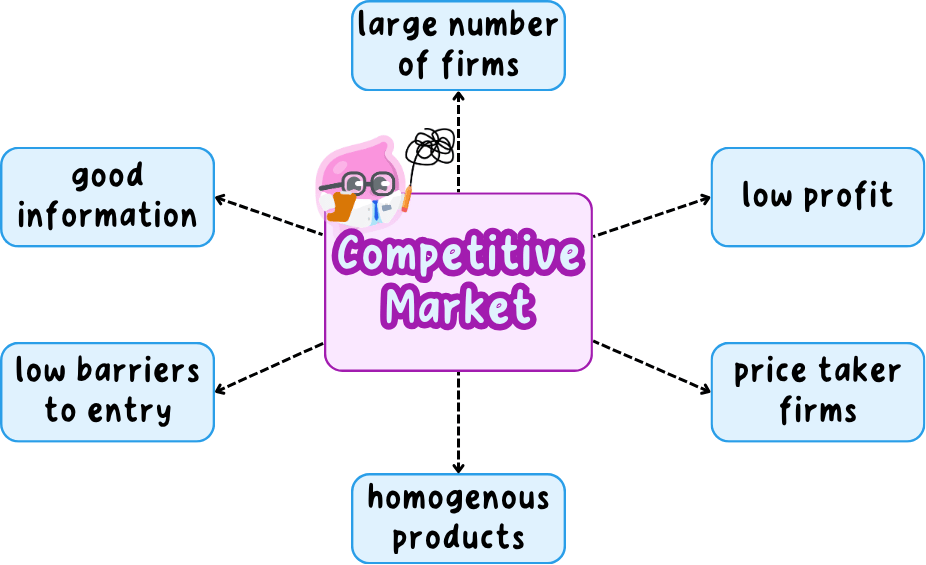
- Hairdressing and barbering is about as clear a competitive market as Britain has.
- There are tens of thousands of salons and barbers, and even the largest chain cuts only a tiny fraction of the country's hair.
- A chair, a mirror, a set of clippers and a rented room are enough to start, so a new barber can open within a few weeks.
- Prices for a basic cut in one town cluster within a pound or two, because a customer charged much more walks to the next shop.
- The same pattern runs through window cleaning, gardening, private tutoring, plumbing and market-stall greengrocery.
Close substitutes and good information let buyers act
- Close substitutes matter because a buyer only switches if the alternative does the same job, so the products have to be alike and not merely numerous.
- Good information matters just as much, since a price difference nobody can see disciplines nobody at all.
- The two work as a pair, because information without substitutes only tells a buyer they are paying too much and leaves them nowhere to go with the news.
- Information has become far cheaper to collect, which is why comparison websites made car insurance and household energy behave more competitively without changing the number of sellers in them.
- A supermarket shelf does the same job in miniature, since own-label and branded versions of one item sit side by side with the price per 100 grams printed under both.
- A competitive market is not a perfect one: no real market has identical products or perfectly informed buyers.
- Many sellers is not enough: buyers who cannot compare or cannot switch leave those sellers undisturbed.
- Firm size is not the test: a village shop five miles from its nearest rival faces little competition, while Aldi and Lidl are large firms in a market that competes hard on price.
Easy entry and easy exit both matter
- Easy entry stops a high profit lasting, since anybody who can see the profit is free to enter and take a share of it.
- Easy exit matters because a firm decides whether to enter by asking what it would lose if the venture failed.
- Exit is easy where most of what a firm spends can be recovered, so a van, a set of tools and a short lease can be sold on or handed back.
- Exit is hard where the spending is sunk, so a purpose-built plant or a buried pipe has almost no value to anyone else and the money is gone.
- The condition is passed only when a firm can get in cheaply and get out again without ruin, which is why the two halves are always stated together.
- A mobile catering van and a water treatment works show the difference in one comparison.
- A van, a fryer and a pitch licence might come to a few thousand pounds, and almost all of it can be sold on second hand if the trade does not work out.
- A treatment works costs hundreds of millions of pounds, is useless for anything else and cannot be moved, so the money can never be recovered.
- That is why one of these markets gains a new seller every month and the other has had the same seller for decades.
Together the conditions fix a price nobody set
- Many sellers, close substitutes, easy entry and exit and well informed buyers reinforce one another, so weakening any one of them weakens the whole result.
- What they produce is a going price that no firm chose, which each firm then has to produce beneath if it wants to stay open.
- That one fact is why a competitive market rewards low costs and punishes waste, whatever the sellers themselves would prefer.
How firms actually behave once the price is out of their hands is section 1.5.2b, and what the whole arrangement does to consumers, producers and workers is 1.5.2c.
- What is meant by a competitive market?
- Why does a competitive market need many buyers as well as many sellers?
- Why does good information matter as much as the number of sellers?
- Why does easy exit from a market make entry into it more likely?
- Name a competitive UK market, and give two conditions it satisfies.
1.5.2b How producers operate in competitive markets
Firms here take the price they are given
Price taker: a firm that is too small a part of its market to affect the market price, so it has to sell at the going rate or not sell at all.
Price maker: a firm large enough, or sheltered enough, to choose its own price and still keep its customers.
- The conditions set out in section 1.5.2a are what make a firm a price taker, so this article starts where that one finished.
- A price taker can still change its price, but both directions are unattractive: charging more loses the customers, while charging less wins sales at a margin that may not cover the trouble.
- Charging more fails because the buyer has a close substitute and can see the price, so the custom lost outweighs the extra earned on each remaining sale.
- Charging less works for a fortnight, until rivals selling the same thing match it and the whole market settles at the lower price with nobody better off.
- What is left are the decisions the firm genuinely controls, its costs, quality, service, range and rate of innovation, and competitive behaviour is the sum of those.
- Six sandwich shops on one street sell a filled roll at about £3.50.
- One raises its price to £4.20, keeps its regulars but loses the office workers who buy on price, and takes less money by the end of the week despite earning more on each roll.
- Another cuts to £3.20 and is busy for a fortnight, until four of the others cut to £3.20 as well and the queue returns to normal at a lower price.
- A third leaves its price alone, moves its bread onto a bulk contract, and ends up charging what everyone else charges while keeping more of it.
- The third shop is the one behaving the way a competitive market rewards.
Holding costs down becomes a condition of survival
- With the price fixed by the market, the only way to widen the gap between price and cost is to push the cost of each unit down.
- A firm whose cost per unit sits above its rivals' cannot pass the difference on, so it comes out of profit until there is no profit left to take it from.
- Firms therefore buy in bulk, cut waste, open for longer hours and replace labour with machinery wherever the machine is cheaper.
- Aldi and Lidl take the strategy to its limit, stocking a few thousand lines rather than tens of thousands, displaying goods in the boxes they arrived in, and printing barcodes on several faces of a package so it scans from any angle.
- Greggs reaches the same end from the other direction, baking and finishing at a small number of large sites so the cost of each sausage roll falls as the volume through those sites rises.
- The pressure is permanent rather than occasional, because a saving one firm finds is copied by the others and the going price then falls to reflect it.
- UK grocery selling shows a whole market pushed into cost cutting by two entrants.
- Aldi and Lidl grew to close to a fifth of British grocery spending between them, selling a narrow range at prices the established chains could not match on their existing costs.
- Tesco and Sainsbury's answered with price-match schemes pegging hundreds of everyday items to Aldi's prices, which only works if their own costs come down far enough to fund it.
- All of them trimmed ranges, closed in-store counters, moved shoppers onto self-service checkouts and pressed suppliers for lower prices.
- Asda and Morrisons, slower to cut costs, lost share and were both sold, which is the punishment a competitive market hands out.
Quality, service and range replace price competition
- Once every seller is near the same price, the only way to hold a customer is to be better rather than cheaper.
- Quality is the first lever, so a supermarket builds a tiered own-label range and a baker advertises where the ingredients came from.
- Service is the second, covering opening hours, delivery slots, click and collect, returns and how quickly a complaint is settled.
- Range is the third, because the shop that stocks the one item a shopper cannot find elsewhere wins the whole basket rather than just that item.
- Loyalty schemes sit between price and service, since Tesco Clubcard prices and Sainsbury's Nectar prices cut the bill only for shoppers who keep coming back.
- None of it is free, and all of it comes out of the same thin margin, which is why a competitive firm is constantly trading one of these against another.
- Competitive firms do not compete on price alone: quality, service and range take most of the effort once prices have converged.
- A firm cannot cover a cost rise by raising its price, unless every rival faces the same rise at the same time.
- Advertising is not proof of market power: a seller of a close substitute advertises simply to be remembered.
Innovation is forced, and its reward is temporary
- A firm that finds a cheaper method or a better product takes sales from its rivals, which is the only way a price taker gets ahead of them at all.
- The advantage lasts only until the rivals copy it, since nothing in a competitive market stops them, so the saving ends up with buyers as a lower price.
- The pressure to innovate therefore never eases, because standing still means falling behind the moment somebody else moves.
- Advertising follows the same logic, as a firm selling something close to identical has to keep its name in front of buyers or lose them to whoever they happened to think of first.
- Entering and leaving are behaviour too, so firms move in when profits look good and out when they do not, and that movement drags the price back towards cost.
What all of this behaviour does to consumers, producers and workers, and why the profits it leaves behind are thin, is section 1.5.2c.
- Label each example as price or non-price competition, since a question often asks for one and not the other.
- Keep the impact on consumers, producers and workers out of this answer, as that is a separate spec point.
- What is a price taker, and how does it differ from a price maker?
- Why does raising the price above rivals usually reduce a firm's total takings?
- Why can a firm in a competitive market not pass a cost increase on to its customers?
- Give two ways a firm competes for customers without changing its price.
- Why does the advantage from an innovation last only a short time here?
1.5.2c The economic impact of competition
Consumers gain most: lower prices, choice and quality
- Price is the gain consumers notice first, because a firm charging above its rivals in a market of close substitutes simply loses the sale.
- The gain is real income rather than a bookkeeping saving, since a household whose weekly shop falls by £5 has £5 to spend on something else.
- Choice widens because a large number of sellers means a large number of versions, locations, opening hours and ways to pay.
- Quality and service improve for the same reason the price falls, as they are what a firm reaches for once it cannot undercut anybody.
- Consumers also gain from innovation they never asked for, because a firm hunting for an edge brings out the cheaper method or the better product first.
- The gains are not spread evenly, since a shopper with a car and a phone can compare and travel while one with neither pays whatever the nearest seller charges.
Producers gain efficiency but lose a comfortable margin
- The gain is that competition forces waste out, so a firm that survives it is leaner than it would otherwise have been and better placed to compete elsewhere.
- Competition can also grow the market, since a lower price sells more units and an efficient firm can end up larger than it would have grown behind a quiet life.
- The cost is that the amount earned on each unit is competed away, leaving very little cushion for a bad year.
- A thin margin also leaves less retained profit for research, new equipment and training, so an industry can be cheap this year and slow to improve over a decade.
- Some firms do not survive the pressure at all, and every closure destroys the value of what the owners put in.
- Small producers are squeezed hardest, because they cannot get the bulk prices, borrowing terms or advertising reach that a large rival takes for granted.
- The squeeze passes up the supply chain, which is why the price a British dairy farmer receives for milk can fall at the same time as the shop price.
- Competition is not simply good or bad for producers: the pressure that removes their margin also removes their waste.
- Not every producer feels it equally: a national chain and a single farm face the same market price with completely different bargaining power.
Workers feel competition through both jobs and pay
- Competition creates jobs where the winning firms expand, so the hundreds of stores Aldi and Lidl opened in Britain came with thousands of new jobs attached.
- It destroys jobs where the losing firms contract, so the same years brought superstore closures, counter closures and head office cuts at the chains losing share.
- Because labour is usually the largest cost a firm can actually control, a firm cutting costs looks early at pay, hours and staffing levels, which shows up as fewer staff on a shop floor and more flexible contracts.
- Workers gain as consumers at the same time, since a pay packet buys more when prices fall, so the effect on a household is not the same as the effect on its wages.
- Competition also raises productivity, and output per worker is what makes higher real pay affordable, so much depends on whether a firm competes by working smarter or by paying less.
- Where the skill a firm needs is scarce, competition between employers pushes those workers' pay up, so competition does not press on every worker in the same direction.
- UK grocery selling over the last twenty years shows all three groups at once.
- Consumers gained, as the discounters forced hundreds of everyday prices down and the established chains matched them rather than lose shoppers.
- Producers divided, with Aldi and Lidl growing to close to a fifth of the market between them while Asda and Morrisons lost share and were both sold.
- Workers saw both sides, with thousands of jobs created in new discount stores and thousands lost as counters, night shifts and head office roles were cut elsewhere.
- Suppliers felt it too, as farmers and food manufacturers were pressed for lower prices by buyers who were themselves under pressure.
Profits stay low because nothing protects a margin
Profit margin: the profit a firm makes on each unit it sells, which is the price of that unit minus the cost of producing it.
- The price is pulled down towards the cost of producing each unit, because a firm asking for more than that loses buyers to a close substitute they can both see and reach.
- Easy entry finishes the job, since a visible margin is an open invitation to outsiders and every newcomer adds to supply and pushes the price down again, which is why no firm here can hold its price above cost for long.
- The mechanism runs in reverse too, so when firms make losses some leave, supply falls and the price recovers, which is why the margin hovers near cost rather than sinking far below it.
- A competitive firm also cannot recover a cost increase by raising its price, so a rise in wages or energy costs lands on the margin rather than on the customer.
- Where a small number of producers dominate, none of that applies, because entry is hard, substitutes are poor and buyers have fewer places to go, so a higher price and a wider margin survive year after year.
- The difference is protection rather than effort, since the sheltered firms are not working harder for their higher profit.
- A tin costs £1.05 to produce and put on a shelf.
- In a competitive market it sells for £1.20, so the margin is 15p.
- Where a small number of producers dominate, the same tin sells for £1.50, so the margin is 45p.
- The cost has not changed, so the gap between 12.5 per cent and 30 per cent is the margin competition would have removed.
- On 20 million tins a year the competitive firm still takes £3 million on this one line, so a thin margin is not a small profit.
How gains and costs balance depends on the market
- It depends on how easily new firms can enter, because a market protected by heavy set-up costs keeps its margin however many names appear on the shelf.
- It depends on whether consumers have good information, since a saving no shopper can find disciplines nobody, while a comparison that takes seconds on a phone disciplines every seller at once.
- It depends on whether the pressure falls on wages or on efficiency, because a firm that reorganises its work passes nothing on to its staff, while one that cuts hours and pay moves the whole cost onto them.
- It depends on the time horizon, as the lower price arrives within months while the lost retained profit for research and equipment only shows up over a decade.
- It depends on how far the shake-out runs, because competition that leaves only two or three sellers ends by destroying the rivalry that produced the gain in the first place.
Judgement: in markets like groceries and air travel the consumer gain has been large, visible and spread across every household, while the losses have been concentrated on particular firms and particular jobs, so competition is usually worth having, provided entry stays genuinely open and the pressure on pay and conditions is held back by law rather than left entirely to the market.
These effects are covered in later sections
How competitive pressure feeds into economic growth and inflation is covered in Paper 2 (2.2.2 and 2.2.4), and how a small number of producers behave when that pressure is absent is section 1.5.3.
- Answer for all three groups the spec names, consumers, producers and workers.
- Explain the lower profits through the mechanism: close substitutes and easy entry drive price down towards cost, unlike in a market dominated by a small number of producers.
- Give two ways consumers gain from competition, and one reason a particular consumer might not.
- Give one gain and one cost of competition for producers.
- How does competition affect workers, and why can the effect run either way?
- Why are profits likely to be lower in a competitive market than in one dominated by a small number of producers?
- A tin costs £1.05 to produce and sells for £1.20: what is the margin as a percentage of the price?
1.5.3a Characteristics of a non-competitive market
Sellers hold power over the price
Non-competitive market: a market supplied by one firm, or by a small number of large firms, where a seller can influence the price instead of having to accept the price the market has already set.
Barriers to entry: anything that makes it difficult or unprofitable for a new firm to start supplying a market, which is what allows that power to last.
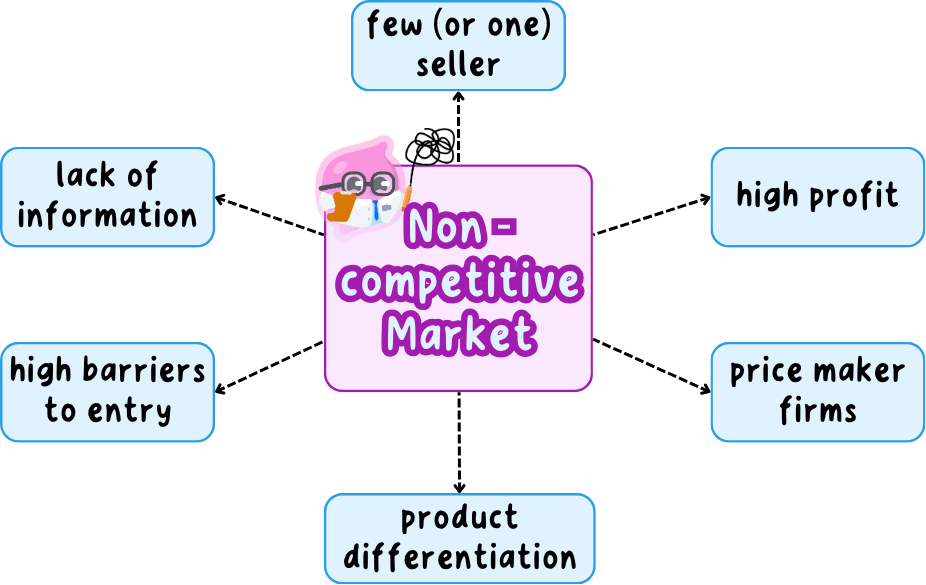
- Few sellers, or only one, because the number of sellers is the number of places a dissatisfied buyer can take their money instead.
- Royal Mail delivers almost every letter posted in the UK, and Thames Water is the only mains water supplier in its region, so an unhappy customer has no second supplier to move to.
- Groceries and energy supply show the other version, where a handful of large firms take most of the spending between them.
- High barriers to entry, so a firm hoping to compete with Network Rail would have to lay its own track and signalling before it carried a single passenger.
- Because entry is so hard, high profits do not pull in newcomers and so are never competed away.
- Products are differentiated or unique, since branding, patents and design make one firm's product hard to replace.
- The less alike two products seem, the less a buyer switches over a small price difference, and the more power each seller keeps.
- Buyers usually know less than sellers, and the complicated tariffs of the big six energy firms made it hard for a household to work out which deal was cheapest.
- Where comparing is hard, buyers stay where they are, and a seller that expects them to stay faces less pressure on its price.
- Firms are price makers rather than price takers, which is the result the other characteristics produce between them rather than a separate cause.
- A price maker chooses the price it charges, knowing that a buyer who refuses it has no close alternative to turn to.
- Even so, no firm can charge any price it likes, because a higher price still loses sales as buyers do without the good altogether.
- Letter post: Royal Mail carries almost all UK letters under a universal service obligation, and no rival delivers to every address in the country.
- Water: Thames Water supplies about 16 million people through the only set of pipes in the area.
- Rail infrastructure: Network Rail owns almost all the track, signalling and major stations in Great Britain, so every train operator has to deal with it.
- Groceries: Tesco, Sainsbury's, Asda and Morrisons take most grocery spending between them, so each is large enough to affect prices across the market.
- Medicines: a pharmaceutical firm holding a patent on a new treatment is the only lawful seller of it until the patent expires.
Barriers to entry keep the competition out
- Legal barriers name one lawful seller, as a patent does for a new medicine and a licence or franchise does for a rail route or a radio frequency.
- Control of a key resource or network needs no law at all, because a firm that owns the only pipes, track or grid can refuse a rival access to them.
- Very high set-up costs deter entry even where nobody is excluded, since laying a water network costs so much that a newcomer would need a large share of the market to cover the outlay.
- Much of that spending is sunk, meaning it cannot be recovered if the attempt fails, so entering is riskier than the figures alone suggest.
- Economies of scale give an established firm a cost per unit that no small newcomer can match.
- Brand strength built by years of advertising works like a legal barrier, since a newcomer has to spend heavily on marketing before it makes a single sale.
- Existing firms can also raise the barrier deliberately, by tying suppliers into long contracts or buying up a promising rival before it grows.
- The height of the barrier decides whether market power lasts, because power that newcomers can compete away is only temporary.
- A non-competitive market is not one seller only: a small number of large firms is enough.
- These firms cannot charge any price they like: a higher price always costs them some sales.
- High profits alone prove nothing: the test is whether barriers stop them being competed away.
Concentration is a matter of degree
- Market structures run along a range from many small sellers to a single seller, and non-competitive markets occupy the concentrated end of it.
- Economists therefore measure the share of the market held by the largest firms rather than sorting every market into one of two boxes.
- UK groceries and energy supply are both concentrated but still have several large firms watching one another, whereas mains water in a region has exactly one.
- The more concentrated a market, the more its price and range depend on the decisions of a few firms rather than on rivalry between many.
- Concentration can also fall, and the growth of Aldi and Lidl in UK groceries shows it is not a permanent state of affairs.
What these firms do with that power is section 1.5.3b, and the two named structures at the concentrated end, monopoly and oligopoly, are section 1.5.3c.
- What is a non-competitive market?
- Give four characteristics of a non-competitive market.
- Name three barriers to entry and say how each keeps a newcomer out.
- Why does product differentiation give a seller power over the price?
- Why is a non-competitive market a matter of degree?
1.5.3b How producers operate in non-competitive markets
Firms with power set their own price
What makes a market non-competitive, and the barriers to entry that keep it that way, is section 1.5.3a. This section is about what the firms inside it then do.
- A firm in a competitive market is a price taker, so it sells at the going rate or watches its customers walk to a rival.
- A firm in a non-competitive market is a price maker, so it chooses its price and the market tells it only how many units it will sell at that price.
- The power comes from the buyer's lack of an alternative, because someone who refuses the price has to go without rather than buy the same thing elsewhere.
- Even so, the firm faces a demand curve that slopes downwards, so a higher price always costs it some sales and pricing stays a trade-off rather than a free hand.
- Where a few large firms share a market, each also has to judge how the others will react before it moves, which is why prices there often move together and change rarely.
- Energy: the big six energy firms raised and cut household tariffs in close step for years, which is one reason Ofgem imposed a price cap.
- Letter post: Royal Mail sets the price of a first class stamp, and a household that thinks it dear has no second letter service to switch to.
- Water: Thames Water charges the bill its regulator allows, because nobody in its region can buy mains water from anyone else.
- Rail track: train operators negotiate access charges with Network Rail rather than shopping around, since there is only one network to run trains on.
Restricting output keeps the price up
- A seller facing no serious rival can supply less than the market would take, because a smaller quantity on sale leaves buyers bidding the price up.
- The chain runs from less output, to a shortage relative to what buyers want, to a higher price, to a larger profit on every unit sold.
- Output therefore tends to be lower and price higher than the same market would produce with many sellers in it, and buyers who would have bought at the lower price go without altogether.
- A firm can hold the price up without cutting production at all, simply by adding new capacity slowly, releasing flights, homes or broadband connections at a pace that keeps the price where it wants it.
- With a few large firms the same result can appear without anybody planning it, if each quietly avoids the price cut that would start a price war it could not win.
Branding and advertising make the product harder to compare
- Product differentiation is the second lever, because the less like a rival's product a good seems, the less a buyer switches over a small price difference.
- Heavy advertising builds that difference in the buyer's mind even where the goods themselves are close, and the brand loyalty it creates then doubles as a barrier to entry.
- Loyalty schemes such as Tesco Clubcard prices and Nectar prices tie the shopper to one seller, because the advertised saving is only there for people who stop comparing across shops.
- Firms also differentiate through service, adding next-day delivery, longer guarantees or app-based accounts, and each addition is another reason not to leave.
- Competition here therefore runs mostly on advertising, branding and range rather than price, which is called non-price competition, and it raises the firm's costs as well as its sales, with those costs recovered from the buyer in the price.
- The identical line: Tesco and Sainsbury's both sell a standard tin of baked beans, and because the tins are almost the same neither can charge much more than the other.
- The differentiated line: each chain also sells its own premium range in its own packaging, which a shopper cannot buy in the other shop.
- The premium line carries a much larger margin, because there is nothing exactly equivalent on the other shelf to compare it with.
- So competition on the identical lines stays fierce while competition on the differentiated lines is much weaker, in the very same shop.
Without competitive pressure, costs drift and innovation slows
- A firm that cannot lose its customers has less reason to cut its costs, because its profit does not depend on being the cheapest producer in the market.
- Costs then drift upwards through overstaffing, careless purchasing and tolerated waste, and a comfortable profit hides the problem.
- The incentive to innovate weakens for the same reason, since a firm with no rival gains little from making its own product obsolete.
- Service quality slips where customers cannot leave, which is why complaints about water companies, rail operators and broadband providers have so often outlasted promises to improve.
- The counter-argument matters, because a protected firm has the profits to fund research, can plan long projects knowing no rival will undercut it, and may have a cost per unit no small firm could match.
- Whether the money is actually spent on research, and whether that lower cost reaches the price, depends on the firm, and that is what a judgement on market power turns on in section 1.5.3c.
- These firms do not stop competing: they compete on advertising, branding, loyalty schemes and service instead of price.
- A large firm is not automatically inefficient: economies of scale can make it the lowest-cost producer.
- Do not stop at prices are higher: run the chain on to output, choice and the buyers who go without.
Consumer choice narrows in ways shoppers notice
- Choice narrows first in the number of sellers, so a buyer unhappy with the price or the service has nowhere else to take their money.
- Choice narrows again in the range on offer, because one firm decides which products exist and drops the lines that suit only a small group of buyers.
- Rural areas feel this most sharply, since a bus route, bank branch or fibre connection that is unprofitable for the one supplier is simply not provided.
- Where a few firms differentiate heavily the shelves can look full of choice while the number of genuine alternatives on price stays small.
- Switching costs deepen the problem, as contracts, exit fees and complicated tariffs keep buyers where they are even when a better offer exists.
- The overall effect on consumers is a higher price, a narrower range and weaker pressure on quality, and how far scale and investment offset that is section 1.5.3c.
- What is the difference between a price maker and a price taker?
- Explain how restricting output raises the price.
- What is non-price competition? Give two examples.
- Why does a firm here face less pressure to cut its costs?
- Give two ways consumer choice narrows in a non-competitive market.
1.5.3c Monopoly and oligopoly
Monopoly means one seller, oligopoly a few
Monopoly: a market supplied by a single seller, or dominated by one firm large enough to set its price without regard to any competitor.
- Both sit at the concentrated end of the range of market structures set out in 1.5.3a, where barriers to entry are what make the power last, and they differ in one thing only: how many firms hold it.
- Monopoly in practice:
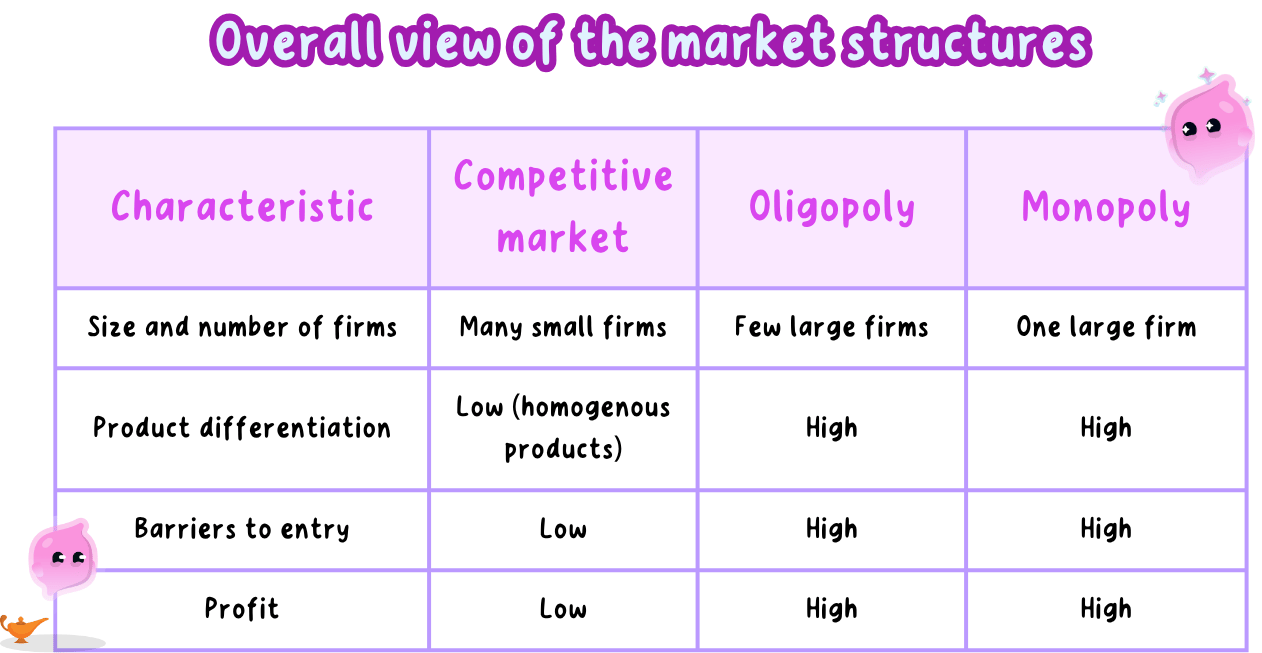
- A pure monopoly with literally one seller is rare, so competition authorities work with dominance instead, treating a large enough market share as monopoly power.
- A share above about 40 per cent is usually enough for a UK firm to be examined as dominant, and a share above half makes dominance very likely.
- The clearest UK cases are those where a single network makes a second seller pointless, such as mains water in a region.
Oligopoly: a market dominated by a few large firms, each of them big enough to affect the price and each watching what the others do.
- Oligopoly in practice:
- A few large firms supply most of the market, and a fringe of small firms can exist alongside them without affecting what the big ones do.
- Each firm is interdependent, judging how rivals will react before it changes its price, which is why prices here often move together and change rarely.
- Because a price cut invites a matching cut and wins no extra customers, the firms compete through advertising, branding and loyalty schemes instead.
- Concentration measures both cases, by adding together the market shares of the largest few firms.
- On that measure mains water and letter post are close to monopoly, while UK groceries, energy supply, mobile networks and banking are oligopolies.
- A market with four large operators, illustrative figures: total market revenue is £20 billion a year, of which the largest operator earns £6 billion.
- The largest operator holds 30 per cent of the market, a large share but nothing like a monopoly.
- Adding the four largest operators: 30 per cent, 25 per cent, 20 per cent and 15 per cent.
- The four largest operators hold 90 per cent between them, with the remaining 10 per cent shared among smaller firms on the fringe of the market.
- Shares like these shift over time as firms merge, grow or lose customers, so always work concentration out from the figures a question gives you rather than from memory.
Monopolistic and oligopolistic power has identifiable causes
- Legal protection names one lawful seller, as a patent does for a new medicine and a licence does for a radio frequency or a rail franchise.
- Control of a key resource or network needs no law, as Network Rail shows: a rival without access to the track cannot run any trains.
- Very large economies of scale can make one supplier the cheapest way to serve a whole market, which is a natural monopoly, since a second water network would raise the cost per user for everybody.
- High sunk costs deter entry even where nobody is excluded, because money spent on track, pipes or a licence cannot be recovered if the venture fails.
- Brand strength built over decades can hold a large share on its own, because buyers who ask for a name rather than a product give a newcomer nothing to compete against.
- Merger and takeover concentrate a market directly by turning several rivals into one larger firm, which is why the Competition and Markets Authority examines large mergers first.
- Network effects concentrate a market quickly, because a service becomes more useful the more people already use it, so buyers gather on the largest platform and make it larger still.
- Thames Water: the only mains water and sewerage supplier for about 16 million people, because a duplicate set of pipes would make no economic sense.
- Mobile networks: a small number of firms own network infrastructure, which is why the CMA examines large mergers between them in detail, as it did with the Vodafone UK and Three UK merger completed in 2025.
- Patented medicines: a pharmaceutical firm holds a lawful monopoly on its new treatment until the patent expires and generic makers can enter.
Higher prices, less choice, weaker service usually follow
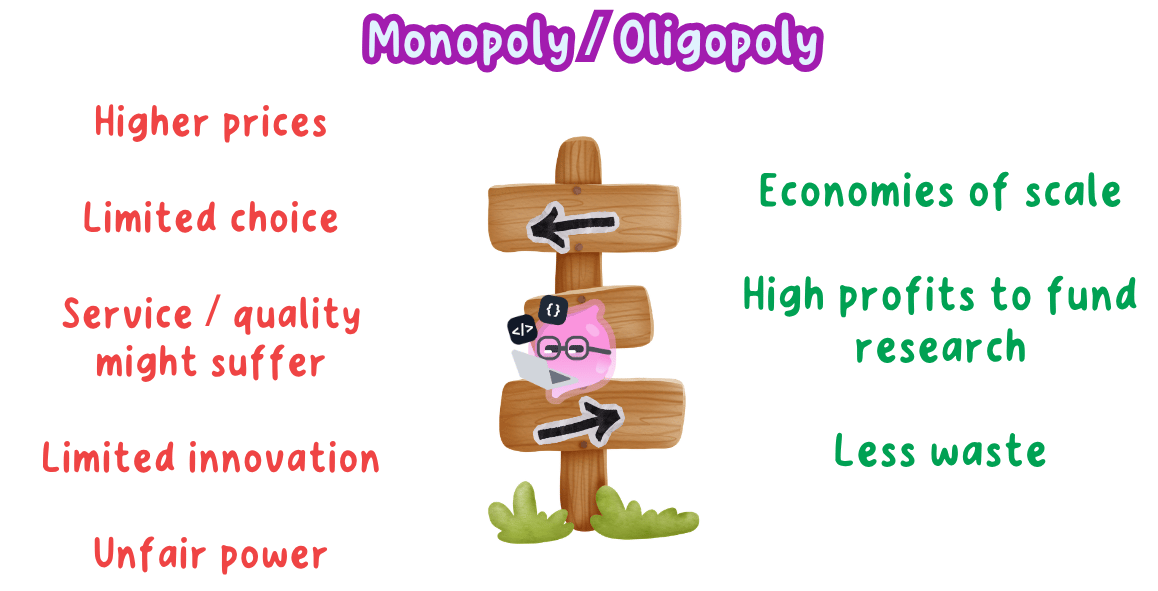
- Price is higher and output lower than a competitive market would produce, because a price maker with no serious rival can hold quantity back and charge well above the cost of supply.
- Buyers who would have paid a competitive price go without, so the harm reaches people who never appear in the firm's sales figures.
- Choice is narrower, since one firm offers one range and drops the lines that suit only a small group of buyers.
- Service and quality suffer where customers cannot leave, which is why complaints about water companies and rail operators have so often outlasted the promises to improve.
Weaker innovation, rising costs and unfair power also follow
- The incentive to innovate weakens, because a protected firm gains little from making its own product obsolete.
- Costs drift upwards without competitive pressure, and a comfortable profit hides the overstaffing and waste that would sink a firm with rivals.
- Income moves from consumers to the owners of the firm, so a dominant seller tends to widen inequality as well as raise the price.
- A dominant firm is often also the only buyer its suppliers can sell to, letting it force down the price it pays a farmer or small manufacturer with nowhere else to go.
- A monopoly does not always charge a high price: large economies of scale can let it undercut several smaller firms.
- Monopoly is not illegal: holding a dominant position is lawful, and it is abuse of that position that is acted against.
- An oligopoly is not a fixed number of firms: the test is whether a few dominate.
The same power can fund scale and research
- Economies of scale make the strongest case for size, because one firm supplying the whole market spreads its fixed costs over the largest possible output and its cost per unit falls.
- High profits can fund research, and a firm shielded from immediate imitation can spend for years on a new medicine before the work pays.
- Patents exist for that reason, because a firm commits years and large sums to a new drug only if it expects to recover the cost from sales afterwards.
- A single owner can plan and maintain a network as one system, so upgrades to the track or the grid are coordinated rather than split between firms with different plans.
- Scale allows a firm to compete internationally and to hold reserves that carry an essential service through a downturn, which a string of small suppliers could not.
How much this power harms consumers depends
- It depends on whether entry is a real threat, because a firm that expects a newcomer if it pushes its price too far behaves much like a firm with rivals, which is why the big four held prices down against Aldi and Lidl.
- It depends on whether a regulator is active, since a price cap from Ofgem, a licence condition from Ofcom or a merger decision from the CMA removes much of the harm.
- It depends on whether the economies of scale are passed on, because a falling cost per unit helps buyers only if the price falls with it.
- It depends on whether the profits fund genuine innovation rather than being paid straight out to shareholders.
- It depends on the time horizon, since a patent that raises the price of a medicine for a few years may be why the medicine exists, and the harm ends when the patent expires while the benefit does not.
- It depends on which market you are looking at, because a natural monopoly in water genuinely is the cheapest way to supply households while a dominant soft drinks brand carries no such cost advantage.
Judgement: market power is neither good nor bad in itself, because the same size that lets a firm hold its price up is what lowers its cost per unit, so the balance turns on whether the threat of entry or an active regulator forces that cost advantage through into the price. That is why UK policy acts against the abuse of market power rather than against being large.
UK policy targets abuse, not size
- How the UK responds to this power, through the CMA and sector regulators, is 1.6.1b.
- Define monopoly and oligopoly first, then say which one your example is.
- Keep causes of market power separate from its consequences.
- What is the difference between a monopoly and an oligopoly?
- Name four causes of monopolistic or oligopolistic power.
- Four operators hold shares of 30, 25, 20 and 15 per cent, so what share do they hold together, and what share is left for smaller firms?
- Give two consequences of market power that harm consumers.
- Give two consequences of market power that can benefit consumers.
1.5.4a The labour market and wage determination
Wages are set by demand and supply
Demand for labour: the number of workers, or hours of work, that firms are willing and able to hire at each wage rate.
Supply of labour: the number of workers, or hours of work, that people are willing and able to offer at each wage rate.
- The labour market works like any other market with the roles reversed: households sell, firms buy, and the price being settled is the wage rate.
- The demand curve for labour slopes downwards, since a higher wage makes every worker more expensive and firms respond by hiring fewer of them or using machinery instead.
- The supply curve for labour slopes upwards, since a higher wage draws in people working elsewhere, tempts in people who were not working and buys extra hours from existing staff.
- The curves cross at the equilibrium wage, which also fixes the number of workers employed.
- Above the equilibrium wage, an excess supply of labour bids the wage down. Below it, an excess demand for labour bids the wage up.
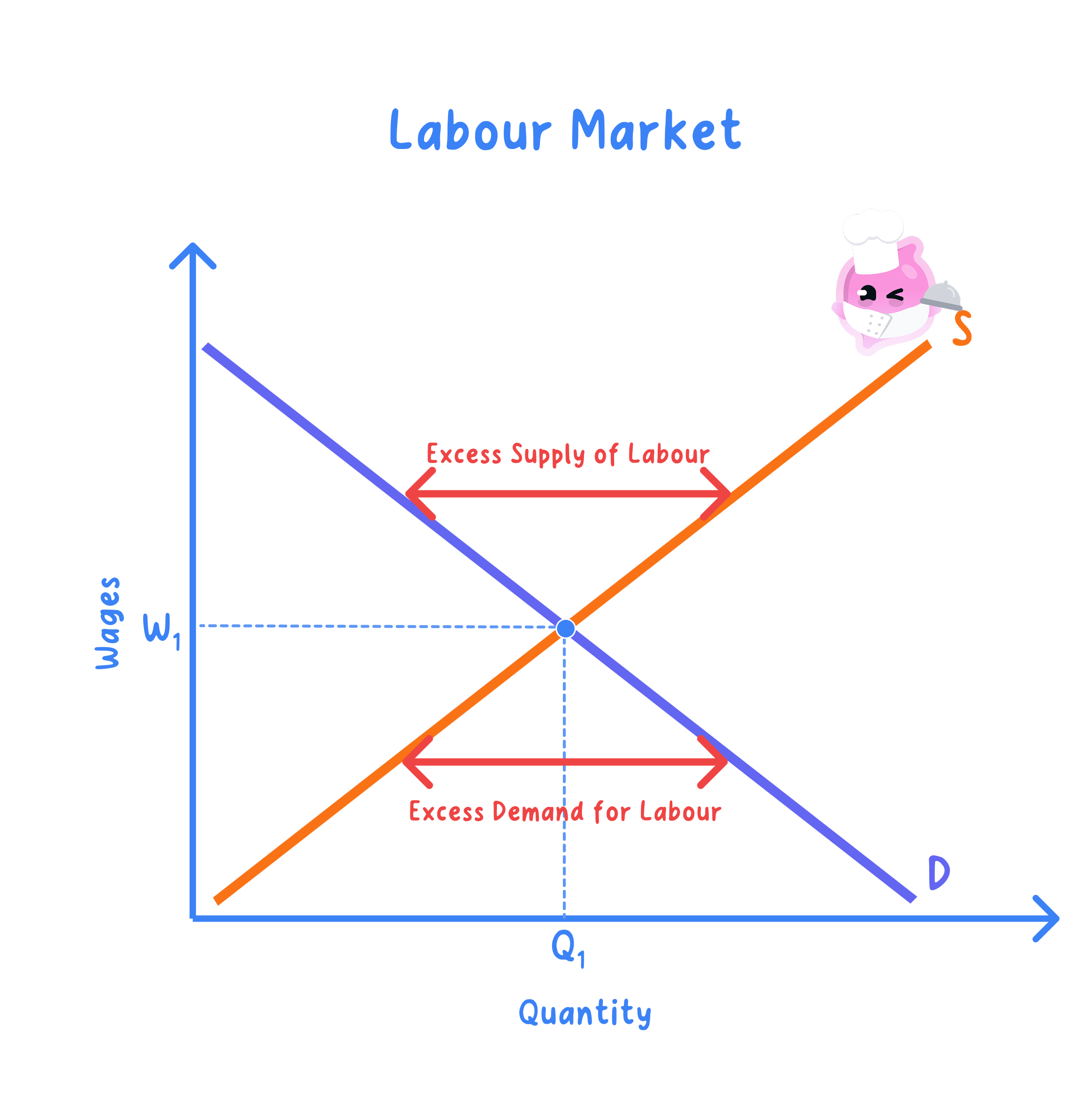
- Warehouse staff in one town: at £11 an hour local firms want 900 workers but only 600 people offer to work, so 300 posts are unfilled, an excess demand for labour of 300, and employers start offering more.
- At £15 an hour 1,000 people offer to work but firms want only 700, leaving 300 people without a job, which is an excess supply of 300.
- At £13 an hour both figures are 800, so £13 is the equilibrium wage and 800 is the quantity of labour employed.
- A new distribution centre opens: at £13 an hour firms now want 1,000 workers rather than 800, a rightward shift of the demand for labour.
- Firms bid the wage above £13, the higher rate draws more people in, and the new crossing point has a higher wage and more than 800 workers employed.
Demand for labour depends on product, productivity, machines
- The demand for labour is a derived demand, meaning it exists only because buyers want the goods and services those workers produce.
- So when demand for the product rises, firms need more output and the demand for that labour shifts right, raising both the wage and employment.
- When demand for the product falls the curve shifts left, which is why weaker high street spending shows up as fewer retail vacancies and slower pay growth.
- Higher productivity raises the demand for labour, because a worker who produces more per hour is worth more to the employer.
- Productivity rises with training, better machinery and better management, which is part of why workers in high-technology firms are paid more than workers doing similar tasks by hand.
- The price of capital matters because machinery substitutes for labour, so cheaper robots or self-service tills shift that demand left, while expensive machinery makes hiring a worker the cheaper option and shifts it right.
- Anything that adds to the cost of employing somebody, such as a rise in employer National Insurance, acts like a higher wage and reduces the number of workers firms want.
- Self-service tills: they replaced a share of checkout work in every large UK chain, shifting the demand for cashiers to the left.
- Online shopping: it did the opposite for warehouse and delivery work, and Amazon and the supermarkets competed for drivers by raising pay.
- Lorry drivers: UK haulage pay jumped in 2021 when the number of qualified drivers fell while demand for haulage held up, a leftward shift of supply meeting an unchanged demand.
Labour supply depends on who can and will work
- The qualifications required limit supply, because only people holding the degree, licence or trade certificate can offer themselves for the work at any wage at all.
- The length and cost of training limits it further, so a job needing seven years of study and heavy fees attracts far fewer entrants than one that trains a worker in a fortnight.
- How pleasant the work is shifts supply, since dangerous, dirty or unsociable work has fewer willing workers at any wage than comfortable work with long holidays.
- Wages in other occupations matter, because a rise in warehouse pay pulls people out of hospitality and shifts the supply of hospitality labour left.
- Migration adds to or subtracts from the pool directly, and the fall in the number of EU workers in UK agriculture and hospitality after 2020 shifted that supply left.
- The size of the working population sets the overall total, changing with the birth rate a generation earlier, the retirement age and how many people choose to work at all.
- Anything that adds to supply shifts the curve right, so the crossing point slides down the demand curve and the wage falls while employment rises; anything that cuts supply does the reverse, which is what happens when a licence becomes harder to obtain.
- A shift is not a movement: a change in the wage moves along the curve, while a change in qualifications, training or migration shifts it.
- The employer does not simply decide the wage: one offering less than the going rate cannot fill its vacancies.
Between occupations, differentials come from the same curves
- A wage differential is a difference in pay, and it comes in two kinds: between occupations and within one occupation.
- Between occupations the difference is simply where each occupation's own demand and supply curves happen to cross.
- A surgeon against a shop assistant.
- The supply of surgeons is very small, because the work needs a degree, years of specialist training and a licence, and the demand is high because the value of what one surgeon produces in a day is very large.
- A small supply meeting a high demand crosses at a high wage.
- The supply of shop assistants is very large, because the job needs no formal qualification, and the value each adds per hour is modest, so that large supply crosses demand at a much lower wage.
- On illustrative figures, a consultant surgeon on about £90,000 a year against a retail assistant on about £22,500 is a differential of four times:
- Dangerous or unpleasant work pays more than pleasant work needing the same skill, because fewer people are willing to do it and its supply curve sits further left.
- Productivity and the value of output explain why the same qualification pays differently in different industries, since a worker in a high-value industry adds more to the employer's revenue.
- Bargaining strength decides where pay settles inside the range the two curves leave open, so an occupation whose workers are organised and hard to replace settles nearer the top of it.
- A refuse collector against a receptionist: both jobs need little formal training, yet the refuse collector is often paid more.
- The work is heavy, dirty and starts before dawn, so fewer people are willing to do it at any wage and the supply curve lies further left, which lifts the crossing point.
Within an occupation, the worker and place matter
- Two people doing the same job are often paid differently, and the explanation is still demand and supply, applied to a narrower market.
- Experience and extra qualifications raise an individual's productivity, so an employer pays more for a worker who needs less supervision and makes fewer mistakes.
- Region matters most in the UK, because London employers face a smaller supply of workers willing to work there at any given wage and a higher cost of living, which is why the same job carries London weighting.
- A job paying £30,000 outside London and £34,500 in London is a differential of 15 per cent:
Employer, contract and law open the rest
- Employer size and ability to pay: a large profitable firm can outbid a small one for the same worker, which is why a mechanic at a main dealer often earns more than one at a village garage.
- The sector: the same accountant is paid on a national scale in the public sector and at whatever a City firm has to offer to win them.
- Hours and contract type: full-time, part-time and agency staff doing the same work are often on different rates.
- Discrimination: it can open a gap that demand and supply do not explain, and UK equal pay law exists because differences in pay by sex or ethnicity are not accounted for by productivity.
- The National Living Wage: it compresses these differences at the bottom by setting a floor the lowest-paid workers in an occupation cannot be paid below.
- Label the axes correctly and mark the crossing point as the equilibrium wage.
- Decide whether an influence shifts demand or supply before stating the effect on the wage.
- Cover differentials within an occupation, not just between occupations.
- Which way does the demand curve for labour slope, and which way does the supply curve slope?
- Why is the demand for labour called a derived demand?
- Name three influences on the supply of labour.
- At £15 an hour 1,000 workers offer their labour and firms want 700, so how large is the excess supply?
- Using demand and supply, why does a surgeon earn more than a shop assistant?
1.5.4b Gross and net pay
Gross pay is earned, net pay is banked
Gross pay: the total pay a worker earns in a period before anything is taken off, including basic pay, overtime, commission and any bonus.
Net pay: the amount actually paid into the worker's bank account once every deduction has been taken off, also called take-home pay.
- A deduction is anything the employer takes off before paying the worker, and the main UK ones are income tax, National Insurance, pension contributions and student loan repayments.
- UK employers take income tax and National Insurance off pay before it is paid out, under a system called PAYE, and send that money straight to HMRC, so the worker never handles it.
- A payslip shows the whole calculation, with gross pay at the top, each deduction in the middle and net pay at the bottom.
- Job advertisements quote gross pay, so a salary of £28,000 is not £28,000 in the bank, and on the illustrative figures used below the gap comes to about £4,300 a year.
Gross pay is the total before deductions
- A salaried worker's gross monthly pay is the annual salary divided by 12, so £28,000 a year is about £2,333 a month before any deduction.
- An hourly-paid worker's gross pay is the hourly rate multiplied by the hours worked, so the figure changes as the hours change.
- Overtime is usually paid at a higher rate, so those extra hours are multiplied by that higher rate and added to the basic pay.
- Bonuses, commission and tips are part of gross pay too, and are taxed in the same way as the rest of it.
- To turn a weekly figure into an annual one multiply by 52, and to turn an annual figure into a monthly one divide by 12.
- The National Living Wage puts a legal floor under the hourly rate for most adult workers, and a full-time worker's gross annual pay on that rate is worked out the same way.
Income tax applies only above the personal allowance
- Every worker has a personal allowance, a slice of income each year that carries no income tax at all.
- Tax is charged only on the income above that allowance, and that figure is called taxable income, so the whole salary is never taxed.
- The basic rate is then applied to the taxable income, and higher rates apply only above a much higher threshold that most GCSE questions stay below.
- This section uses illustrative figures of a personal allowance of about £12,570 and a basic rate of 20 per cent. Allowances and rates are changed by the government, so treat them as an illustration and always use whichever figures an exam question gives you.
- Never tax the whole salary: apply the rate only to income above the personal allowance.
- Never forget National Insurance: income tax alone leaves net pay too high.
- Never swap the two totals: gross is before deductions, net is after them.
National Insurance, pensions and loans come off too
- National Insurance contributions are the second deduction, and like income tax they are charged only on earnings above a threshold rather than on the whole amount.
- This section uses an illustrative employee rate of 8 per cent on earnings above the same £12,570, which keeps the whole calculation to a single threshold.
- A workplace pension contribution is usually a percentage of gross pay, and most UK employees are enrolled automatically with the employer adding a contribution of its own.
- A student loan repayment is taken only once income passes a set threshold, and is a percentage of the income above it rather than a fixed bill.
- Every extra deduction lowers net pay for the same gross pay, which is why two workers on identical salaries can take home different amounts.
Five steps turn gross pay into net pay
- Find gross annual pay, either straight from the salary or by multiplying the hourly rate by the hours worked in the year.
- Take the personal allowance off gross pay to get taxable income.
- Apply the basic rate to that taxable income to find the income tax.
- Work out National Insurance on the earnings above the threshold.
- Add the deductions together, take the total off gross pay to reach net pay, then divide by 12 for a monthly figure.
- Nadia, salary £28,000 a year: illustrative figures: a personal allowance of £12,570, a basic rate of 20 per cent and National Insurance at 8 per cent on earnings above the same threshold.
- Taxing the whole £28,000 instead would have given £5,600 of income tax rather than £3,086, an error of £2,514, and Nadia's total deductions of £4,320.40 are 15.43 per cent of her gross pay.
A pension contribution is a further deduction
- A pension contribution comes off net pay after income tax and National Insurance have already been taken out.
- Nadia's workplace pension: takes 5 per cent of her gross pay, deducted after tax and National Insurance.
- That is £116.67 a month less in her account than before the pension came off, which is the point that every extra deduction lowers net pay.
The same steps work for hourly pay
- Only the first step changes, because gross pay has to be built out of the hourly rate and the hours before anything can be deducted.
- Multiply the hourly rate by the hours in a week for weekly gross pay, then multiply by 52 for the gross annual figure.
- Overtime hours are multiplied by the overtime rate and added on before the total is turned into an annual figure.
- Overtime pay goes through the same personal allowance, income tax and National Insurance as basic pay.
- A worker whose gross annual pay falls below the personal allowance pays no income tax at all, which is worth checking before doing any arithmetic.
- Priya is paid £12.50 an hour and works 30 hours a week: the same illustrative allowance and rates apply.
- Her total deductions of £1,940.40 are about 10 per cent of gross pay against Nadia's 15.43 per cent, because a larger share of her pay sits inside the untaxed allowance.
Net pay is what a household spends
- Household spending decisions, from rent to a phone contract, are made out of net pay, so it is the figure any budget starts from.
- The gap between gross and net widens as pay rises, because a larger share of a bigger salary sits above the personal allowance and is taxed.
- So a pay rise never adds its full amount to take-home pay: a £1,000 rise inside the basic rate band adds only £720 to take-home pay, once income tax and National Insurance have both come off.
- Comparing two job offers therefore means comparing net pay, since a different pension contribution or a student loan repayment can make the higher salary the lower take-home figure.
- Use the allowance and rates given in the question, not memorised figures.
- State the time period, dividing by 12 for a month or 52 for a week.
- What is the difference between gross pay and net pay?
- State the formula linking gross pay, net pay and deductions.
- Name three deductions taken from a UK worker's gross pay.
- A worker earns £28,000, the personal allowance is £12,570 and the basic rate is 20 per cent, so how much income tax do they pay?
- The same worker pays National Insurance at 8 per cent on earnings above the same threshold, so what is their net annual pay?
