Question 99
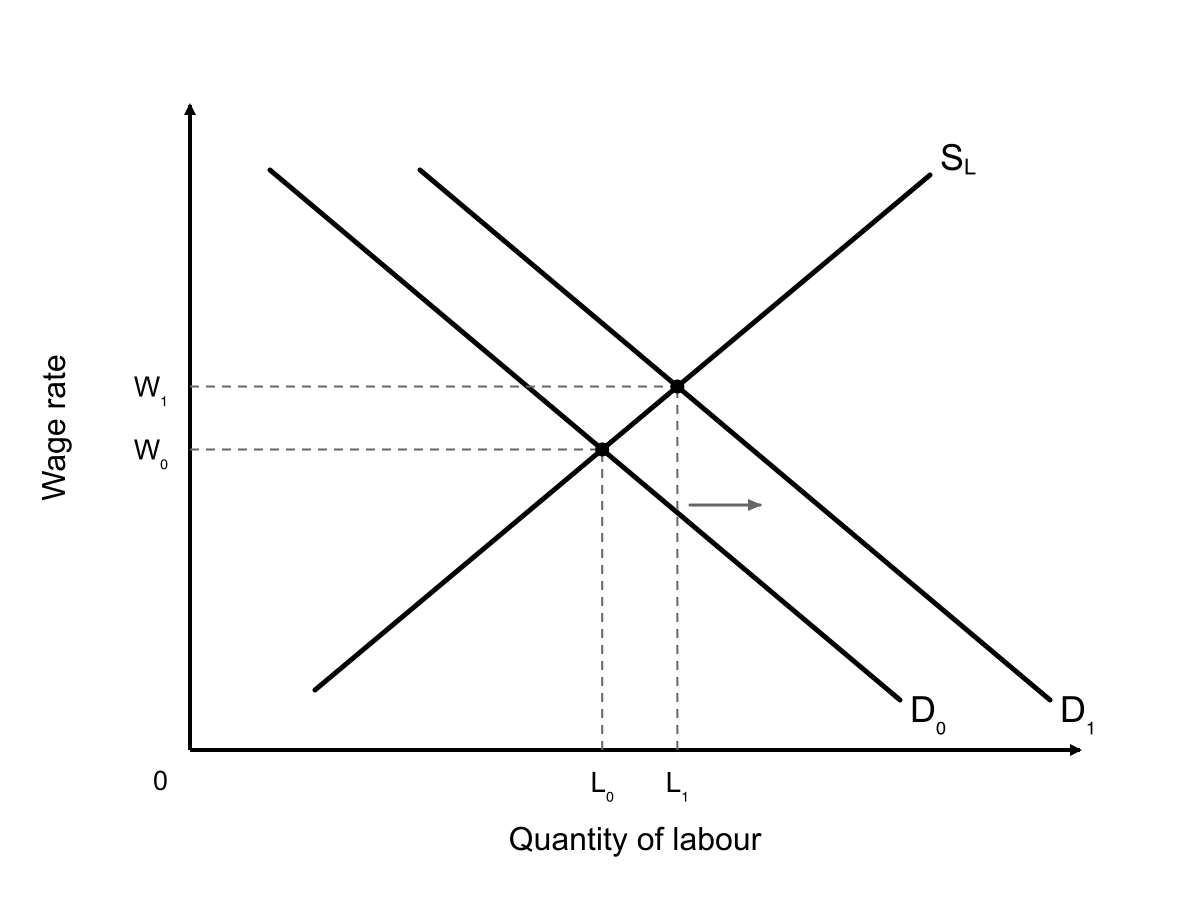 Demand for the product made by these workers rises, shifting labour demand from D₀ to D₁. What is the most likely result?
Employment rises, but the equilibrium wage must remain at W₀
The equilibrium wage falls from W₁ to W₀ and employment falls from L₁ to L₀
The equilibrium wage rises from W₀ to W₁ and employment rises from L₀ to L₁
The supply of labour shifts right and the equilibrium wage falls
1.5 Competitive and concentrated markets Questions
149 exam-style questions on AQA GCSE Economics 1.5 Competitive and concentrated markets, covering 1.5.1a The range of market structures, 1.5.1b Distinguishing between market structures, 1.5.2a Characteristics of a competitive market, 1.5.2b How producers operate in competitive markets, 1.5.2c The economic impact of competition, 1.5.3a Characteristics of a non-competitive market, 1.5.3b How producers operate in non-competitive markets, 1.5.3c Monopoly and oligopoly, 1.5.4a The labour market and wage determination, and 1.5.4b Gross and net pay. Each one has a worked solution and a mark scheme showing where the marks go.