Differences in skills and wages widen income gaps
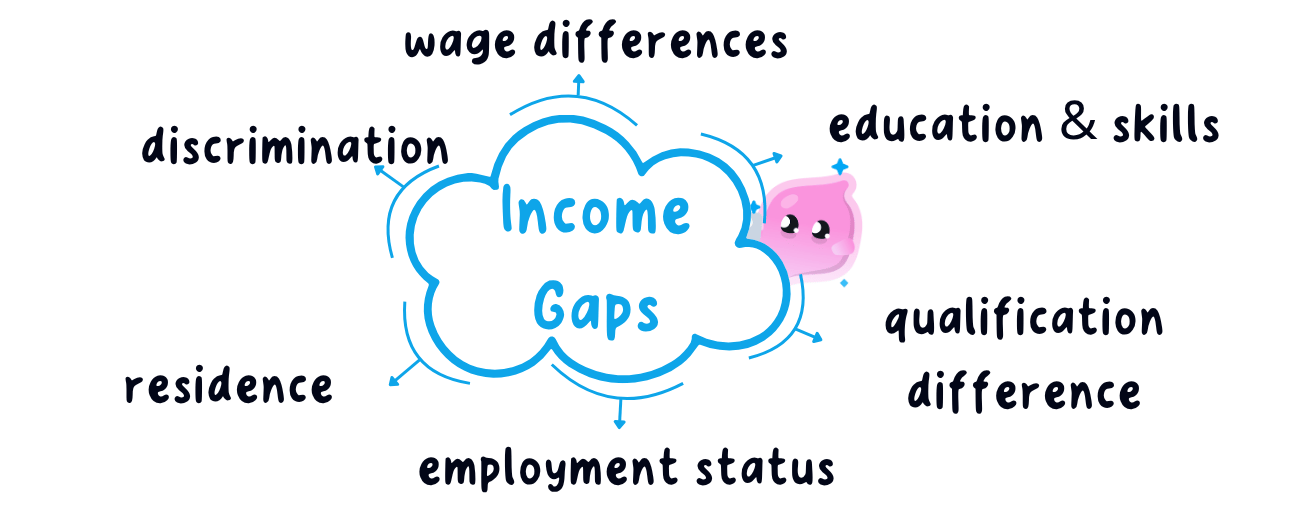
- Wage differences: are a major cause of income inequality, because some jobs pay far more than others.
- Education and skills: raise earning power, so a more qualified worker can usually command a higher wage.
- Workers with few qualifications are often stuck in low-paid jobs, which widens the income gap.
- Bargaining power: matters too, as workers in short supply, or represented by a strong trade union, can push wages up.
Example
- An NHS consultant, after years of training, earns far more than an entry-level care worker.
- When a skill is in short supply, such as specialist software engineering, employers bid wages up to attract it.
Employment status affects who earns an income
- Unemployment: removes earnings from work, so households relying on benefits usually have low incomes.
- Insecure or part-time work: provides fewer hours and lower pay than a full-time job.
- People who cannot find full-time work, or who work only a few hours, fall further behind full-time earners.
Region and discrimination also widen the gaps
- Region: average pay and job opportunities are not the same across the UK; ONS figures consistently show household incomes are higher in London and the South East than in the North East and Wales.
- Discrimination: occurs when people are paid or treated differently because of their gender, ethnicity or disability rather than their skills or productivity.
- The ONS's annual gender pay gap statistics are a real, ongoing example of how discrimination and occupational differences can leave one group earning less on average than another for broadly similar work.
Common Mistake
- Inequality is not simply the result of some people not trying hard enough.
- It also comes from differences in wages, skills, asset ownership, inheritance, region and discrimination that an individual cannot always control.
The causes reinforce one another over time
- Low wages make it hard to save, so little wealth builds up.
- Without wealth there is nothing to inherit, so the gap can pass to the next generation.
- Because these causes feed into each other, inequality can persist unless something breaks the cycle.
Example
- An NHS consultant, after years of training, earns far more than an entry-level care worker.
- When a skill is in short supply, such as specialist software engineering, employers bid wages up to attract it.
Owning assets and inheritance widen wealth gaps
- Ownership of assets: creates wealth inequality, because those who own homes, shares or businesses earn rent, dividends and rising asset values.
- People who already have wealth can save and invest more, so their wealth grows faster.
- Inheritance: passes wealth from one generation to the next, giving some families a head start.
- Those who inherit property or money can buy assets early in life, while others start with nothing.
Note
- Wealth tends to create more wealth, because assets earn returns that can be reinvested.
- This is why wealth gaps can widen even between people who earn similar wages.
Inequality can harm living standards and society
Definition
Social mobility: how easily a person can move to a different income or wealth group from the one they were born into.
- Inequality can leave those at the bottom in poverty, unable to afford a decent standard of living.
- Poorer households often have worse health and education, because they cannot afford good food, housing or extra support.
- Large gaps can reduce social mobility, making it harder for children from poor families to move up.
- Very wide gaps can create social tension and resentment between groups.
Case study
- In areas with high inequality, poorer children often attend worse-resourced schools, which limits their chances.
- This can trap talented people in low-paid work, which is a loss to them and to the economy.
Wide inequality can weaken the economy
- Poorer households spend a larger share of any income, so weak incomes at the bottom can reduce total spending in the economy.
- Wasted potential lowers productivity, as skills go undeveloped when people cannot afford training.
- Governments may have to spend more on benefits and public services to support low-income households.
Note
- Money given to low-income households is usually spent quickly, which supports demand and jobs.
- So reducing extreme inequality can, in some cases, help the wider economy.
Some inequality can create useful incentives
- Some inequality can act as an incentive, rewarding effort, skill and risk-taking.
- The chance to earn more encourages people to gain skills, work hard and take on responsibility.
- The prospect of higher rewards encourages enterprise, as people start businesses hoping to succeed.
- Higher earners can save and invest, which may help fund investment and growth.
Common Mistake
- Do not treat inequality and poverty as the same thing: inequality is about the gap between groups, while poverty is about being unable to afford basic needs.
- Some inequality can exist without anyone being in poverty.
Whether inequality helps or harms depends on degree
- It depends on how large the gap is, because a little inequality can motivate effort, while an extreme gap tends to cause more harm than good.
- It depends on social mobility, because if people born into poorer households can realistically move up, the same size of gap causes less lasting harm.
- It depends on what higher earners do with their money, because savings and investment by high earners only benefit growth if that money is actually invested, rather than left idle.
- On balance, a moderate degree of inequality can reward effort without much cost, but very wide and persistent gaps usually do more economic and social harm than good.
Exam technique
- For an evaluate question on inequality, weigh the harms, such as poorer health and lower social mobility, against the argument that some inequality rewards effort and enterprise.
- Reach a supported judgement rather than sitting on the fence, for example by linking the size of the gap and the level of social mobility to your conclusion.
- Avoid the common trap of listing causes without developing them: explain how each cause leads to a wider gap, rather than just naming it.
Self review
- Give three causes of income or wealth inequality.
- Explain how inheritance can widen wealth inequality.
- Give two ways in which inequality can harm the economy.
- Explain one way in which some inequality might be beneficial.
- Why does the effect of inequality on society depend on social mobility?