Globalisation cuts prices and widens choice for consumers
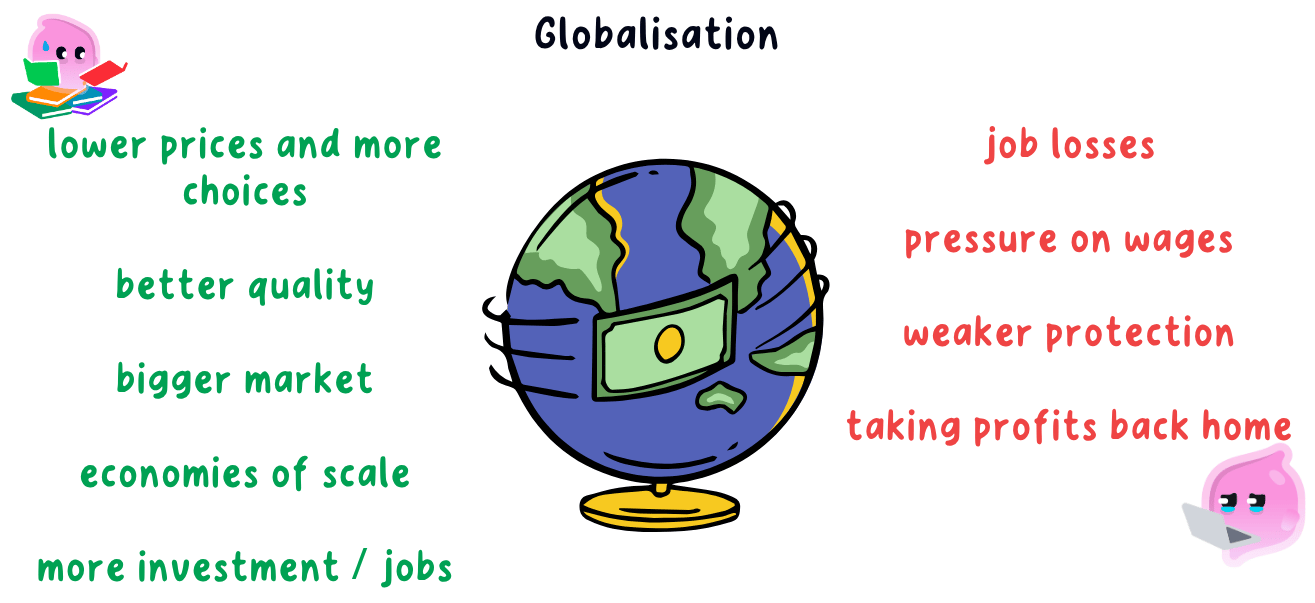
- Lower prices: goods can be made wherever costs are lowest, so shoppers in developed countries such as the UK pay less.
- Greater choice: consumers can buy products and foods from all over the world, all year round.
- Better quality: firms have to compete with rivals from many countries, which can raise quality as well as value.
Case study
- A UK supermarket such as Sainsbury's sells food, clothes and electronics sourced from dozens of countries.
- Because it buys where costs are lowest, shoppers pay less and get far more choice.
- Fruit that was once seasonal, such as grapes or berries, is now available all year round.
Producers and workers in developed countries can gain too
- Bigger markets: firms can sell to customers across the world, not just at home.
- Economies of scale: producing on a larger global scale lowers the average cost of each unit.
- Investment and jobs: a multinational choosing to build in the UK brings new jobs, wages and often new skills.
Case study
- Nissan's factory in Sunderland was built through foreign investment and employs thousands of UK workers.
- It manufactures cars for sale across the UK and beyond, showing producers and workers in a developed country gaining from a globalised market.
- The jobs, wages and supply-chain orders it creates spread through the local economy.
- In 2026 Nissan announced a wider global restructuring that cut jobs elsewhere in Europe, but the company confirmed no redundancies at Sunderland, showing how one plant's fortunes can diverge from those of a struggling parent company.
But developed-country workers can also lose out
- Job losses: production can move to countries with lower costs, so traditional industries in developed economies shrink.
- UK manufacturing and steel-making are examples of industries that have faced this kind of pressure over recent decades.
- Pressure on wages: firms can threaten to move production abroad, which can weaken the bargaining power of workers who stay.
Note
- Not every developed-country worker gains from globalisation at the same time.
- The same global market that creates jobs at a car plant can destroy them at a steel plant.
Less developed countries can gain jobs and investment
- New jobs: multinationals building factories create paid work for people who had few other opportunities.
- Foreign investment: money, machinery and new technology flow into the local economy.
- Rising exports: growing sales abroad can lift national income and reduce poverty over time.
Case study
- Bangladesh's garment industry now employs several million workers, most of them producing clothes for export to developed-country retailers.
- Foreign investment and new export orders have been a major source of the country's economic growth over the past three decades.
Wages and conditions there can still be poor
- Low wages: workers in less developed countries are often paid far less than workers doing similar jobs in developed countries.
- Weaker protection: labour laws and enforcement can be weaker, so conditions and workers' rights are not always well protected.
- Profits leaving the country: much of the profit a multinational makes is often sent back to its home country rather than staying in the local economy.
Common Mistake
- Never give a one-sided answer on globalisation.
- Lower prices and new jobs must be weighed against lost jobs in developed countries and low pay in less developed ones.
- Top marks come from a balanced judgement, not a list of only good or only bad points.
How far globalisation's benefits outweigh its costs
- It depends on which country you look at, because consumers and growing firms in developed countries such as the UK tend to gain quickly, while some workers in both developed and less developed countries can lose out or be paid poorly.
- It depends on whether jobs and wages in less developed countries improve over time, because a country whose export industries mature and raise pay and conditions gains far more than one stuck with permanently low wages.
- It depends on how mobile the affected workers are, because workers who can retrain or move into new industries lose less than those concentrated in a single declining industry or town.
- On balance, globalisation raises average living standards worldwide, but a strong answer names the specific producers, workers or consumers who gain and who lose, rather than treating it as simply good or bad.
Exam technique
- Use the three groups in the question (producers, workers, consumers) and the three settings (developed countries, less developed countries, the UK) to structure your answer, rather than writing about globalisation in general.
- Anchor a point in a real example, such as Nissan's Sunderland plant for UK gains or low pay in a garment-exporting country for the costs, rather than asserting a benefit or drawback without evidence.
Self review
- Give one benefit of globalisation for UK consumers.
- Give one benefit and one drawback for producers and workers in a developed country such as the UK.
- Give one benefit and one drawback for producers and workers in a less developed country.
- Why can the gains from globalisation be shared unevenly between different groups?
- What makes a judgement on globalisation balanced rather than one-sided?