Revision notes for Edexcel GCSE Computer Science Low-level and high-level languages. Open the guide for explanations and worked examples. Written against the Edexcel GCSE Computer Science (1CP2) specification, so the content matches what's examinable rather than general Computer Science background.
Low-level and high-level languages
What you'll learn
- What low-level and high-level programming languages are.
- The difference between machine code, assembly language, and languages such as Python.
- Why different types of language are used for different jobs.
- How to explain characteristics and purposes clearly in exam answers.
Why programming languages exist
A computer program is a set of instructions that tells a computer what to do. Humans need a way to write those instructions, and the computer needs a way to run them.
The key problem is that the CPU — the part of the computer that processes instructions — does not understand English or Python directly. At the hardware level, it works with electrical signals represented as binary values: 0s and 1s.
Definition
Programming language
A programming language is a formal language used to write instructions that a computer can follow.
Different programming languages sit at different “levels”. The level tells you how close the language is to the hardware.
Abstraction: the big idea
Before comparing languages, you need the word abstraction.
Definition
Abstraction
Abstraction means hiding unnecessary detail so that a programmer can focus on the main problem rather than every hardware detail.
A high level of abstraction means the language hides lots of hardware detail. A low level of abstraction means the programmer can see and control more of what the hardware is doing.
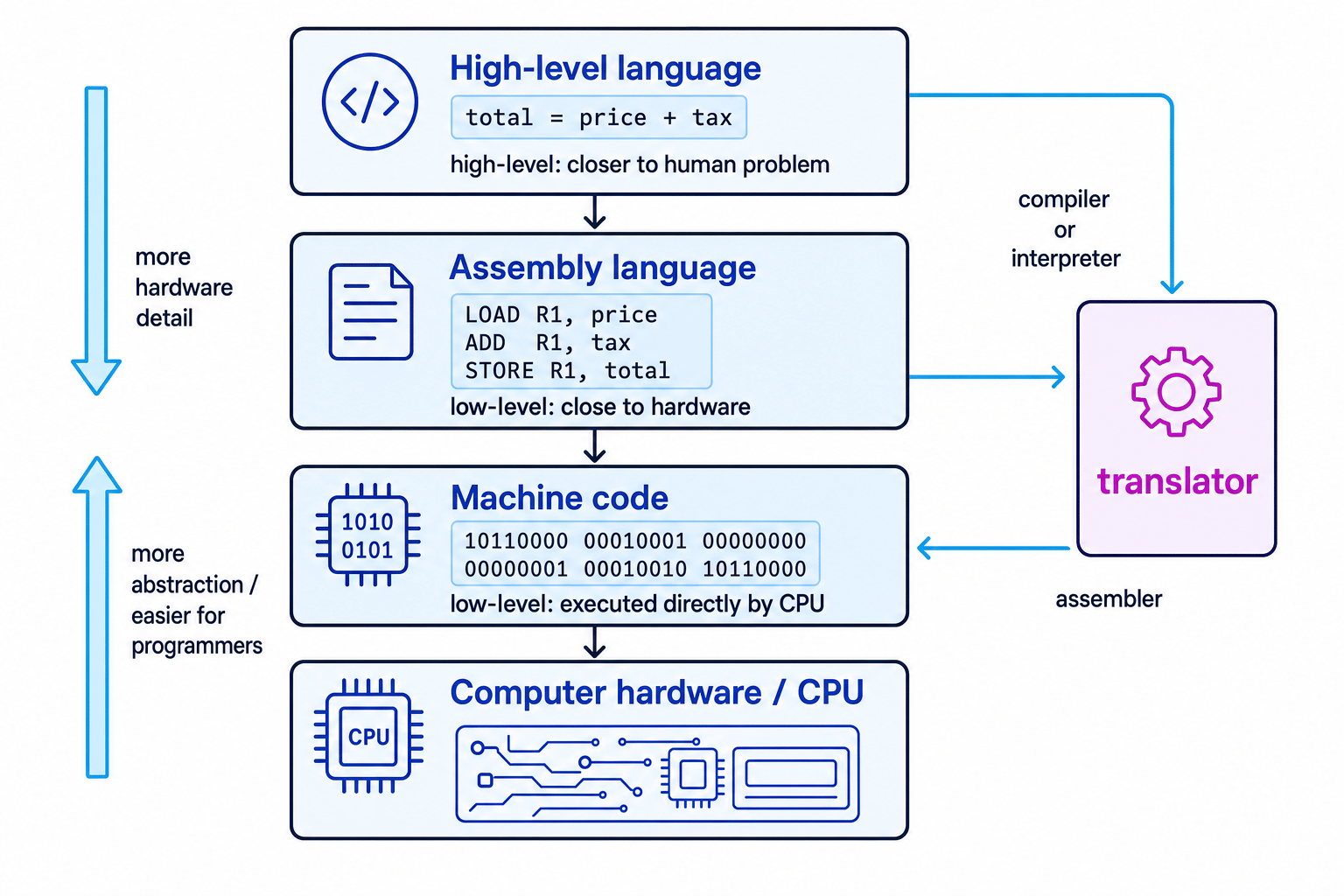
This diagram shows the idea of language levels and common translators. The vertical layers show closeness to hardware, not one fixed route that every program must follow.
Key Idea
Level means distance from hardware
A low-level language is close to the computer’s hardware. A high-level language is closer to human language and the problem the programmer is solving.
Low-level languages
A low-level programming language gives the programmer more direct control over the computer’s hardware. Low-level languages are harder for humans to read and write, but they are very close to the instructions the CPU actually runs.
There are two main low-level languages you should know for GCSE:
- Machine code
- Assembly language
Machine code
Definition
Machine code
Machine code is the binary code made of 0s and 1s that can be executed directly by the CPU.
Machine code is the lowest-level programming language. It is made from binary instructions. Each CPU type has its own machine code, so machine code written for one processor may not work on a different processor.
Characteristics of machine code
Machine code is:
- Executed directly by the CPU — no further translation is needed.
- Written in binary — this makes it very hard for humans to read.
- Processor-specific — it depends on the CPU architecture.
- Very close to hardware — it can control specific hardware operations.
- Difficult to debug and maintain — small changes can be hard to understand.
Machine code might look like a long sequence such as 1011 0000 0001 0010. You are not expected to learn real machine code instructions for GCSE; you just need to understand what machine code is and why it matters.
Assembly language
Definition
Assembly language
Assembly language is a low-level language that uses short words called mnemonics to represent machine code instructions.
A mnemonic is a short, memorable code such as LOAD, ADD, or STORE. Assembly language is easier for humans than pure binary, but it is still closely linked to the CPU.
An assembler is a translator that converts assembly language into machine code.
Characteristics of assembly language
Assembly language is:
- Low-level — it is still close to the hardware.
- More readable than machine code — it uses mnemonics instead of just binary.
- Processor-specific — different CPU types use different assembly languages.
- Efficient and precise — it can give detailed control over memory and processor operations.
- Translated by an assembler — the CPU cannot directly run assembly language.
Assembly language may include references to registers, which are tiny storage locations inside the CPU. For example, R1 might mean “register 1”.
Example
Spotting low-level code
You are shown these two fragments:
- Fragment A:
total = price + tax - Fragment B:
LOAD R1, price,ADD R1, tax,STORE R1, total
- Fragment A uses meaningful variable names and one statement that describes the overall problem: calculating a total. This suggests a high level of abstraction.
- Fragment B breaks the task into CPU-like operations: loading a value, adding another value, and storing the result. It also refers to
R1, which looks like a CPU register. - Therefore, Fragment B is the low-level fragment. It is closer to the hardware and would need an assembler if it were real assembly language.
Purposes of low-level languages
Low-level languages are useful when the programmer needs close control over the hardware.
They may be used for:
- Device drivers — software that lets the operating system communicate with hardware such as printers, keyboards, or graphics cards.
- Embedded systems — computers built into larger devices, such as washing machines, routers, or traffic lights.
- Firmware — software stored on a device that controls how the hardware behaves.
- Performance-critical code — parts of a program where speed or memory use is especially important.
Low-level code is not usually chosen for ordinary applications because it takes longer to write and is harder to maintain.
High-level languages
Definition
High-level language
A high-level programming language is a language that is designed to be easier for humans to read and write, with less direct concern for hardware details.
Python is a good example of a high-level language. A statement such as total = price + tax is much closer to the way a human thinks about the problem than to the way a CPU actually performs the calculation.
Characteristics of high-level languages
High-level languages are usually:
- Easier to read and write — they use words, symbols, and structures closer to human thinking.
- Easier to debug — errors are often easier to find because the code is more understandable.
- More portable — the same program can often run on different types of computer after translation.
- Quicker to develop in — programmers can solve problems using fewer lines of code.
- Less directly linked to hardware — the programmer does not usually control exact CPU instructions.
- Translated before execution — a compiler or interpreter is needed.
A compiler translates a whole high-level program into machine code before it is run. An interpreter translates and runs a high-level program one instruction at a time. You do not need to go deep into translators for this spec point, but you should know that high-level code must be translated because the CPU ultimately runs machine code.
Purposes of high-level languages
High-level languages are used for most software development because they make programming faster and less error-prone.
They are suitable for:
- Application software, such as word processors or booking systems.
- Games and interactive programs.
- Websites and web apps.
- Data processing and school/business systems.
- Programs where readability and maintainability are important.
A high-level language lets the programmer focus on the problem being solved, not on individual CPU instructions.
Common Mistake
Low-level does not mean old or bad
Do not write that low-level languages are “worse” than high-level languages. They are different tools. Low-level languages are harder to use, but they are valuable when direct hardware control is needed.
Comparing low-level and high-level languages
| Feature | Low-level languages | High-level languages |
|---|---|---|
| Closeness to hardware | Very close to the CPU and memory | Further from hardware |
| Readability | Harder for humans to read | Easier for humans to read |
| Examples | Machine code, assembly language | Python, Java, JavaScript |
| Translation | Machine code runs directly; assembly uses an assembler | Uses a compiler or interpreter |
| Portability | Usually processor-specific | Usually more portable |
| Control | More direct hardware control | Less direct hardware control |
| Development speed | Slower to write and maintain | Faster to write and maintain |
| Typical purpose | Drivers, firmware, embedded systems | Apps, games, websites, general programs |
Choosing the right language level
In an exam, you may be asked why one type of language is suitable for a particular task. The best answers link a characteristic to a purpose.
A characteristic is a feature of the language. A purpose is what the language is used for.
Example
Choosing a language level for a task
A company needs two programs: one for controlling a small sensor inside a medical device, and one for managing staff holiday bookings.
- The sensor program is close to hardware. It may need to control memory, input/output signals, or timing very precisely.
- A low-level language could be suitable for the sensor because it gives more direct control over the hardware and can be efficient.
- The holiday booking system mainly stores, searches, and displays data for users. It does not need direct CPU or memory control.
- A high-level language would be suitable for the booking system because it is easier to write, debug, maintain, and adapt.
Tip
Characteristic or purpose?
If the question asks for a characteristic, describe what the language is like. If it asks for a purpose, describe what it is used for and why that matters.
The key contrast
Low-level languages are close to the machine. They give control and efficiency, but they are difficult for humans.
High-level languages are close to the programmer. They make code easier to understand and maintain, but they hide hardware details and need translation.
For GCSE, you do not need to write real assembly or machine code. You do need to recognise the difference, describe characteristics, and explain suitable uses.
Exam technique
In the exam
- If asked to compare, use paired points: for example, “low-level is closer to hardware, whereas high-level is closer to human language.”
- Always link purposes to the scenario: embedded system or driver suggests low-level; general application software suggests high-level.
- Avoid vague answers such as “high-level is better”. Say exactly why: easier to read, easier to debug, more portable, or faster to develop.
- Remember that the CPU ultimately executes machine code, so high-level and assembly programs must be translated.
Self review
Check yourself
- What are two characteristics of a low-level programming language?
- Why is Python considered a high-level language?
- Give one situation where assembly language might be more suitable than a high-level language.
You've reached the end
Test yourself on this topic, or move on to the next guide.
How was this guide?