Revision notes for Edexcel GCSE Computer Science Benefits of subprograms. Open the guide for explanations and worked examples. Written against the Edexcel GCSE Computer Science (1CP2) specification, so the content matches what's examinable rather than general Computer Science background.
Benefits of subprograms
What you'll learn
- What a subprogram is: a named block of instructions that carries out a specific task.
- How subprograms support decomposition: breaking a problem into smaller parts.
- How subprograms support abstraction: hiding unnecessary detail so you can focus on the main idea.
- The main benefits: easier reuse, testing, debugging, maintenance, readability and teamwork.
Starting point: why split up a program?
A program is a set of instructions written to solve a problem. As programs get bigger, it becomes harder to understand everything at once.
For example, a quiz program might need to:
- ask for the player’s name
- ask several questions
- check answers
- calculate a score
- display feedback
- save the result
If all of that code is written as one long block, it can become difficult to read, test or change. Subprograms help by splitting the program into named sections.
Definition
Decomposition and abstraction
Decomposition means breaking a large problem into smaller, more manageable parts. Abstraction means focusing on the important details and hiding unnecessary detail.
Example
Decomposing a quiz program
- Separate the main responsibilities: getting the player’s name, asking questions, calculating the score, displaying feedback and saving the result are different jobs.
- Turn jobs that are repeated or logically separate into subprograms, such as
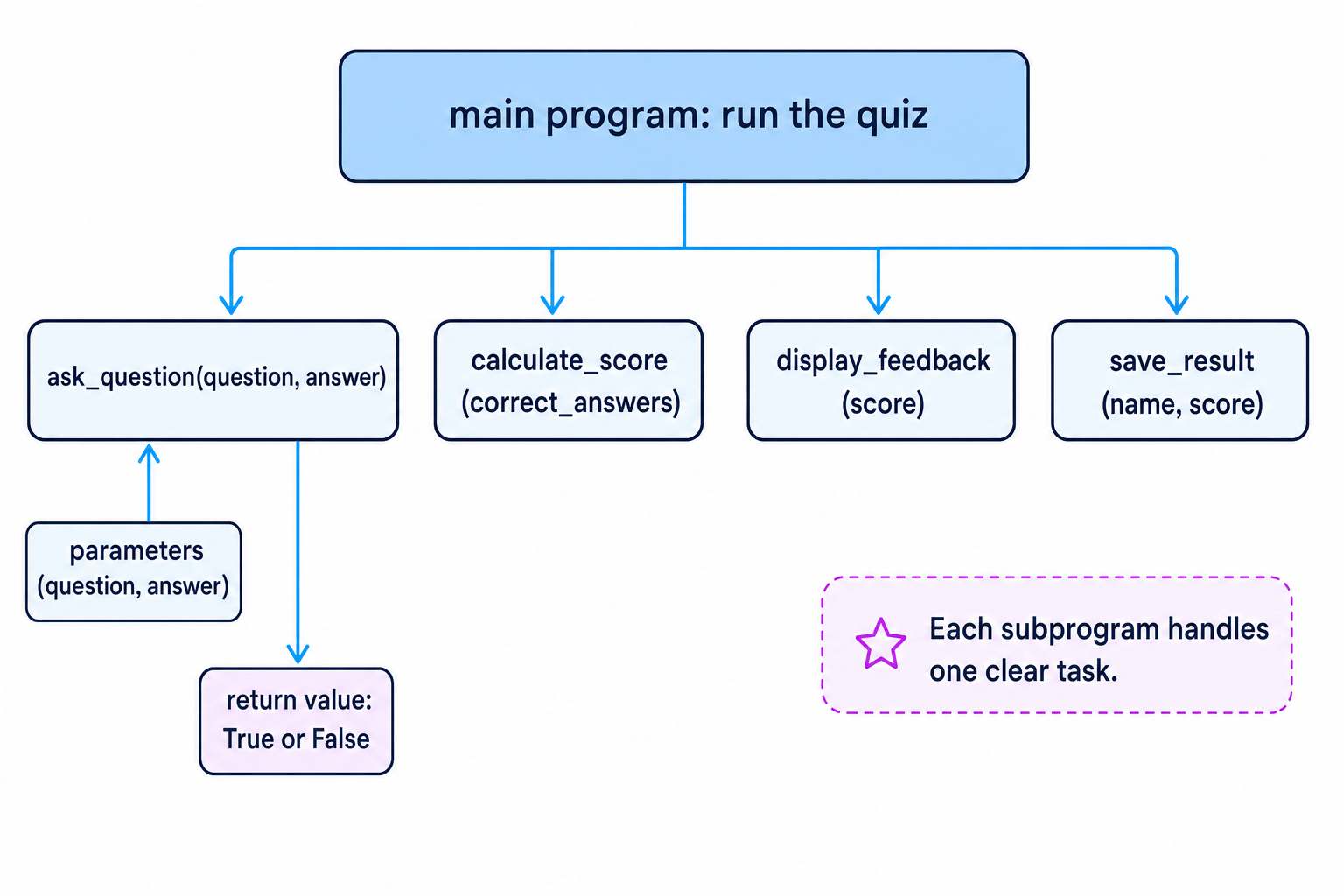
ask_question()andcalculate_score(). - Decide what information each subprogram needs. For example,
ask_question(question, answer)needs the question text and the correct answer. - Decide what each subprogram should give back. For example,
ask_question()could returnTrueif the answer is correct andFalseif it is not.
What is a subprogram?
Definition
Subprogram
A subprogram is a named block of instructions that performs one specific task. The main program, or another subprogram, can call it by name when that task is needed.
A call means telling the program to run a particular subprogram. After the subprogram finishes, control usually returns to the part of the program that called it.
Subprograms can also receive values called parameters, which are named pieces of data the subprogram uses. A subprogram may send back a return value, which is the result it gives to the part of the program that called it.
Here is a simple way to picture a main quiz program calling smaller subprograms.
Functions and procedures
You may see two common types of subprogram.
A function is a subprogram that returns a value. For example, calculate_score() might return the final score.
A procedure is a subprogram that performs an action but does not return a useful value. For example, display_feedback() might print a message on the screen.
In Python 3, both are written using def, but the idea is still useful: some subprograms calculate and return something, while others mainly carry out an action.
Key Idea
One clear job
A good subprogram should usually have one clear purpose. If you can describe its job with a short, meaningful name like calculate_total() or check_password(), it is likely to be easier to understand.
Benefit 1: programs become easier to understand
Subprograms make a program more readable because each part has a clear name.
Instead of reading a long block of code, you can read the main program almost like a plan:
get_player_name()run_quiz()calculate_score()display_feedback()save_result()
You do not need to know every detail immediately. You can understand the overall structure first, then look inside a specific subprogram if needed.
This is abstraction in action: the details are still there, but they are hidden inside named sections.
Benefit 2: code can be reused
Reuse means writing code once and using it many times. This is one of the biggest benefits of subprograms.
If several parts of a program need to do the same task, you can call the same subprogram instead of copying and pasting the same code.
Example
Avoiding repeated validation code
- Imagine a school system checks whether an age is valid in three places: registration, sports team sign-up and trip booking.
- Without a subprogram, the same range check might be copied into all three places. If the allowed age range changes, all three copies must be found and edited.
- With a subprogram such as
is_valid_age(age), each part of the program calls the same check. The rule is written once. - If the age rule changes later, only
is_valid_age(age)needs to be updated, so the program is less likely to become inconsistent.
Tip
Reuse is stronger than copy-paste
In an exam, “code can be reused” is a better answer than “you do not have to write as much code” because it explains the programming benefit more precisely.
Benefit 3: programs are easier to test and debug
Testing means checking that a program works correctly. Debugging means finding and fixing errors in a program.
Subprograms help because you can test one small part at a time. If a subprogram has a clear input and expected output, it is much easier to check whether that part is working.
Example
Testing a scoring subprogram
- Suppose
calculate_points(wins, draws)should use the formula points=wins×3+drawspoints = wins \times 3 + drawspoints=wins×3+draws. - Test it with 4 wins and 2 draws. The expected result is 4×3+2=144 \times 3 + 2 = 144×3+2=14.
- If the subprogram returns 10 instead, the fault is likely to be inside
calculate_points(), not in the menu, input code or display code. - Because the scoring logic is in one place, you can fix the formula once and then retest that subprogram.
Benefit 4: programs are easier to maintain
Maintenance means changing a program after it has been written. This might include fixing bugs, adding new features or changing how something works.
Subprograms make maintenance easier because related code is grouped together. If the scoring system changes, you look for calculate_score(). If the password rules change, you look for check_password().
This saves time and reduces the chance of accidentally changing the wrong part of the program.
Common Mistake
Vague benefit answers
Avoid answers like “subprograms make the program better” or “it is easier”. Always say what becomes easier, such as testing, debugging, reading, reusing or maintaining the code.
Benefit 5: less duplicated code means fewer errors
Repeated code is risky. If the same instructions are copied into several places, a mistake may be copied too. If the code later needs changing, one copy might be updated while another is forgotten.
Using a subprogram means there is one main version of the logic. This improves consistency.
For example, if every login screen calls check_password(password), they all follow the same password rule. That is safer than having slightly different password checks in different places.
Benefit 6: teamwork is easier
In larger projects, different programmers can work on different subprograms.
To do this, they agree the subprogram’s interface. In this context, the interface means how other parts of the program use it: its name, parameters and return value.
For example, one programmer could write calculate_score(correct_answers), while another writes display_feedback(score). As long as both programmers agree what data is passed in and what is returned, they can work more independently.
Bringing the benefits together
Subprograms are useful because they support good program structure. They are not just a way to shorten code; they help you design programs that are easier to reason about.
A strong GCSE answer might explain several linked benefits:
| Benefit | What it means |
|---|---|
| Readability | The main program is easier to follow because tasks have meaningful names. |
| Reuse | The same subprogram can be called many times. |
| Less duplication | Code is not copied into lots of places. |
| Easier testing | Small parts can be checked separately. |
| Easier debugging | Errors can be narrowed down to a particular subprogram. |
| Easier maintenance | Changes can be made in one relevant place. |
| Teamwork | Different people can work on different subprograms. |
Exam technique
In the exam
- Name a specific benefit, such as reuse, easier testing, easier debugging, easier maintenance or improved readability.
- Explain the effect of that benefit, for example: “the code only needs changing in one place”.
- If the question gives a scenario, link your answer to it: mention the actual task, such as calculating a score, checking a password or displaying results.
Self review
Check yourself
- What is the difference between a function and a procedure?
- Why does using one validation subprogram reduce the chance of inconsistent rules?
- How do subprograms support decomposition and abstraction?
You've reached the end
Test yourself on this topic, or move on to the next guide.
How was this guide?