Question 19
FA student adds dilute hydrochloric acid to 25.0 cm325.0\,\mathrm{cm^{3}}25.0cm3 of sodium hydroxide solution. The student measures the pH of the mixture with a pH meter.
The graph shows the results.
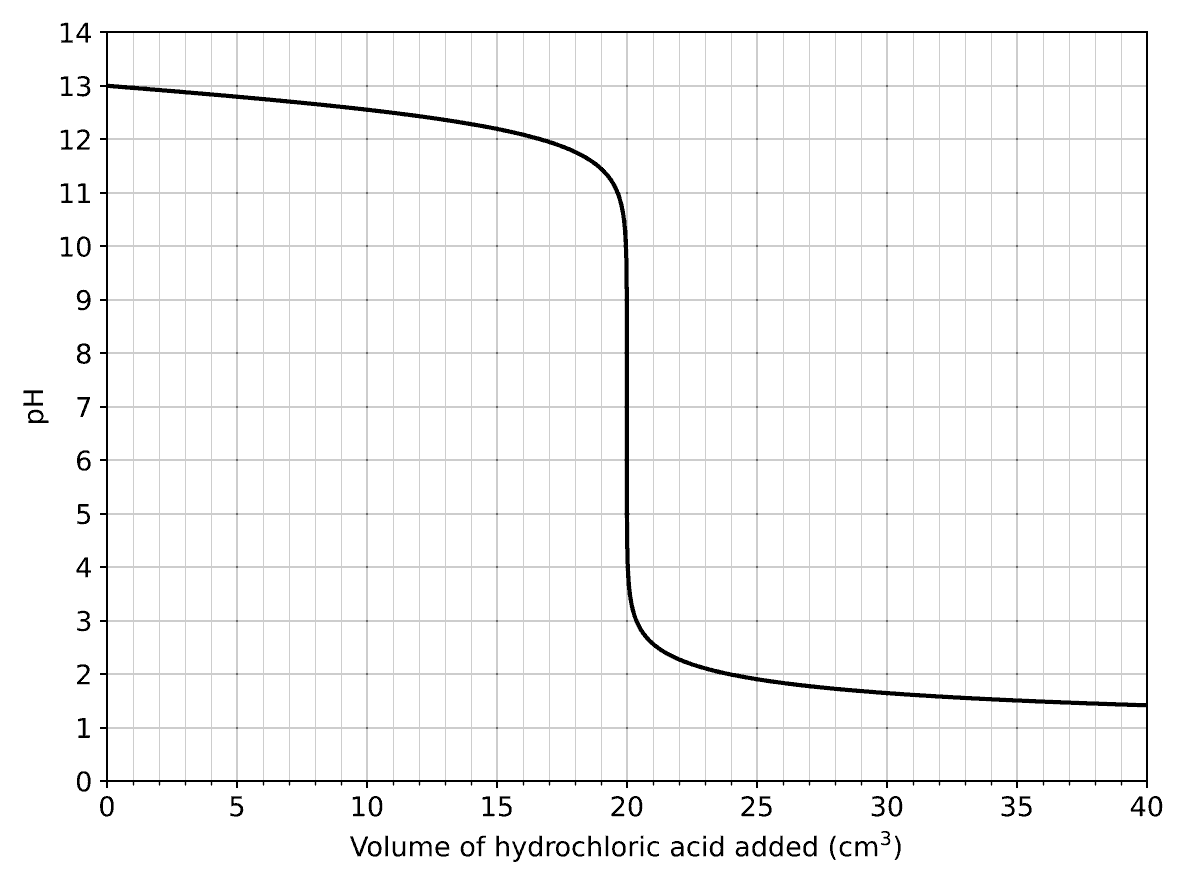
Statement 1: The mixture is neutral when 20 cm320\,\mathrm{cm^{3}}20cm3 of acid has been added.
Statement 2: After 30 cm330\,\mathrm{cm^{3}}30cm3 of acid has been added, the mixture contains more hydrogen ions than hydroxide ions.
Statement 3: If the student used 50.0 cm350.0\,\mathrm{cm^{3}}50.0cm3 of the same sodium hydroxide solution, 20 cm320\,\mathrm{cm^{3}}20cm3 of acid would still make the mixture neutral.
Which statements are correct?
A
1 only
B
1 and 2 only
C
1 and 3 only
D
1, 2 and 3
3.3 Types of chemical reactions Questions
112 exam-style questions on OCR GCSE Chemistry 3.3 Types of chemical reactions, covering 3.3.1 Oxidation and reduction in terms of oxygen, 3.3.2 Acids, alkalis and neutralisation, 3.3.3 The pH scale and measuring pH, 3.3.4 Oxidation and reduction in terms of electrons, 3.3.5 Dilute and concentrated, weak and strong acids, and 3.3.6 Hydrogen ion concentration and pH. Each one has a worked solution and a mark scheme showing where the marks go.