Question 6
FA student investigates the reduction of copper oxide.
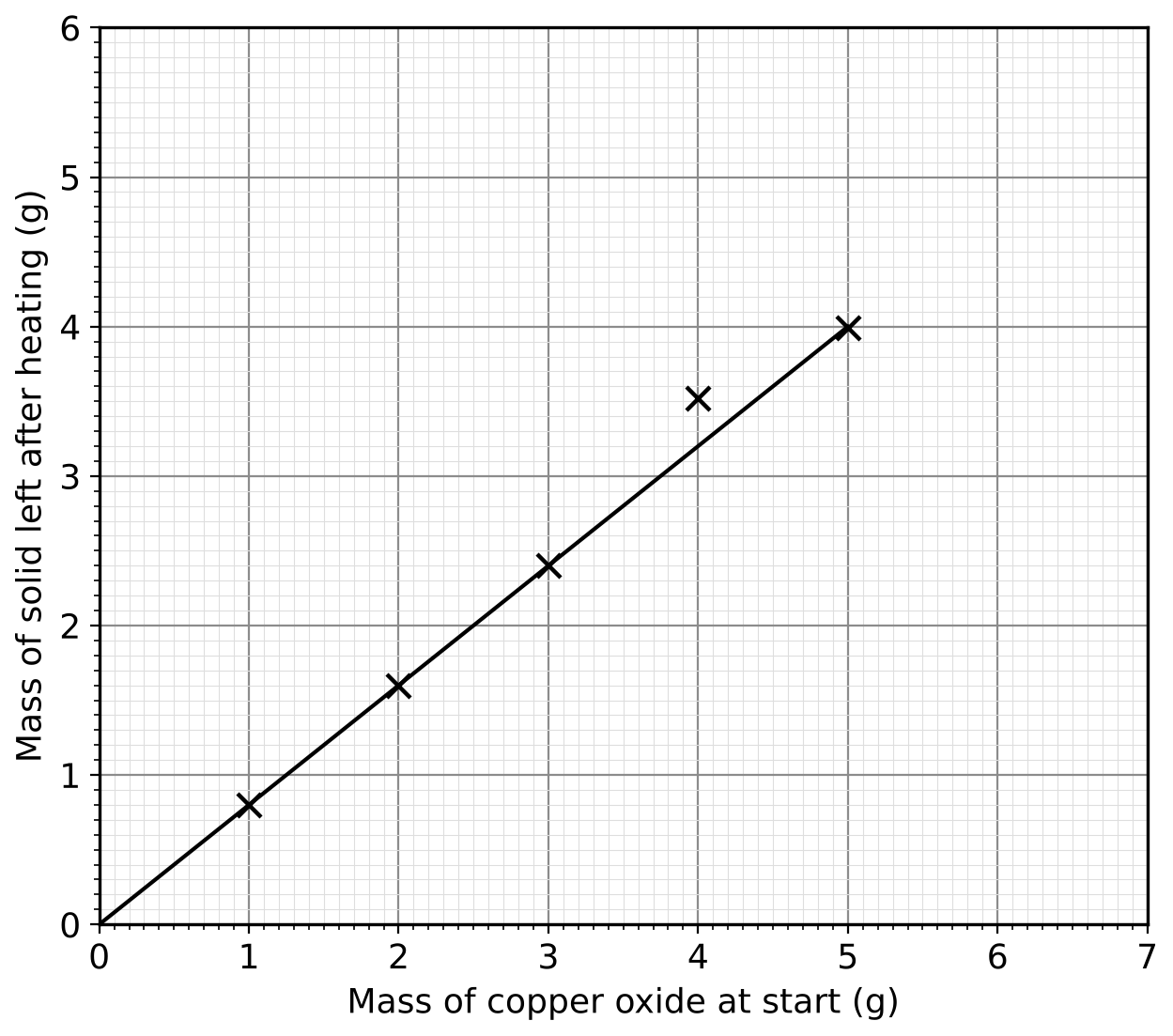
The student heats different masses of black copper oxide in a stream of hydrogen gas. The copper oxide turns into pink-brown copper.
copper oxide + hydrogen → copper + water
The water leaves the tube as steam. The student measures the mass of solid left after heating.
The graph shows the results.
a.[1]
Explain why copper oxide is reduced in this reaction.
b.[2]
Name the substance that is oxidised in this reaction.
Explain your answer.
c.i.[1]
One of the results is anomalous.
Write down the mass of copper oxide at the start for the anomalous result.
c.ii.[2]
Suggest a reason for the anomalous result.
Explain your answer.
d.[2]
Use the graph to calculate the percentage by mass of oxygen in copper oxide.
e.[1]
Use the graph to predict the mass of copper the student would make from 7.00 g of copper oxide.
f.[2]
The student says:
"The mass of solid goes down, so mass is not conserved in this reaction."
Evaluate the student's statement.
3.3 Types of chemical reactions Questions
53 exam-style questions on OCR GCSE Chemistry 3.3 Types of chemical reactions, covering 3.3.1 Oxidation and reduction in terms of oxygen, 3.3.2 Acids, alkalis and neutralisation, 3.3.3 The pH scale and measuring pH, 3.3.4 Oxidation and reduction in terms of electrons, 3.3.5 Dilute and concentrated, weak and strong acids, and 3.3.6 Hydrogen ion concentration and pH. Each one has a worked solution and a mark scheme showing where the marks go.