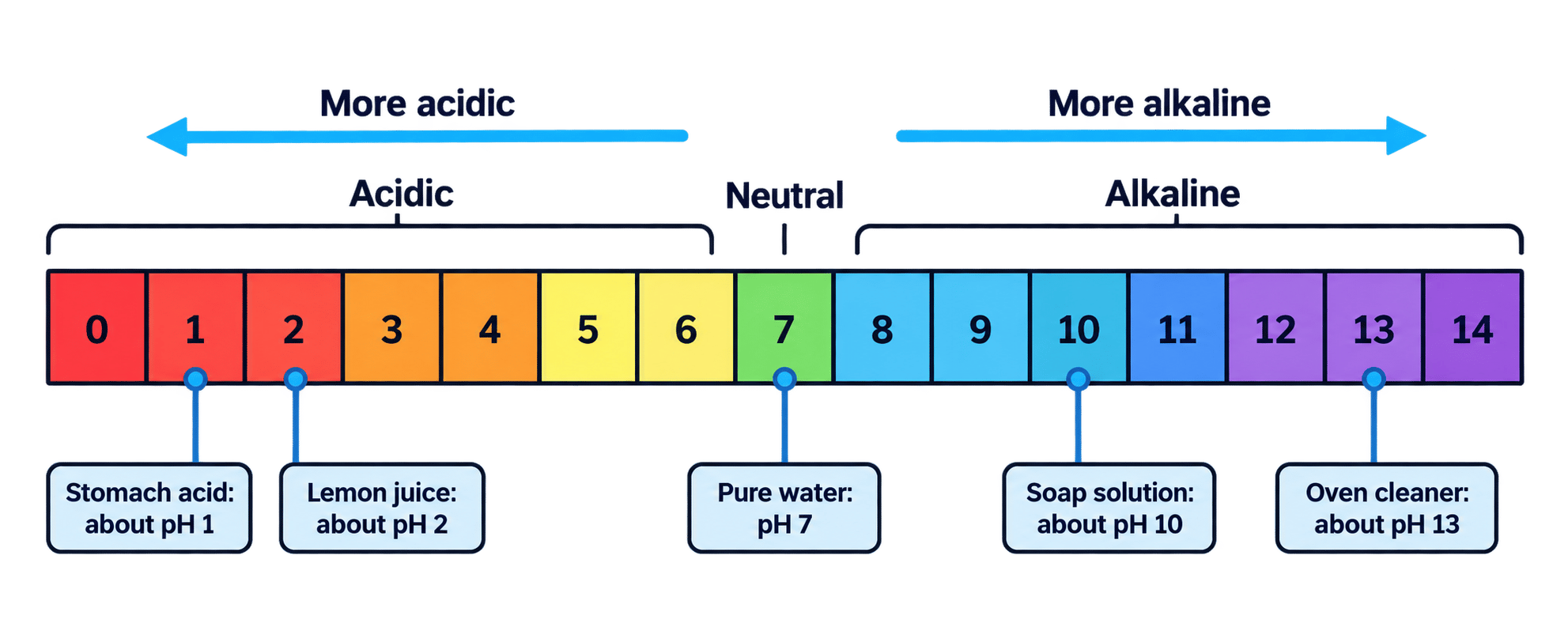
The pH scale measures acidity and alkalinity
Definition
pH
A number, usually from 0 to 14, that shows how acidic or alkaline a solution is.
Definition
Neutral solution
A solution that is neither acidic nor alkaline, with a pH of 7.
- pH values usually run from 0 to 14, and every aqueous solution has a place on this one scale.
- A solution with a pH below 7 is acidic, and the lower the pH, the more acidic it is.
- A solution with a pH of 7 is neutral, like pure water.
- A solution with a pH above 7 is alkaline, and the higher the pH, the more alkaline it is.
- Placing solutions on the same scale shows their relative acidity, so a solution of pH 2 is more acidic than one of pH 5.
Example
Stomach acid is about pH 1, lemon juice about pH 2, pure water pH 7, soap solution about pH 10 and oven cleaner about pH 13.
Universal indicator shows an approximate pH through its colour
Definition
Universal indicator
A mixture of dyes that turns a different colour in each part of the pH range.
- A few drops of universal indicator added to a solution give a colour that depends on the pH.
- Acidic solutions turn it red, orange or yellow, with red for the lowest pH.
- A neutral solution turns it green.
- Alkaline solutions turn it blue or purple, with purple for the highest pH.
- The colour is matched against a colour chart to read off the pH, usually to the nearest whole number.
- Indicator paper soaked in universal indicator works in the same way when a drop of solution is placed on it.
- A glass rod transfers one drop to the paper, so the rest of the sample is not contaminated.
Common Mistake
Do not use litmus to find a pH, because it only turns red in acid and blue in alkali and cannot show how acidic a solution is.
A pH probe gives a more precise reading
Definition
pH probe
An electronic sensor that is dipped into a solution and shows its pH as a number.
- Before use, the probe is calibrated in solutions of known pH, such as pH 4 and pH 7, so its readings are accurate.
- Rinse the probe with distilled water before it goes into each new sample, so no solution is carried over.
- Dip the tip of the probe into the sample and wait until the reading is steady before recording it.
- A probe gives the pH to one or two decimal places, such as pH 6.4, while a colour chart gives whole numbers.
- This makes a probe better for spotting small changes, such as the pH of a pond water sample shifting over a week.
- A probe also avoids judging a colour, which varies from person to person and does not work in a coloured solution such as blackcurrant squash.
Note
A pH probe can be connected to a data logger to record the pH continuously, for example while an alkali is added to an acid.
Choosing a pH method by the precision needed
- Universal indicator solution is quick and cheap and shows the approximate pH of a colourless solution.
- Indicator paper suits small samples, such as a single drop taken from a pipette.
- A pH probe suits a precise value, a coloured solution or a series of readings over time.
- Whichever method is used, a clean container and a fresh sample stop contamination from changing the result.
- Samples that are being compared are all tested by the same method, so the comparison is fair.
Practical
Measuring the pH of household solutions
- Aim: compare the pH of several household solutions.
- Apparatus: a white spotting tile, dropping pipettes, universal indicator with its pH colour chart, a pH probe and meter, buffer solutions of known pH, small beakers, a wash bottle of distilled water and household solutions such as vinegar, lemon juice, bicarbonate of soda solution and blackcurrant squash.
Part 1: using universal indicator
- Put a few drops of each solution into a separate well of the white spotting tile, which makes the colours easy to see.
- Add one drop of universal indicator to each well.
- Compare each colour with the pH colour chart straight away.
- Record the pH of each solution and whether it is acidic, neutral or alkaline.
Part 2: using a pH probe
- Calibrate the pH probe by dipping it into a buffer solution of known pH and adjusting the meter to that value.
- Pour a little of each solution into a separate small beaker.
- Dip the probe into the first solution, wait for the reading to settle and record it.
- Rinse the probe with distilled water before testing the next solution.
Accuracy and safety
- A pH probe gives a more precise value than universal indicator, which only gives a whole number from the colour.
- Rinsing the probe between samples stops one solution contaminating the next.
- Test coloured solutions, such as blackcurrant squash, with the probe, because their own colour hides the colour of the indicator.
- Wear eye protection and do not taste any of the solutions.
Self review
- What pH does a neutral solution have?
- One solution has pH 3 and another has pH 5; which is more acidic?
- What colour does universal indicator turn in a solution of pH 13?
- Why can litmus not be used to measure pH?
- Give two advantages of a pH probe over universal indicator.