1.1.1 The particle model and changes of state
All matter is made of moving, attracting particles
Particle model
A model that represents all matter as tiny particles whose arrangement, spacing and movement explain the properties of solids, liquids and gases.
Kinetic energy
The energy an object or particle has because it is moving.
- All matter, whether solid, liquid or gas, is made of tiny particles such as atoms, molecules or ions.
- The particles are in constant motion, even in a solid.
- Neighbouring particles pull on one another through forces of attraction.
- The gaps between particles are empty space, with nothing in them at all.
- The more kinetic energy the particles have, the faster they move and the more easily they overcome those attractions.
- The state of a substance depends on the balance between the energy of its particles and the strength of the attractions between them.
- Do not describe the gaps between particles as filled with air, because air is itself made of particles.
- Do not say that particles get bigger when a substance is heated, because heating changes their movement and spacing, not their size.
How particles differ in solids, liquids and gases
- In a solid, the particles are packed closely in a fixed, regular pattern and can only vibrate about fixed positions.
- Strong attractions hold solid particles in place, so a solid keeps its own shape and volume.
- In a liquid, the particles are still touching but are arranged randomly and can slide past one another.
- A liquid therefore flows and takes the shape of its container, but its volume stays the same.
- In a gas, the particles are far apart, move quickly in random directions and barely attract one another.
- A gas spreads out to fill any container and can be compressed, because there is so much space between its particles.
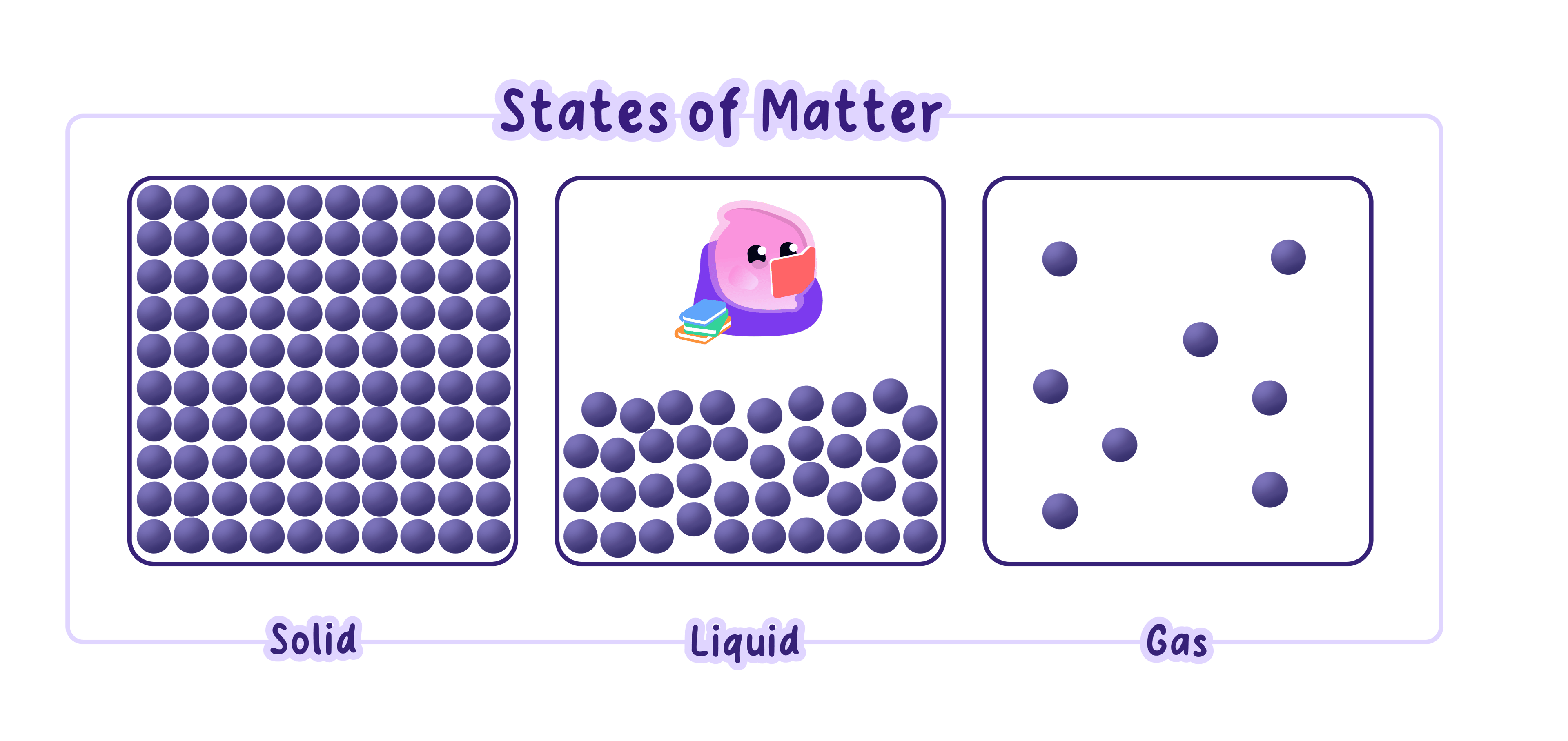
- Ice, liquid water and steam are all made of the same water molecules, arranged and moving in different ways.
- Pushing the plunger of a sealed syringe of air squashes the gas, but a sealed syringe of water barely moves because its particles are already touching.
Changing particle energy causes changes of state
Evaporation
A change from liquid to gas that happens only at the surface of a liquid, at temperatures below its boiling point.
Sublimation
A change of state in which a solid turns directly into a gas without first becoming a liquid.
- Melting happens when heating gives solid particles enough energy to break free of their fixed positions and slide past one another.
- Boiling happens when particles throughout a liquid gain enough energy to overcome the attractions and separate as a gas.
- Even in a cool liquid, the fastest-moving particles at the surface have enough energy to escape, which is how evaporation happens.
- Condensing and freezing are the reverse changes, which happen when cooling removes energy so the attractions pull the particles closer together.
- At normal atmospheric pressure, solid carbon dioxide sublimes rather than melts, so its particles go straight from fixed positions to moving freely as a gas.
- A puddle dries on a cool day as its fastest water molecules escape from the surface, far below 100 ∘C100\ ^{\circ}\text{C}100 ∘C.
- Dry ice, which is solid carbon dioxide, sublimes at −78 ∘C-78\ ^{\circ}\text{C}−78 ∘C, so it shrinks away without ever leaving a liquid puddle.
- Water vapour from a hot shower condenses on a cold bathroom mirror because the mirror takes energy from the particles.
Physical changes keep particles, chemical changes rearrange atoms
Physical change
A change in which no new substance forms, such as a change of state or dissolving.
Chemical change
A change in which one or more new substances form, with properties different from those of the starting substances.
- In a change of state, the particle model shows the same particles moving differently, so the substance keeps its identity.
- After dissolving, the sugar particles in a cup of tea are still sugar particles, spread out among the water particles.
- In a chemical change, the particle model shows atoms being rearranged, so the particles after the change are different from those before it.
- When magnesium burns, magnesium atoms and oxygen molecules become magnesium oxide, a white powder with properties unlike either starting substance.
- Physical changes are usually easy to reverse, as when melted chocolate sets again, whereas most chemical changes are hard to reverse.
- Do not treat bubbling as proof of a chemical change, because boiling water also gives off a gas without any new substance forming.
- Do not use reversibility as the test, because some chemical reactions can be reversed; the test is whether a new substance forms.
- How are the particles arranged and how do they move in a liquid?
- Why can a gas be compressed when a solid cannot?
- Why can water evaporate at room temperature, well below its boiling point?
- What happens to the particles when steam condenses on a cold surface?
- How does the particle model show the difference between melting ice and burning magnesium?
1.1.2 Limitations of the particle model
The particle model shows particles as solid spheres
Particle model
A model that represents all matter as tiny particles whose arrangement, spacing and movement explain the properties of solids, liquids and gases.
- Particle diagrams draw every particle of a substance as an identical solid sphere.
- The model treats the particles as inelastic spheres, like bowling balls that are hard and never change shape.
- The spacing of the spheres shows the state: packed in rows for a solid, touching but jumbled for a liquid and far apart for a gas.
- The model explains why solids keep their shape, why liquids flow and why gases can be compressed.
- Because it is a simplified picture, the model leaves out several features of real particles that matter during a change of state.
A model is judged by what it explains, so a limitation is anything real particles do that the spheres in a diagram cannot show.
Real particles are not solid spheres drawn to scale
- Real atoms are not solid all the way through, because each one is mostly empty space.
- Many particles are not spheres at all, since a water molecule is bent and a carbon dioxide molecule is a straight line of three atoms.
- Particles of different substances have different sizes, so one set of identical circles cannot represent every substance.
- Diagrams cannot show the size of particles compared with the spaces between them.
- In steam, the water molecules themselves take up less than a thousandth of the volume, so a diagram drawn to scale would look almost empty.
- About 1 cm31\,\text{cm}^31cm3 of liquid water boils to make roughly 1700 cm31700\,\text{cm}^31700cm3 of steam, yet the number of water molecules stays the same.
- Almost all of that extra volume is empty space between the molecules, which an ordinary particle diagram has no room to show.
The model leaves out forces of attraction
- Real particles attract their neighbours, but the spheres in a diagram have no forces drawn between them.
- These forces of attraction are what hold a solid in shape and keep a liquid together.
- The strength of the attractions varies from one substance to another, which a set of identical circles cannot show.
- Oxygen boils at −183 ∘C-183\ ^{\circ}\text{C}−183 ∘C while water boils at 100 ∘C100\ ^{\circ}\text{C}100 ∘C, a difference caused by how strongly their particles attract.
- The attractions act between particles, so melting and boiling overcome them without breaking the particles themselves apart.
Do not describe melting ice as breaking the bonds inside water molecules, because the molecules stay whole and only the attractions between them are overcome.
The model cannot show energy in changes of state
Kinetic energy
The energy an object or particle has because it is moving.
- A particle diagram is a still picture, so it cannot show how fast the particles are moving.
- Heating a substance gives its particles more kinetic energy, which a diagram can only hint at with arrows.
- During melting and boiling, the energy supplied goes into overcoming attractions between particles, and no sphere diagram shows where that energy goes.
- During condensing and freezing, energy is released as the attractions pull the particles closer together, which the diagram cannot show either.
- Two diagrams side by side show the arrangement before and after a change of state, but not the energy transfer that caused it.
- When a question asks for limitations of the particle model, name the feature the diagram leaves out and then say what real particles do instead.
- Missing forces, non-spherical shapes, particle size compared with the spaces and energy transfer are separate limitations, so choose different ones when more than one is asked for.
- What shape does the particle model give to every particle?
- Why is a water molecule a poor fit for the solid sphere picture?
- Which forces between particles are missing from a particle diagram?
- Why can a particle diagram of steam never be drawn to scale?
- What happens to the energy supplied to a solid while it melts?
