Question 3
HIn the particle model, particles are often shown as small, hard spheres, like snooker balls, that do not attract each other.
a.[2]
Explain two limitations of this model when it is used to show changes of state.
b.[3]
A molecule of nitrogen, N2\mathrm{N_{2}}N2, has a diameter of about 0.30 nm.
In nitrogen gas at room temperature, the distance between the centres of neighbouring molecules is about 3.3 nm.
A teacher builds a scale model of nitrogen gas. The teacher uses polystyrene balls with a diameter of 4.0 cm to represent the molecules.
Calculate the distance between the centres of neighbouring balls in the model.
Give your answer in metres.
c.[2]
The diagram shows how a textbook represents the particles in a gas. The particles are drawn about one particle diameter apart.
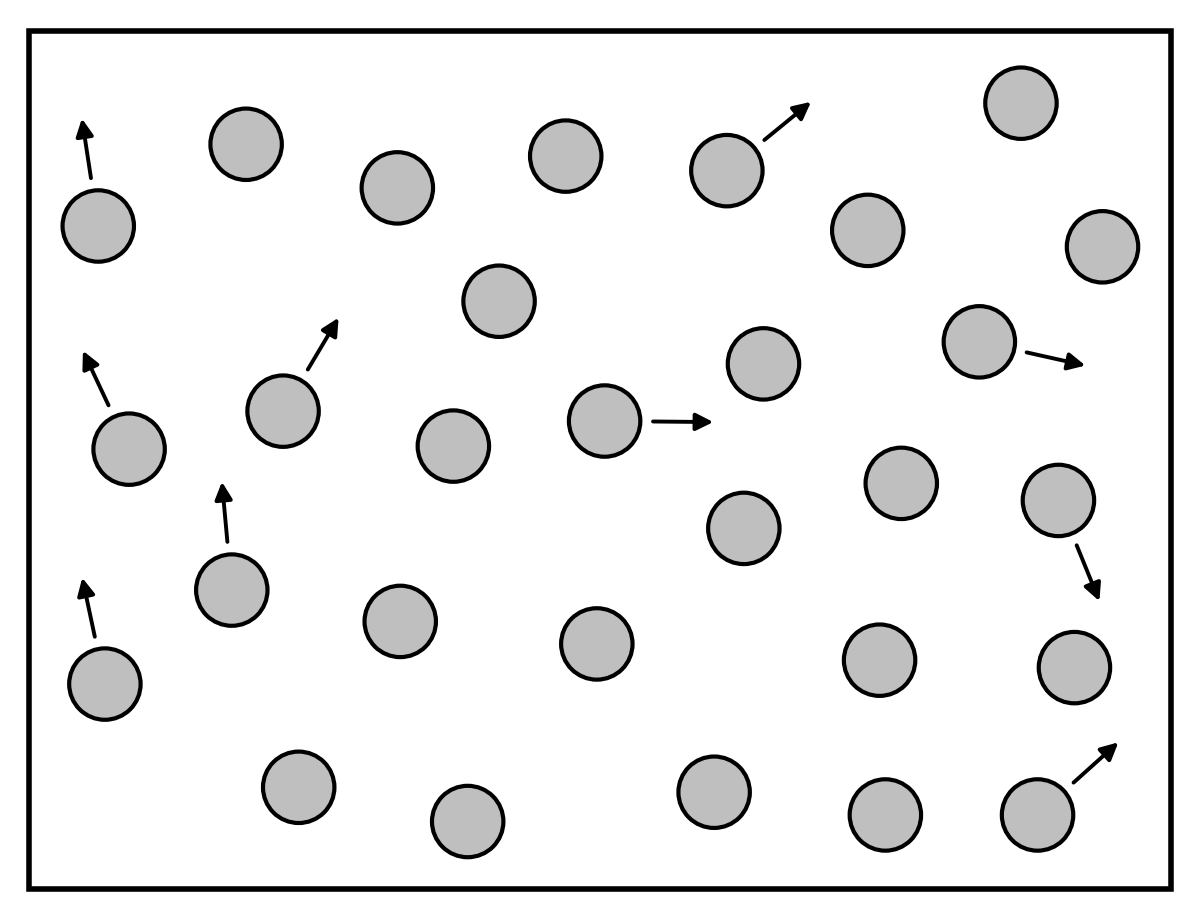
Explain why this diagram could give students the wrong idea about how easily a gas can be compressed.
d.[2]
Ice floats on liquid water, because the particles in ice are further apart than the particles in liquid water.
Explain how this shows a limitation of the particle model.
1.1 The particle model Questions
48 exam-style questions on OCR GCSE Chemistry 1.1 The particle model, covering 1.1.1 The particle model and changes of state and 1.1.2 Limitations of the particle model. Each one has a worked solution and a mark scheme showing where the marks go.