All matter is made of moving, attracting particles
Definition
Particle model
A model that represents all matter as tiny particles whose arrangement, spacing and movement explain the properties of solids, liquids and gases.
Definition
Kinetic energy
The energy an object or particle has because it is moving.
- All matter, whether solid, liquid or gas, is made of tiny particles such as atoms, molecules or ions.
- The particles are in constant motion, even in a solid.
- Neighbouring particles pull on one another through forces of attraction.
- The gaps between particles are empty space, with nothing in them at all.
- The more kinetic energy the particles have, the faster they move and the more easily they overcome those attractions.
- The state of a substance depends on the balance between the energy of its particles and the strength of the attractions between them.
Common Mistake
- Do not describe the gaps between particles as filled with air, because air is itself made of particles.
- Do not say that particles get bigger when a substance is heated, because heating changes their movement and spacing, not their size.
How particles differ in solids, liquids and gases
- In a solid, the particles are packed closely in a fixed, regular pattern and can only vibrate about fixed positions.
- Strong attractions hold solid particles in place, so a solid keeps its own shape and volume.
- In a liquid, the particles are still touching but are arranged randomly and can slide past one another.
- A liquid therefore flows and takes the shape of its container, but its volume stays the same.
- In a gas, the particles are far apart, move quickly in random directions and barely attract one another.
- A gas spreads out to fill any container and can be compressed, because there is so much space between its particles.
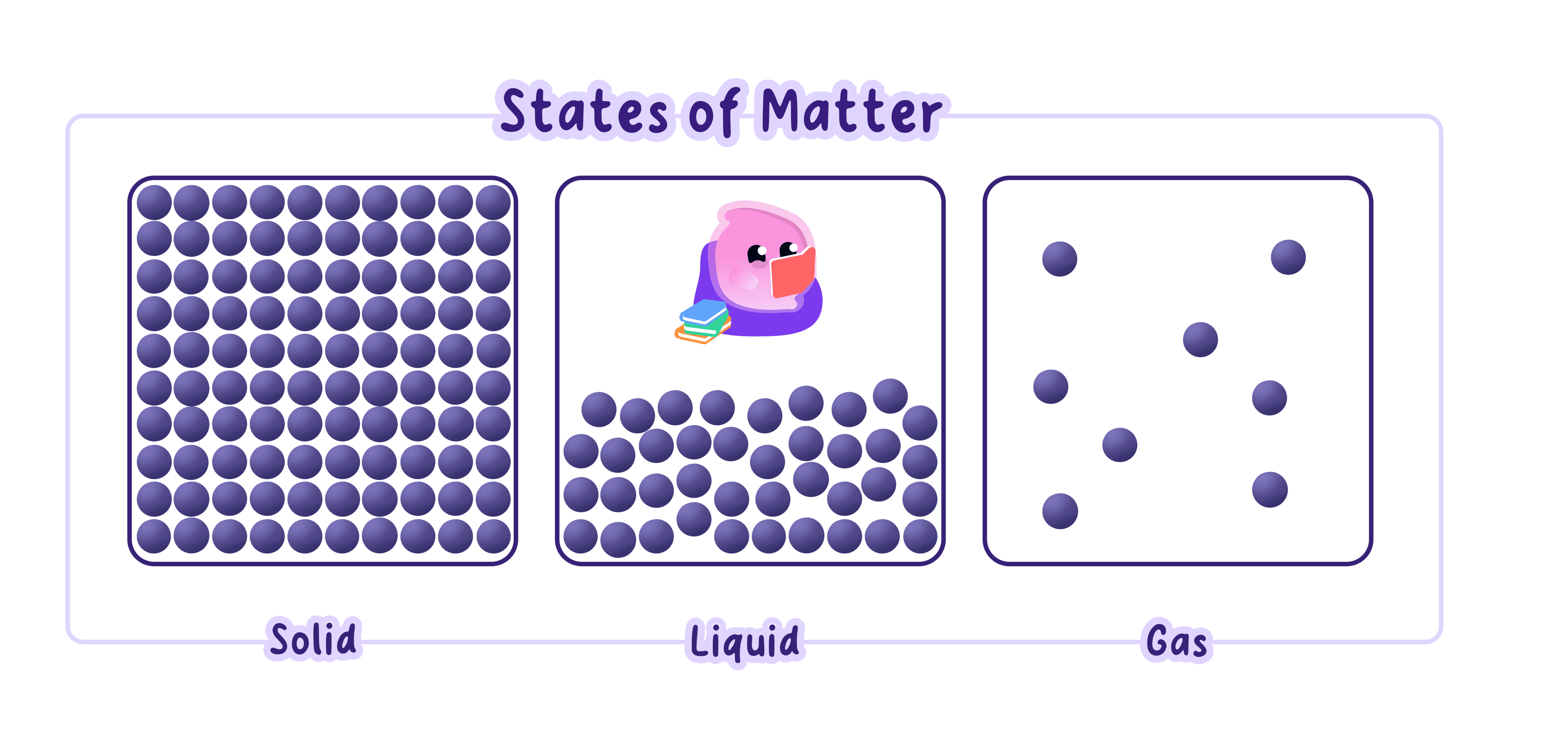
Example
- Ice, liquid water and steam are all made of the same water molecules, arranged and moving in different ways.
- Pushing the plunger of a sealed syringe of air squashes the gas, but a sealed syringe of water barely moves because its particles are already touching.
Changing particle energy causes changes of state
Definition
Evaporation
A change from liquid to gas that happens only at the surface of a liquid, at temperatures below its boiling point.
Definition
Sublimation
A change of state in which a solid turns directly into a gas without first becoming a liquid.
- Melting happens when heating gives solid particles enough energy to break free of their fixed positions and slide past one another.
- Boiling happens when particles throughout a liquid gain enough energy to overcome the attractions and separate as a gas.
- Even in a cool liquid, the fastest-moving particles at the surface have enough energy to escape, which is how evaporation happens.
- Condensing and freezing are the reverse changes, which happen when cooling removes energy so the attractions pull the particles closer together.
- At normal atmospheric pressure, solid carbon dioxide sublimes rather than melts, so its particles go straight from fixed positions to moving freely as a gas.
Example
- A puddle dries on a cool day as its fastest water molecules escape from the surface, far below 100 ∘C100\ ^{\circ}\text{C}100 ∘C.
- Dry ice, which is solid carbon dioxide, sublimes at −78 ∘C-78\ ^{\circ}\text{C}−78 ∘C, so it shrinks away without ever leaving a liquid puddle.
- Water vapour from a hot shower condenses on a cold bathroom mirror because the mirror takes energy from the particles.
Physical changes keep particles, chemical changes rearrange atoms
Definition
Physical change
A change in which no new substance forms, such as a change of state or dissolving.
Definition
Chemical change
A change in which one or more new substances form, with properties different from those of the starting substances.
- In a change of state, the particle model shows the same particles moving differently, so the substance keeps its identity.
- After dissolving, the sugar particles in a cup of tea are still sugar particles, spread out among the water particles.
- In a chemical change, the particle model shows atoms being rearranged, so the particles after the change are different from those before it.
- When magnesium burns, magnesium atoms and oxygen molecules become magnesium oxide, a white powder with properties unlike either starting substance.
- Physical changes are usually easy to reverse, as when melted chocolate sets again, whereas most chemical changes are hard to reverse.
Common Mistake
- Do not treat bubbling as proof of a chemical change, because boiling water also gives off a gas without any new substance forming.
- Do not use reversibility as the test, because some chemical reactions can be reversed; the test is whether a new substance forms.
Self review
- How are the particles arranged and how do they move in a liquid?
- Why can a gas be compressed when a solid cannot?
- Why can water evaporate at room temperature, well below its boiling point?
- What happens to the particles when steam condenses on a cold surface?
- How does the particle model show the difference between melting ice and burning magnesium?
