Chemists count particles in moles
Definition
Mole
The amount of a substance that contains 6.02 × 10²³ particles, such as atoms, molecules or ions.
Definition
Avogadro constant
The number of particles in one mole of a substance, 6.02 × 10²³.
- One drop of water contains more than 102110^{21}1021 molecules, so chemists count particles in very large, fixed groups.
- One mole of any substance contains 6.02×10236.02 \times 10^{23}6.02×10²³ particles.
- This number is the Avogadro constant, written in standard form because it is so large.
- The amount of a substance in moles is given the unit mol.
- Always say which particles you are counting, because one mole of oxygen molecules, O2\text{O}_2O2, contains two moles of oxygen atoms.
- For an ionic compound, one mole of formula units of NaCl\text{NaCl}NaCl contains one mole of Na+\text{Na}^{+}Na+ ions and one mole of Cl−\text{Cl}^{-}Cl− ions.
Example
A mole works like a dozen, except that it stands for 6.02×10236.02 \times 10^{23}6.02×10²³ items instead of 121212.
The Avogadro constant converts moles into particles
- Multiply the amount in moles by the Avogadro constant to find the number of particles: number of particles=moles×6.02×10²³\text{number of particles} = \text{moles} \times 6.02 \times 10^{23}number of particles=moles×6.02×10²³
- Divide a number of particles by the Avogadro constant to find the amount in moles.
- 3.01×10233.01 \times 10^{23}3.01×10²³ water molecules is 3.01×10236.02×1023=0.500 mol\dfrac{3.01 \times 10^{23}}{6.02 \times 10^{23}} = 0.500\,\text{mol}6.02×10233.01×1023=0.500mol.
- To count the atoms in molecules, multiply by the number of atoms in each molecule.
- One mole of H2O\text{H}_2\text{O}H2O contains two moles of hydrogen atoms and one mole of oxygen atoms.
Example
- How many atoms are in 0.200 mol0.200\,\text{mol}0.200mol of carbon dioxide, CO2\text{CO}_2CO2?
- Number of molecules =0.200×6.02×1023=1.204×1023= 0.200 \times 6.02 \times 10^{23} = 1.204 \times 10^{23}=0.200×6.02×1023=1.204×10²³.
- Each molecule contains 333 atoms, so the number of atoms =3×1.204×1023=3.612×1023= 3 \times 1.204 \times 10^{23} = 3.612 \times 10^{23}=3×1.204×1023=3.612×10²³.
- To three significant figures, there are 3.61×10233.61 \times 10^{23}3.61×10²³ atoms.
Mass of one mole equals relative formula mass
Definition
Relative formula mass
The mass of one formula unit of a substance compared with one-twelfth of the mass of a carbon-12 atom, given the symbol Mr.
- The mass of one mole of an element is its relative atomic mass in grams, so one mole of carbon atoms has a mass of 12.0 g12.0\,\text{g}12.0g.
- The mass of one mole of a compound is its relative formula mass in grams, so one mole of water, Mr=18.0M_r = 18.0Mr=18.0, has a mass of 18.0 g18.0\,\text{g}18.0g.
- This works because relative masses compare particles on the same scale, and one mole always contains the same number of particles.
- A magnesium atom is about twice as heavy as a carbon atom, so 24.3 g24.3\,\text{g}24.3g of magnesium contains the same number of atoms as 12.0 g12.0\,\text{g}12.0g of carbon.
- The mass of one mole of a substance is called its molar mass, measured in grams per mole.
- Equal masses of different substances therefore contain different numbers of particles.
Common Mistake
Do not give MrM_rMr a unit, because it is a relative value, whereas the mass of one mole is measured in grams.
Moles equal mass divided by relative formula mass
- Calculate the amount in moles from a mass using: moles=mass (g)Mr\text{moles} = \frac{\text{mass (g)}}{M_r}moles=Mrmass (g)
- Rearrange it to find the mass from an amount in moles: mass (g)=moles×Mr\text{mass (g)} = \text{moles} \times M_rmass (g)=moles×Mr
- Always work out MrM_rMr first, using the relative atomic masses from the Periodic Table.
- For calcium carbonate, Mr(CaCO3)=40.1+12.0+(3×16.0)=100.1M_r(\text{CaCO}_3) = 40.1 + 12.0 + (3 \times 16.0) = 100.1Mr(CaCO3)=40.1+12.0+(3×16.0)=100.1.
- So 0.300 mol0.300\,\text{mol}0.300mol of calcium carbonate has a mass of 0.300×100.1=30.03 g0.300 \times 100.1 = 30.03\,\text{g}0.300×100.1=30.03g, which is 30.0 g30.0\,\text{g}30.0g to three significant figures.
Example
- Calculate the amount in moles in 11.0 g11.0\,\text{g}11.0g of carbon dioxide (ArA_rAr: C = 12.0, O = 16.0).
- Mr(CO2)=12.0+(2×16.0)=44.0M_r(\text{CO}_2) = 12.0 + (2 \times 16.0) = 44.0Mr(CO2)=12.0+(2×16.0)=44.0.
- moles=11.044.0=0.250 mol\text{moles} = \dfrac{11.0}{44.0} = 0.250\,\text{mol}moles=44.011.0=0.250mol.
Linking mass and number of particles through moles
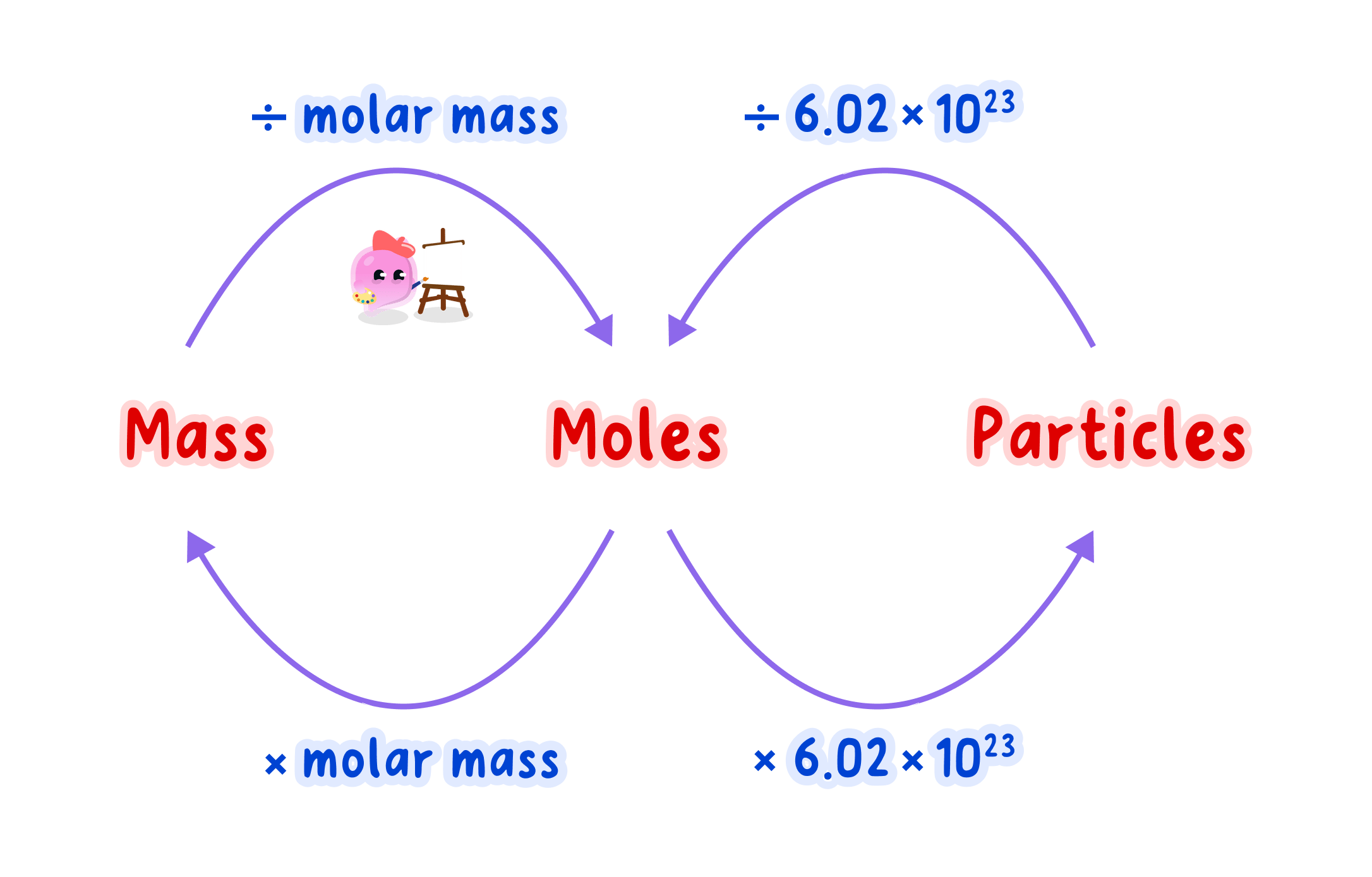
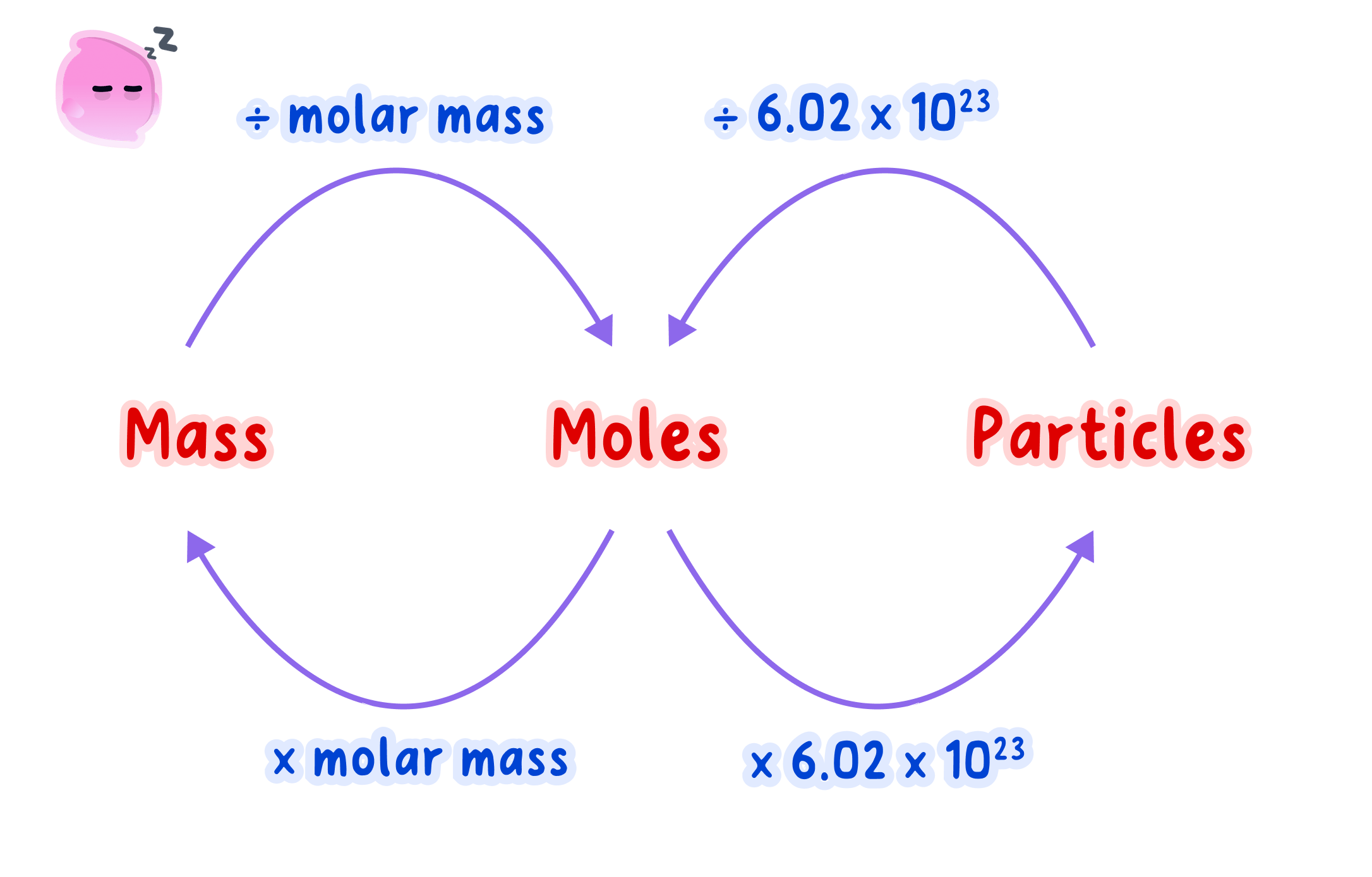
- To go from a mass to a number of particles, convert the mass into moles first and then multiply by the Avogadro constant.
- 4.86 g4.86\,\text{g}4.86g of magnesium is 4.8624.3=0.200 mol\dfrac{4.86}{24.3} = 0.200\,\text{mol}24.34.86=0.200mol, which contains 0.200×6.02×1023=1.20×10230.200 \times 6.02 \times 10^{23} = 1.20 \times 10^{23}0.200×6.02×1023=1.20×10²³ atoms.
- To go from a number of particles to a mass, divide by the Avogadro constant and then multiply by MrM_rMr.
- The mass of one atom in grams is its relative atomic mass divided by the Avogadro constant.
- One magnesium atom has a mass of 24.36.02×1023=4.04×10⁻²³ g\dfrac{24.3}{6.02 \times 10^{23}} = 4.04 \times 10^{-23}\,\text{g}6.02×102324.3=4.04×10⁻²³g.
- Because moles count particles, equal amounts in moles of two substances contain the same number of particles, whatever their masses.
Exam technique
- When a question gives a mass and asks for a number of particles, divide by MrM_rMr before you multiply by 6.02×10236.02 \times 10^{23}6.02×10²³, because the Avogadro constant applies to an amount in moles.
- Give the final answer in standard form, to the number of significant figures the question asks for.
Self review
- What is the value of the Avogadro constant?
- How many molecules are in 2.00 mol2.00\,\text{mol}2.00mol of water?
- What is the mass of one mole of sodium chloride (ArA_rAr: Na = 23.0, Cl = 35.5)?
- How many moles are in 8.0 g8.0\,\text{g}8.0g of methane, CH4\text{CH}_4CH4 (ArA_rAr: C = 12.0, H = 1.0)?
- Why do 12.0 g12.0\,\text{g}12.0g of carbon and 24.3 g24.3\,\text{g}24.3g of magnesium contain the same number of atoms?
