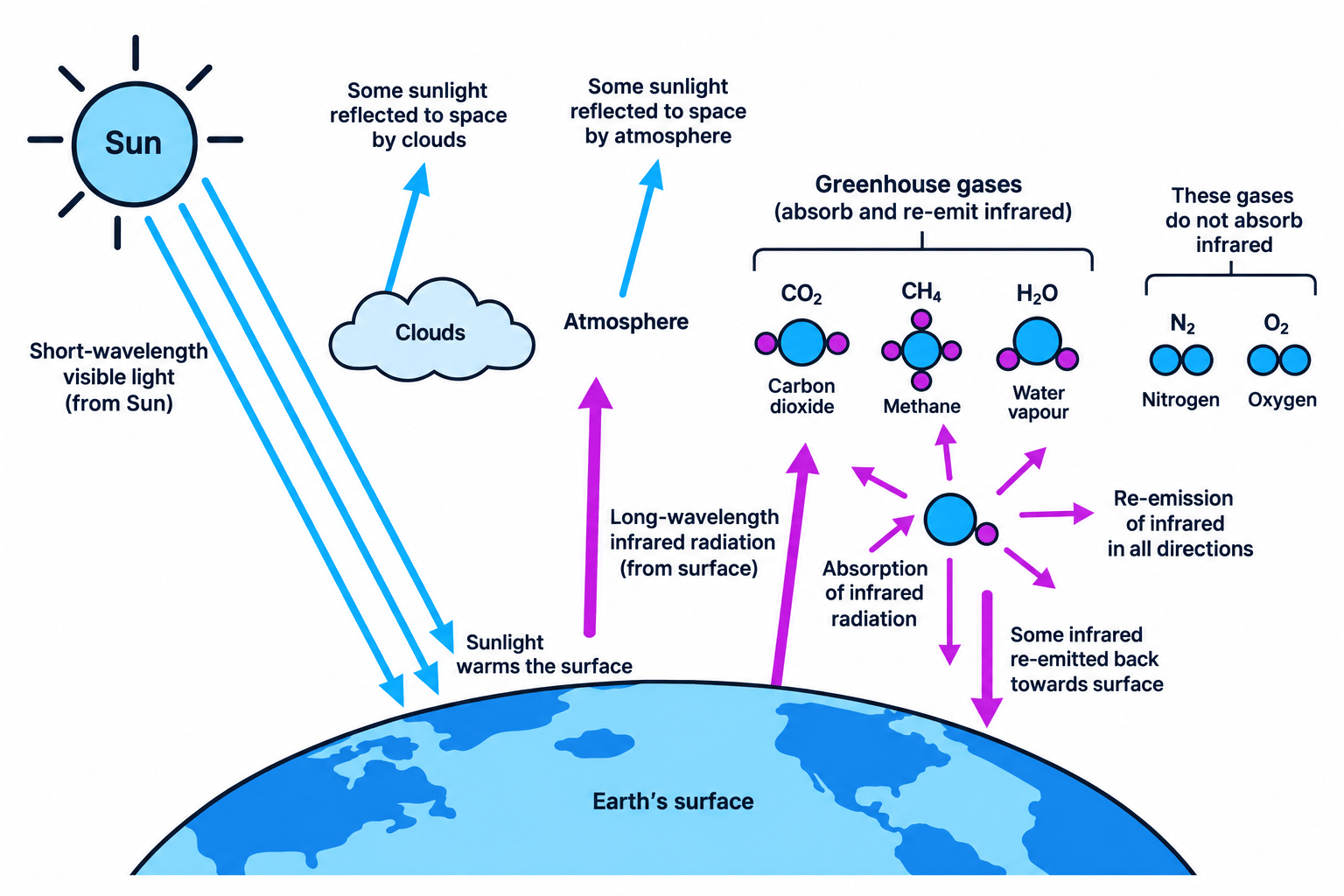
In the greenhouse effect, gases absorb and re-emit infrared
Greenhouse effect
The warming of the Earth's surface and lower atmosphere caused by gases that absorb infrared radiation given out by the surface and re-emit it.
Greenhouse gas
A gas in the atmosphere, such as carbon dioxide, methane or water vapour, that absorbs infrared radiation.
- The Sun gives out mainly visible light and ultraviolet radiation, which have short wavelengths.
- Most of this radiation passes through the atmosphere, although some is reflected back into space by clouds, ice and the atmosphere.
- The land and oceans absorb the radiation that reaches them and warm up.
- The warm surface then gives out energy as infrared radiation, which has a longer wavelength.
- Molecules of carbon dioxide, methane and water vapour absorb some of this infrared radiation, which makes their bonds vibrate more.
- The molecules then re-emit infrared radiation in all directions, including back towards the surface, so the lower atmosphere stays warmer.
- Nitrogen and oxygen, which make up about 99% of the air, do not absorb infrared radiation, so they are not greenhouse gases.
- The natural greenhouse effect keeps the Earth's average surface temperature at about 15 ∘C15\ ^{\circ}\text{C}15 ∘C instead of about −18 ∘C-18\ ^{\circ}\text{C}−18 ∘C.
Do not say that greenhouse gases reflect heat back to the Earth, because they absorb infrared radiation and then re-emit it.
Human activities add carbon dioxide and methane
Anthropogenic
Caused or produced by human activity.
Fossil fuel
A fuel such as coal, crude oil or natural gas, formed over millions of years from the buried remains of living things.
- Burning fossil fuels in power stations, vehicles and homes releases carbon dioxide that was locked away for millions of years.
- Deforestation increases carbon dioxide in two ways.
- Trees that are burnt or left to rot release the carbon they contained as carbon dioxide.
- Fewer trees remain to take in carbon dioxide by photosynthesis.
- Methane comes from cattle as they digest food, from rice grown in flooded fields and from waste rotting in landfill sites.
- Leaks from natural gas wells and pipes also release methane, because natural gas is mainly methane.
- There is far less methane than carbon dioxide in the air, but each methane molecule has a much stronger warming effect.
Do not link greenhouse gases with acid rain or the ozone layer, because global warming is caused by gases absorbing infrared radiation.
Measurements, ice cores and models link emissions to warming
Ice core
A long cylinder of ice drilled from an ice sheet, whose trapped air bubbles show the make-up of the atmosphere in the past.
- Direct measurements since 1958 show carbon dioxide in the air rising from about 315 to over 420 parts per million.
- Air bubbles trapped in ice cores show that carbon dioxide stayed at about 280 parts per million for thousands of years before about 1800.
- The rise began with the Industrial Revolution, when large-scale burning of coal started.
- Temperature records show that the global average temperature has risen by more than 1 ∘C1\ ^{\circ}\text{C}1 ∘C since the late 1800s.
- Carbon dioxide levels and temperature have risen together, and the greenhouse effect explains how extra carbon dioxide causes warming.
- Climate models that include human emissions match the observed warming, while models that include only natural causes, such as changes in the Sun's output and volcanic eruptions, do not.
A correlation between two sets of data does not prove that one causes the other, which is why the greenhouse mechanism and the climate models are needed as well.
Uncertainties mostly affect the size and speed of changes
Climate model
A computer simulation that uses the physics and chemistry of the atmosphere and oceans to reproduce past climate and predict future climate.
- Temperature records before about 1900 come from fewer places, mostly on land in Europe and North America, so early global averages are less certain.
- Ice cores and other indirect records estimate past conditions rather than measuring them directly.
- Natural factors, such as changes in the Sun's output, volcanic eruptions and ocean currents, also change the climate, so the human share has to be separated out carefully.
- Climate models have to simplify processes such as cloud formation, so different models predict a range of future warming.
- Future warming also depends on how much greenhouse gas people will emit, which cannot be known in advance.
Several independent types of evidence point the same way, so scientists are confident that human activity is adding to climate change even though the size of future changes is uncertain.
Cutting emissions can limit future climate change
Mitigation
Action taken to reduce the causes of climate change, mainly by cutting greenhouse gas emissions or removing these gases from the air.
- Higher levels of carbon dioxide and methane strengthen the greenhouse effect and raise the global average temperature.
- Sea levels rise as warmer ocean water expands and ice on land melts, flooding low-lying coasts.
- Weather patterns change, with more frequent heatwaves, droughts, heavy rainfall and floods in different regions.
- Changing temperatures and rainfall can destroy habitats and lower crop yields in some areas.
- Using renewable energy and nuclear power instead of fossil fuels cuts carbon dioxide emissions.
- Carbon capture and storage collects carbon dioxide from power stations and stores it underground.
- Planting trees and stopping deforestation keeps more carbon dioxide out of the air.
- Collecting methane from landfill sites and reducing waste and cattle numbers cuts methane emissions.
When a question asks you to evaluate a way of reducing climate change, say which gas it reduces and how, then weigh this against a drawback such as cost or the need for many countries to act together.
- What type of radiation does the Earth's warm surface give out?
- How do greenhouse gas molecules keep the lower atmosphere warm?
- Name two human activities that release methane.
- What do ice cores show about carbon dioxide levels before 1800?
- Give one uncertainty in the evidence for climate change and one way of mitigating its effects.