Question 2
FCarbon forms millions of different compounds.
The table shows four compounds of carbon and hydrogen from the same family.
| Name | Number of carbon atoms | Formula |
|---|---|---|
| methane | 1 | CH₄ |
| ethane | 2 | C₂H₆ |
| propane | 3 | C₃H₈ |
| butane | 4 | ? |
a.[1]
Complete the table. Write the formula of butane.
b.[1]
A carbon atom has 6 electrons.
Write the electronic structure of a carbon atom.
c.[1]
How many covalent bonds does each carbon atom form in these compounds?
d.[1]
Use your answer to (b) to explain why carbon forms this number of bonds.
e.[2]
Give two reasons why carbon can form so many different compounds.
f.[2]
Hexane, C₆H₁₄, has six carbon atoms joined in a chain.
Cyclohexane, C₆H₁₂, has six carbon atoms joined in a ring.
The diagram shows the displayed formulae of hexane and cyclohexane.
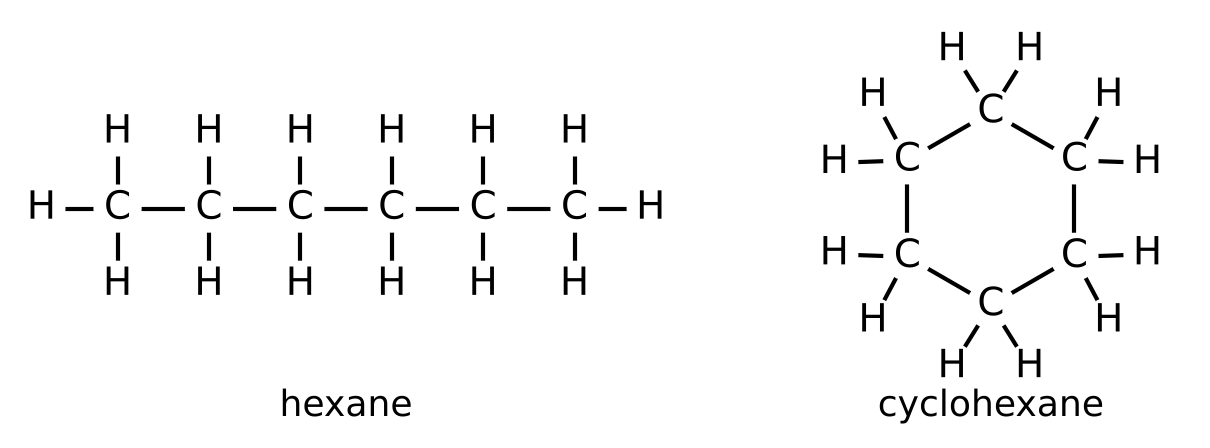
Suggest why cyclohexane has two fewer hydrogen atoms than hexane.
2.3 Properties of materials Questions
122 exam-style questions on OCR GCSE Chemistry 2.3 Properties of materials, covering 2.3.1 Carbon bonding and the variety of organic compounds, 2.3.2 Diamond, graphite, fullerenes and graphene, 2.3.3 Bond strength, changes of state and predicting states, 2.3.4 Bulk properties and types of bonding, and 2.3.5 Nanoparticles: scale, surface area, uses and risks. Each one has a worked solution and a mark scheme showing where the marks go.