Question 30
FA cube of a nanoparticulate material has sides of length 3 nm. It is cut up into 27 smaller cubes, each with sides of length 1 nm.
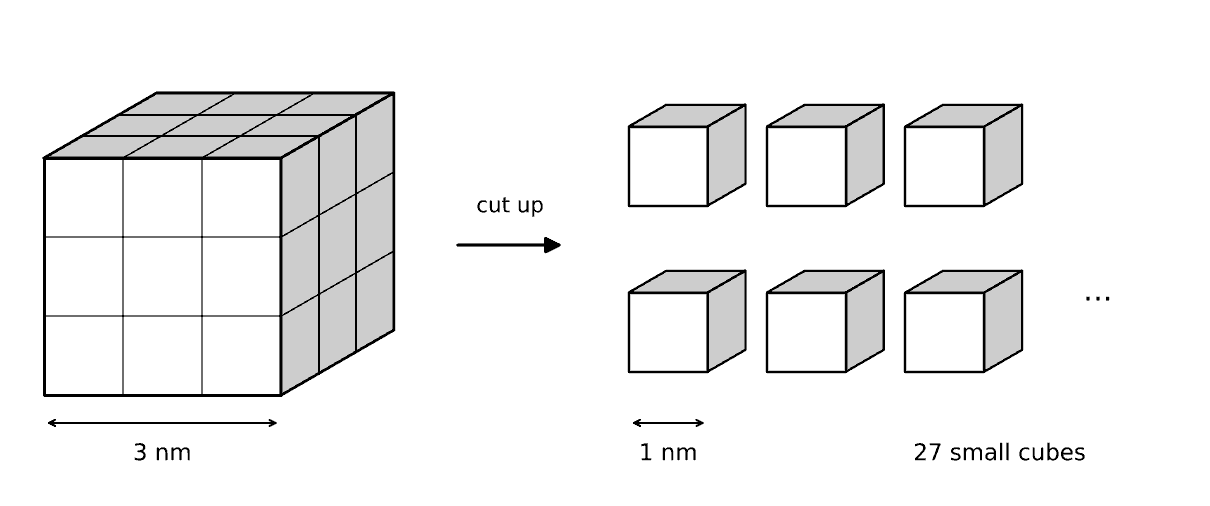
Use the equations:
surface area of a cube = 6 × (side length)2^{2}2
volume of a cube = (side length)3^{3}3
Which statement is correct?
A
The total surface area stays the same, and the surface area to volume ratio of each cube increases by a factor of 3.
B
The total surface area increases by a factor of 9, and the surface area to volume ratio of each cube increases by a factor of 9.
C
The total surface area increases by a factor of 27, and the surface area to volume ratio of each cube increases by a factor of 27.
D
The total surface area increases by a factor of 3, and the surface area to volume ratio of each cube increases by a factor of 3.
2.3 Properties of materials Questions
122 exam-style questions on OCR GCSE Chemistry 2.3 Properties of materials, covering 2.3.1 Carbon bonding and the variety of organic compounds, 2.3.2 Diamond, graphite, fullerenes and graphene, 2.3.3 Bond strength, changes of state and predicting states, 2.3.4 Bulk properties and types of bonding, and 2.3.5 Nanoparticles: scale, surface area, uses and risks. Each one has a worked solution and a mark scheme showing where the marks go.