Question 30
FA student adds the same mass of three metal powders, P, Q and R, with the same particle size, to separate samples of dilute hydrochloric acid. The acid is in excess. The volume and concentration of acid and the temperature are the same each time.
The graph shows the volume of hydrogen collected.
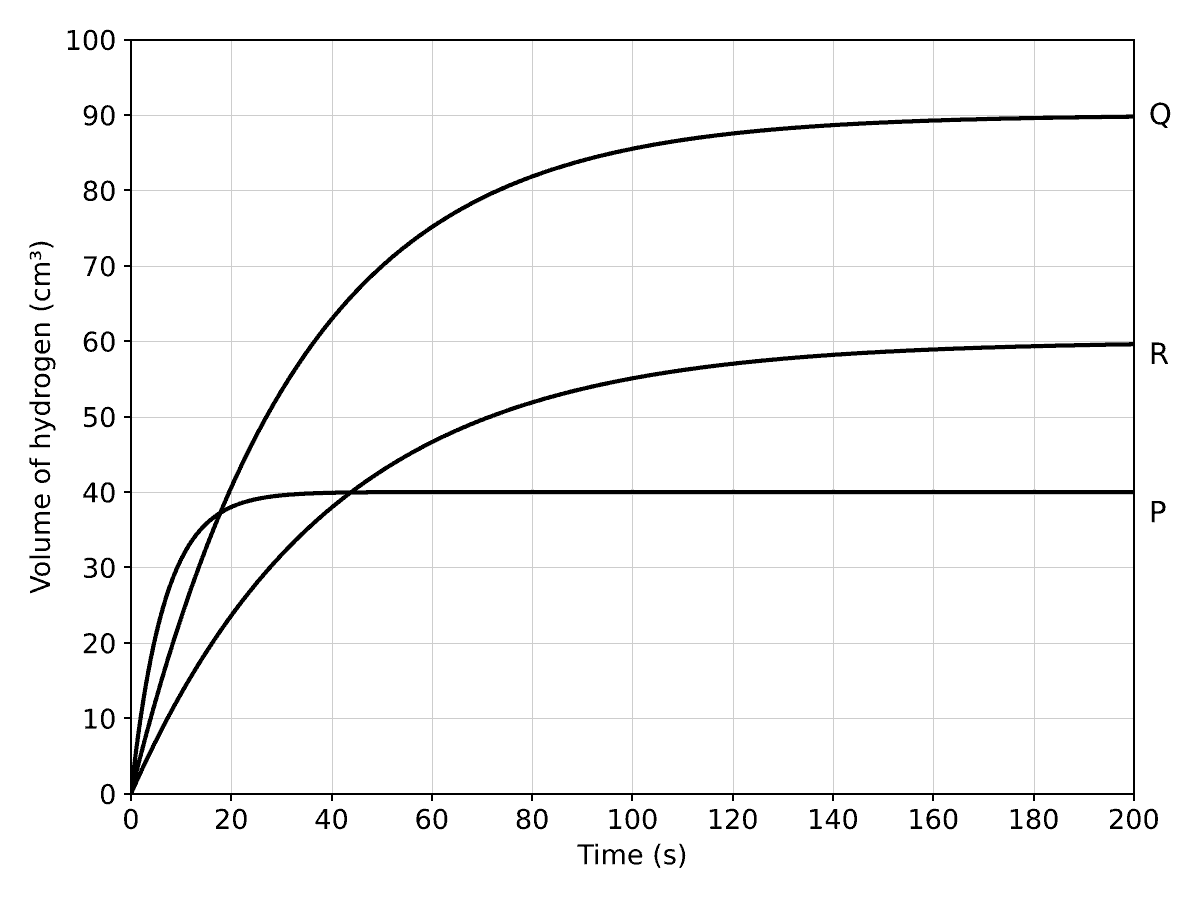
What is the order of reactivity of the metals, from most reactive to least reactive?
A
P, Q, R
B
Q, R, P
C
R, Q, P
D
Q, P, R
4.1 Predicting chemical reactions Questions
113 exam-style questions on OCR GCSE Chemistry 4.1 Predicting chemical reactions, covering 4.1.1 Properties and trends in Groups 1, 7 and 0, 4.1.2 Properties of the transition metals, 4.1.3 Reactivity predicted from position in the Periodic Table, and 4.1.4 Reactivity of metals and the reactivity series. Each one has a worked solution and a mark scheme showing where the marks go.