Question 9
HFlame emission spectroscopy can be used to measure the concentration of metal ions in a solution. The brighter the emission line, the higher the concentration of the metal ions.
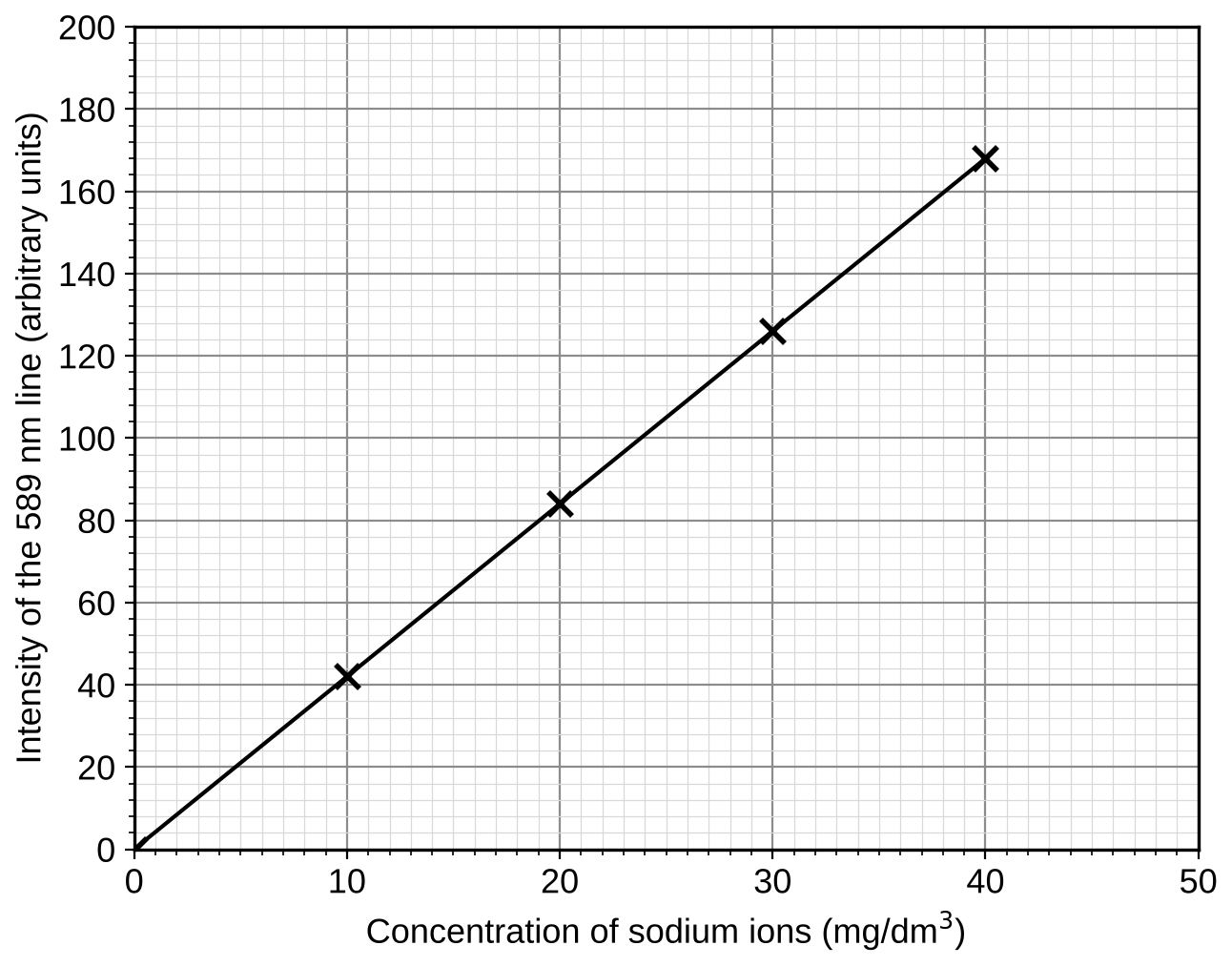
A scientist measures the intensity of the sodium emission line at 589 nm for some standard solutions.
The graph shows the results and the scientist's calibration line.
The scientist dilutes 10.0 cm³ of a mineral water to a total volume of 50.0 cm³ with pure water.
The intensity of the sodium line for the diluted solution is 63.
a.[1]
Suggest why the scientist uses flame emission spectroscopy rather than a flame test.
b.[4]
Use the graph to calculate the mass of sodium ions, in mg, in a 750 cm³ bottle of the mineral water.
Give your answer to 2 significant figures.
c.[2]
The label on the bottle states "Sodium: 72 mg/dm³".
A student says: "The scientist's results show that the label is wrong."
Evaluate the student's statement.
d.[2]
An undiluted sample of a different mineral water gives an intensity of 240.
Explain why the scientist should dilute this sample before using the graph to find its concentration.
4.2 Identifying the products of chemical reactions Questions
52 exam-style questions on OCR GCSE Chemistry 4.2 Identifying the products of chemical reactions, covering 4.2.1 Tests to identify gases, 4.2.2 Tests for aqueous ions and flame tests, and 4.2.3 Instrumental methods of analysis. Each one has a worked solution and a mark scheme showing where the marks go.