Hydrogen ion concentration decides the pH
Definition
pH
A number, usually from 0 to 14, that shows how acidic or alkaline a solution is.
Definition
Hydrogen ion concentration
The amount of hydrogen ions dissolved in each cubic decimetre of solution, written as [H+] and measured in mol/dm³.
- The square brackets in [H+][\text{H}^+][H+] stand for the concentration of hydrogen ions, measured in mol/dm3\text{mol/dm}^3mol/dm3.
- The higher the [H+][\text{H}^+][H+], the lower the pH and the more acidic the solution.
- The lower the [H+][\text{H}^+][H+], the higher the pH.
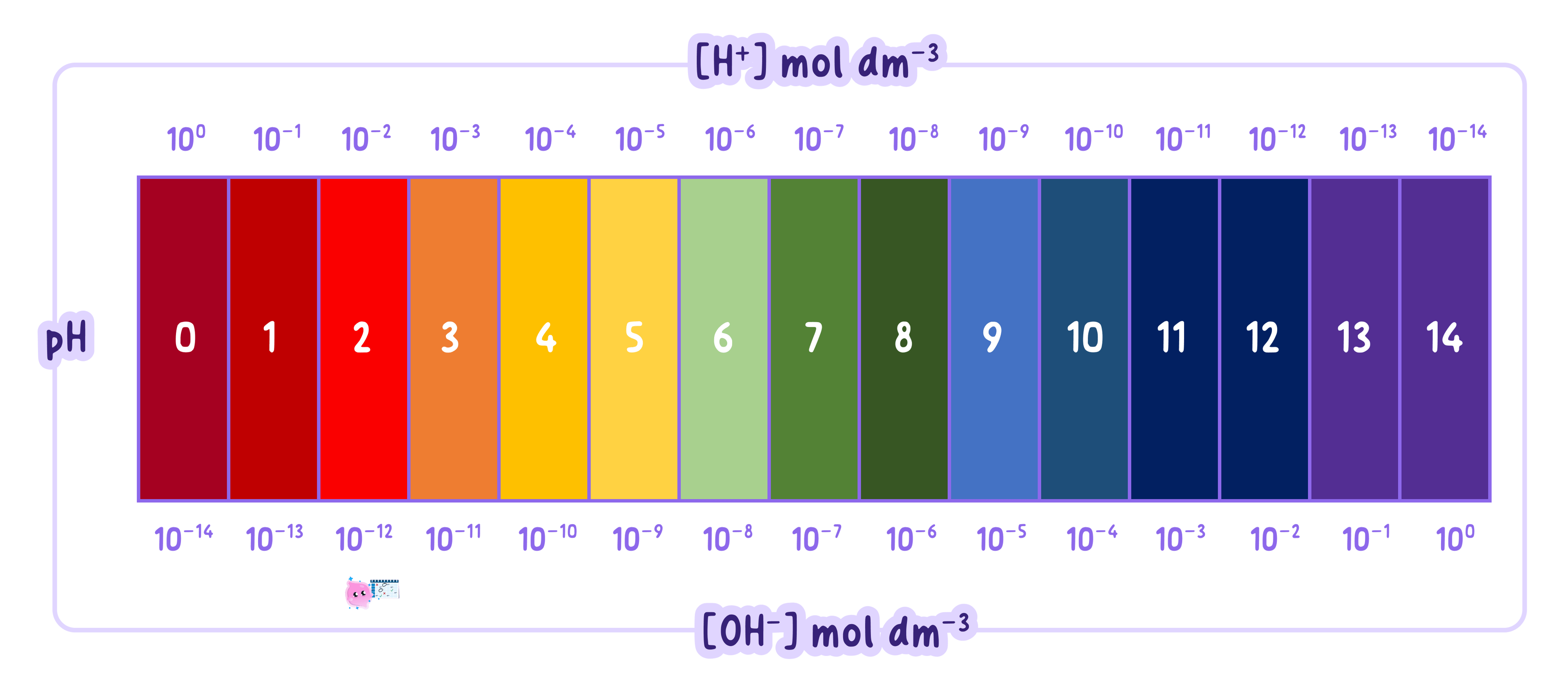
- Pure water contains a tiny concentration of hydrogen ions, 1×10⁻⁷ mol/dm31 \times 10^{-7}\,\text{mol/dm}^31×10−7mol/dm3, which gives it pH 7.
- For whole-number values the pH matches the power of ten, so [H+]=1×10⁻³ mol/dm3[\text{H}^+] = 1 \times 10^{-3}\,\text{mol/dm}^3[H+]=1×10−3mol/dm3 gives pH 3.
Key Idea
A pH value is a compact way of writing a hydrogen ion concentration, with a smaller pH number meaning more hydrogen ions.
Hydrogen ions in neutral, acidic and alkaline solutions
Definition
Neutral solution
A solution that is neither acidic nor alkaline, with a pH of 7.
- In a neutral solution at pH 7, the concentrations of hydrogen ions and hydroxide ions are equal.
- An acidic solution has more hydrogen ions than hydroxide ions, so its pH is below 7.
- An alkaline solution has fewer hydrogen ions than hydroxide ions, so its pH is above 7.
- Even at pH 12 some hydrogen ions are present, at 1×10⁻¹² mol/dm31 \times 10^{-12}\,\text{mol/dm}^31×10−12mol/dm3.
- Adding acid raises the [H+][\text{H}^+][H+] and lowers the pH, while adding alkali removes hydrogen ions and raises the pH.
Common Mistake
Do not say that an alkaline solution contains no hydrogen ions, because every aqueous solution contains some.
Each tenfold concentration increase lowers pH by one
- Multiplying [H+][\text{H}^+][H+] by ten lowers the pH by one.
- Going from 1×10−41 \times 10^{-4}1×10⁻⁴ to 1×10⁻³ mol/dm31 \times 10^{-3}\,\text{mol/dm}^31×10−3mol/dm3 gives ten times more hydrogen ions, and the pH falls from 4 to 3.
- Dividing [H+][\text{H}^+][H+] by ten raises the pH by one.
- Diluting a strong acid tenfold with water divides its [H+][\text{H}^+][H+] by ten, so pH 1 becomes pH 2.
- A change of two pH units means a factor of 10×10=10010 \times 10 = 10010×10=100 in [H+][\text{H}^+][H+], and three units means a factor of 100010001000.
Common Mistake
Do not treat pH 2 as twice as acidic as pH 4, because pH 2 has 100100100 times the hydrogen ion concentration.
pH differences give the hydrogen ion concentration factor
- Subtract the smaller pH from the larger one to find the number of steps.
- Raise ten to that power to find the factor, so a difference of three gives 103=100010^3 = 1000103=1000.
- The solution with the lower pH has the higher hydrogen ion concentration.
- The same method works in reverse, so a solution with 100010001000 times fewer hydrogen ions has a pH three units higher.
Example
- Lemon juice has a pH of about 2 and tomato juice a pH of about 4; compare their hydrogen ion concentrations.
- Find the difference in pH: 4−2=24 - 2 = 24−2=2.
- Convert the difference to a factor: 102=10010^2 = 100102=100.
- Lemon juice has the lower pH, so its hydrogen ion concentration is about 100100100 times greater than that of tomato juice.
Self review
- What is the pH of a solution with [H+]=1×10⁻⁵ mol/dm3[\text{H}^+] = 1 \times 10^{-5}\,\text{mol/dm}^3[H+]=1×10−5mol/dm3?
- How do the hydrogen ion and hydroxide ion concentrations compare in a neutral solution?
- What happens to the pH when [H+][\text{H}^+][H+] increases by a factor of ten?
- How many times greater is [H+][\text{H}^+][H+] at pH 3 than at pH 6?
- A strong acid of pH 1 is diluted tenfold with water; what is its new pH?
