Exothermic reactions transfer energy to the surroundings
Exothermic reaction
A reaction that transfers energy to the surroundings, so the temperature of the surroundings rises.
Surroundings
Everything outside the reacting chemicals, such as the water they are dissolved in, the container and the air.
- In an exothermic reaction, energy stored in the reacting chemicals is transferred to the surroundings.
- A thermometer in the reaction mixture shows a temperature rise.
- Combustion of fuels, such as methane burning in a gas cooker, is exothermic.
- Neutralisation of an acid by an alkali is exothermic, and so are most reactions of metals with acids.
- Oxidation reactions, such as iron powder reacting with oxygen in a disposable hand warmer, are exothermic too.
Self-heating cans of coffee warm the drink using the exothermic reaction between calcium oxide and water.
Endothermic reactions take in energy from the surroundings
Endothermic reaction
A reaction that takes in energy from the surroundings, so the temperature of the surroundings falls.
- In an endothermic reaction, energy is taken in from the surroundings and stored in the products.
- A thermometer in the reaction mixture shows a temperature fall.
- Thermal decomposition, such as heating calcium carbonate to make calcium oxide, is endothermic and needs continuous heating.
- The reaction of citric acid with sodium hydrogencarbonate solution is endothermic, so the mixture feels cold.
- Photosynthesis is endothermic, taking in energy from sunlight to make glucose.
- Instant cold packs for sports injuries contain ammonium nitrate, which takes in energy from the surroundings as it dissolves in water.
Do not describe an endothermic reaction as giving out cold, because the temperature falls when energy is taken in from the surroundings.
Temperature change shows the type of reaction
- Measure the starting temperature of the solution before adding the other reactant.
- Record the highest or lowest temperature reached after mixing.
- Calculate the temperature change by subtracting the starting temperature from the final temperature.
- A positive temperature change means the reaction is exothermic.
- A negative temperature change means the reaction is endothermic.
- A reading of 21.0 ∘C21.0\ ^{\circ}\text{C}21.0 ∘C rising to 28.5 ∘C28.5\ ^{\circ}\text{C}28.5 ∘C gives a change of +7.5 ∘C+7.5\ ^{\circ}\text{C}+7.5 ∘C, so that reaction is exothermic.
- Aim: measure the temperature change of a reaction to decide whether it is exothermic or endothermic.
- Apparatus: a polystyrene cup with a lid, a 250 cm3250\,\text{cm}^3250cm3 beaker to stand the cup in, a thermometer reading to 0.5 ∘C0.5\ ^{\circ}\text{C}0.5 ∘C or a temperature probe, a 25 cm325\,\text{cm}^325cm3 measuring cylinder, a stop clock, a spatula, a digital balance, dilute hydrochloric acid, dilute sodium hydroxide solution, citric acid solution and sodium hydrogencarbonate.
Method
- Stand the polystyrene cup in the beaker, which stops it tipping over.
- Measure 25 cm325\,\text{cm}^325cm3 of the first solution into the cup.
- Put the lid on, push the thermometer through the hole in it and record the starting temperature.
- Add the second reactant, which is 25 cm325\,\text{cm}^325cm3 of solution or a weighed mass of solid, then replace the lid, stir and start the stop clock.
- Read the thermometer every 303030 seconds until the temperature stops changing.
- Record the highest or lowest temperature and work out the temperature change.
- Repeat with each other pair of reactants, using the same volumes and concentrations each time.
Accuracy and safety
- The polystyrene and the lid reduce energy transfer to or from the room, so the temperature change measured is closer to the true value.
- Stir the mixture before each reading, so that the temperature is the same all through it.
- Hydrochloric acid with sodium hydroxide solution gives a temperature rise, while citric acid with sodium hydrogencarbonate gives a fall.
- Wear eye protection, because acids and alkalis are irritant.
Reaction profiles show energy levels and activation energy
Reaction profile
A diagram showing how the energy of the reacting substances changes as reactants turn into products.
Activation energy
The minimum energy that colliding particles must have for a reaction to happen.
- The vertical axis shows energy and the horizontal axis shows the progress of reaction.
- A short horizontal line on the left shows the energy of the reactants, and one on the right shows the energy of the products.
- A curve joins the two lines, rising to a peak before falling to the products.
- The rise to the peak shows that energy must be supplied before the reactants can change into products.
- The activation energy is shown by an upward arrow from the reactants line to the top of the peak.
- The overall energy change is shown by an arrow from the reactants line to the products line.
A fuel needs a spark or a flame to start burning because of its activation energy, even though the reaction then gives out energy.
Comparing exothermic and endothermic reaction profiles
- In an exothermic profile, the products are drawn lower than the reactants.
- The difference is the energy given out to the surroundings, so the energy change arrow points down.
- In an endothermic profile, the products are drawn higher than the reactants.
- The difference is the energy taken in from the surroundings, so the energy change arrow points up.
- Both types of reaction have an activation energy, so both profiles rise to a peak.
- In an endothermic profile the peak is above the products, so the activation energy is always larger than the energy change.
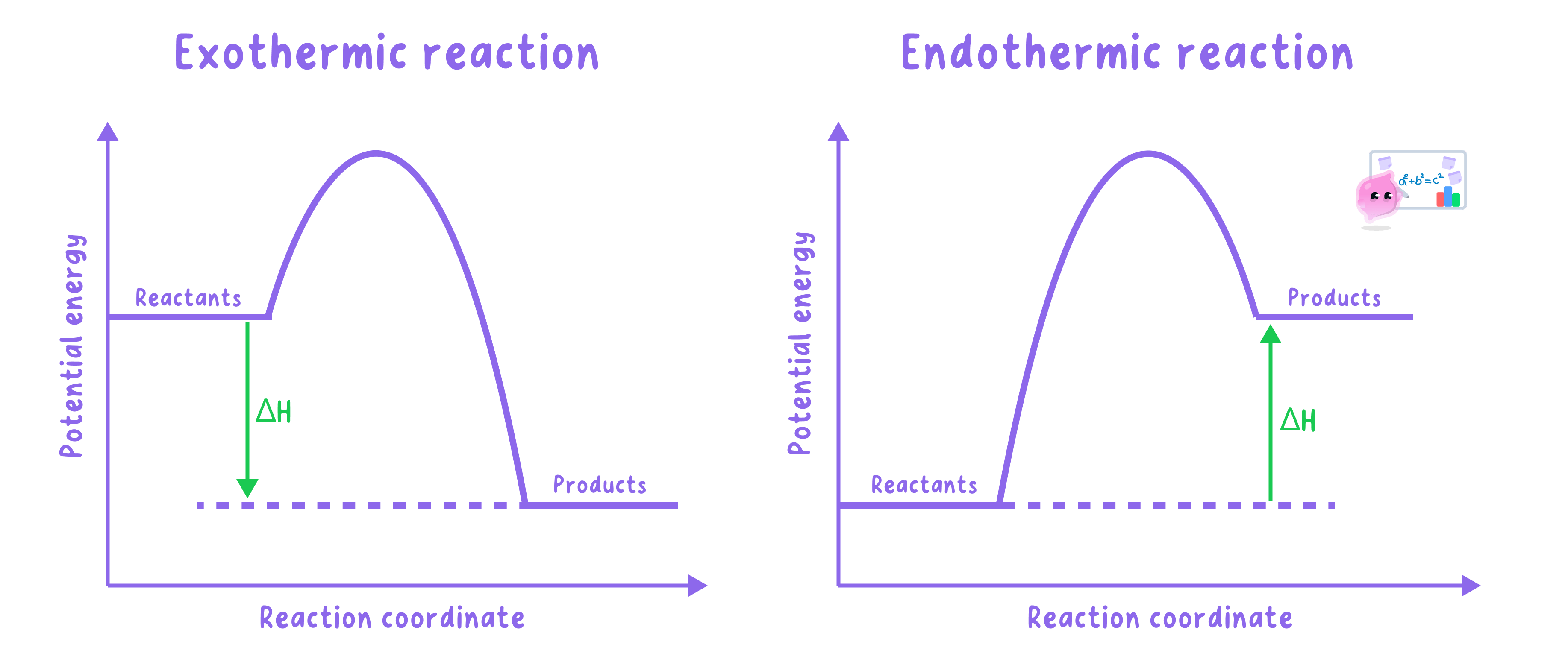
- When a question asks you to draw a reaction profile, label both axes and the reactants and products lines, and use single-headed arrows for the activation energy and the energy change.
- Start the activation energy arrow at the reactants line, not at the axis or at the products line.
- What happens to the temperature of the surroundings during an endothermic reaction?
- Give two examples of exothermic reactions.
- The temperature of a solution falls from 20.0 ∘C20.0\ ^{\circ}\text{C}20.0 ∘C to 14.5 ∘C14.5\ ^{\circ}\text{C}14.5 ∘C; is the reaction exothermic or endothermic?
- What is activation energy?
- On an exothermic reaction profile, where are the products drawn compared with the reactants?
