Question 7
FA student adds sodium hydroxide solution, 5 cm35\,\mathrm{cm^{3}}5cm3 at a time, to 25 cm325\,\mathrm{cm^{3}}25cm3 of dilute hydrochloric acid in a polystyrene cup. Both solutions start at 20.0 ∘C20.0\,^\circ\mathrm{C}20.0∘C.
The student records the highest temperature after each addition. The graph shows the results.
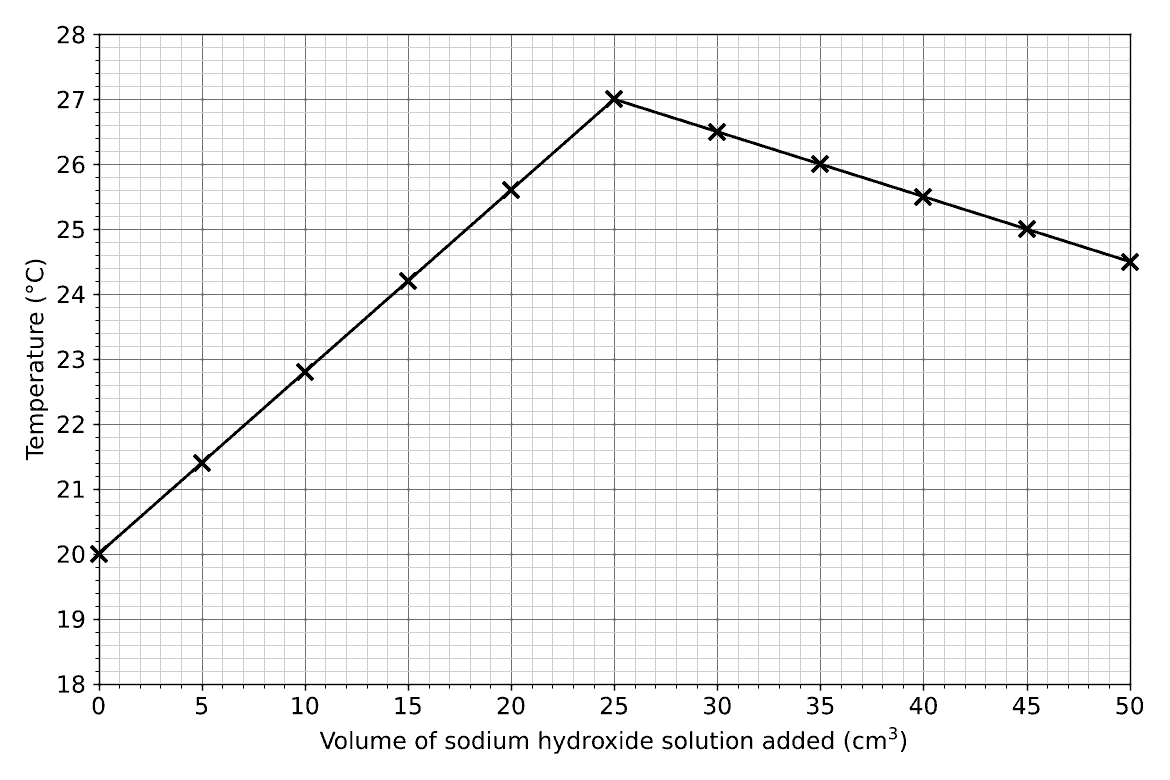
Statement 1: The reaction is exothermic.
Statement 2: All the acid has reacted when about 25 cm325\,\mathrm{cm^{3}}25cm3 of sodium hydroxide solution has been added.
Statement 3: The temperature falls after 25 cm325\,\mathrm{cm^{3}}25cm3 has been added because the reaction becomes endothermic.
Statement 4: The maximum temperature rise is 7.0 ∘C7.0\,^\circ\mathrm{C}7.0∘C.
Which statements are correct?
1 and 4 only
1, 2 and 4 only
1, 3 and 4 only
2, 3 and 4 only
3.2 Energetics Questions
51 exam-style questions on OCR GCSE Chemistry 3.2 Energetics, covering 3.2.1 Exothermic and endothermic reactions and reaction profiles and 3.2.2 Calculating energy change from bond energies. Each one has a worked solution and a mark scheme showing where the marks go.