Question 3
HA company electroplates steel bicycle parts with nickel.
The electrolyte is green nickel sulfate solution, which contains Ni²⁺ ions.
a.[3]
A trainee sets up the cell with the steel part connected to the positive terminal and a nickel bar connected to the negative terminal.
The diagram shows the trainee's cell.
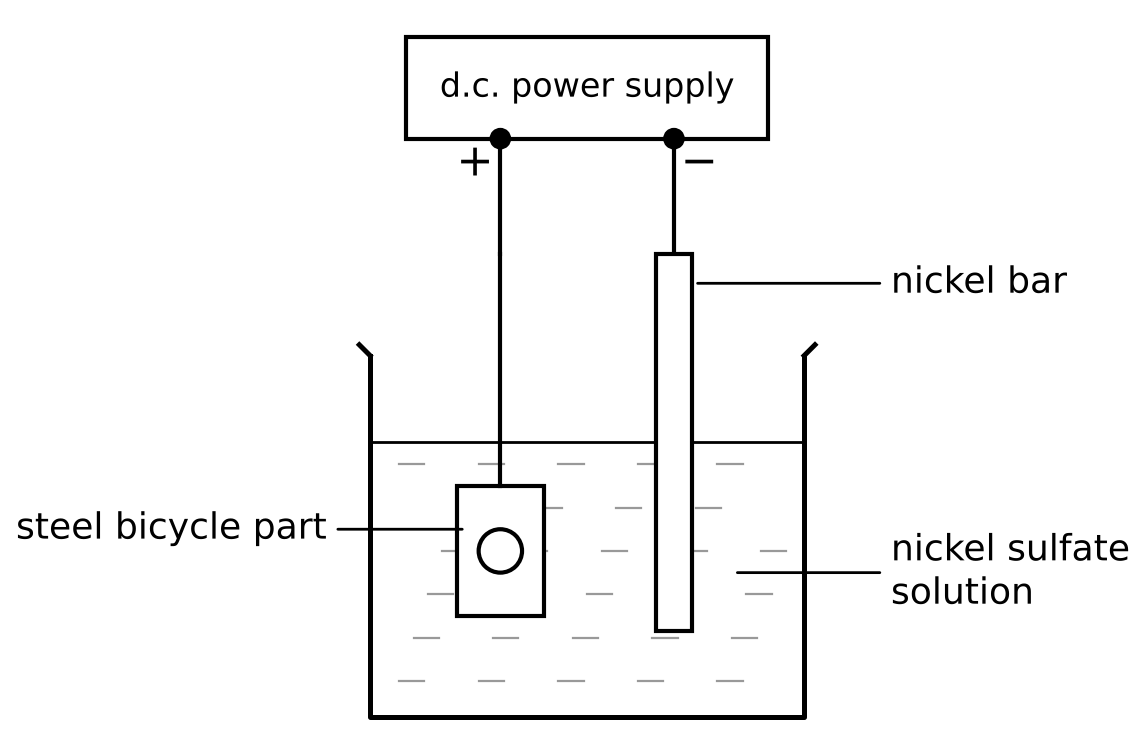
Explain why the steel part is not plated with nickel. Describe what happens at each electrode.
b.[4]
The cell is then set up correctly.
Write the half equations for the reactions at the anode and at the cathode.
c.[2]
Explain why the green colour of the nickel sulfate solution does not change during plating.
d.
[3]
The company measures the mass of nickel deposited on one part at a constant current.
The table shows the results.
| Time (min) | Mass of nickel deposited (g) |
|---|---|
| 0 | 0.00 |
| 10 | 0.12 |
| 20 | 0.24 |
| 30 | 0.36 |
| 40 | 0.48 |
The company needs 0.90 g of nickel on each part. To save time, the company doubles the current.
The mass of nickel deposited is directly proportional to the current.
Calculate the time needed to deposit 0.90 g of nickel at the new current.
3.4 Electrolysis Questions
52 exam-style questions on OCR GCSE Chemistry 3.4 Electrolysis, covering 3.4.1 Products formed at the electrodes in electrolysis and 3.4.2 The technique of electrolysis. Each one has a worked solution and a mark scheme showing where the marks go.