Question 1
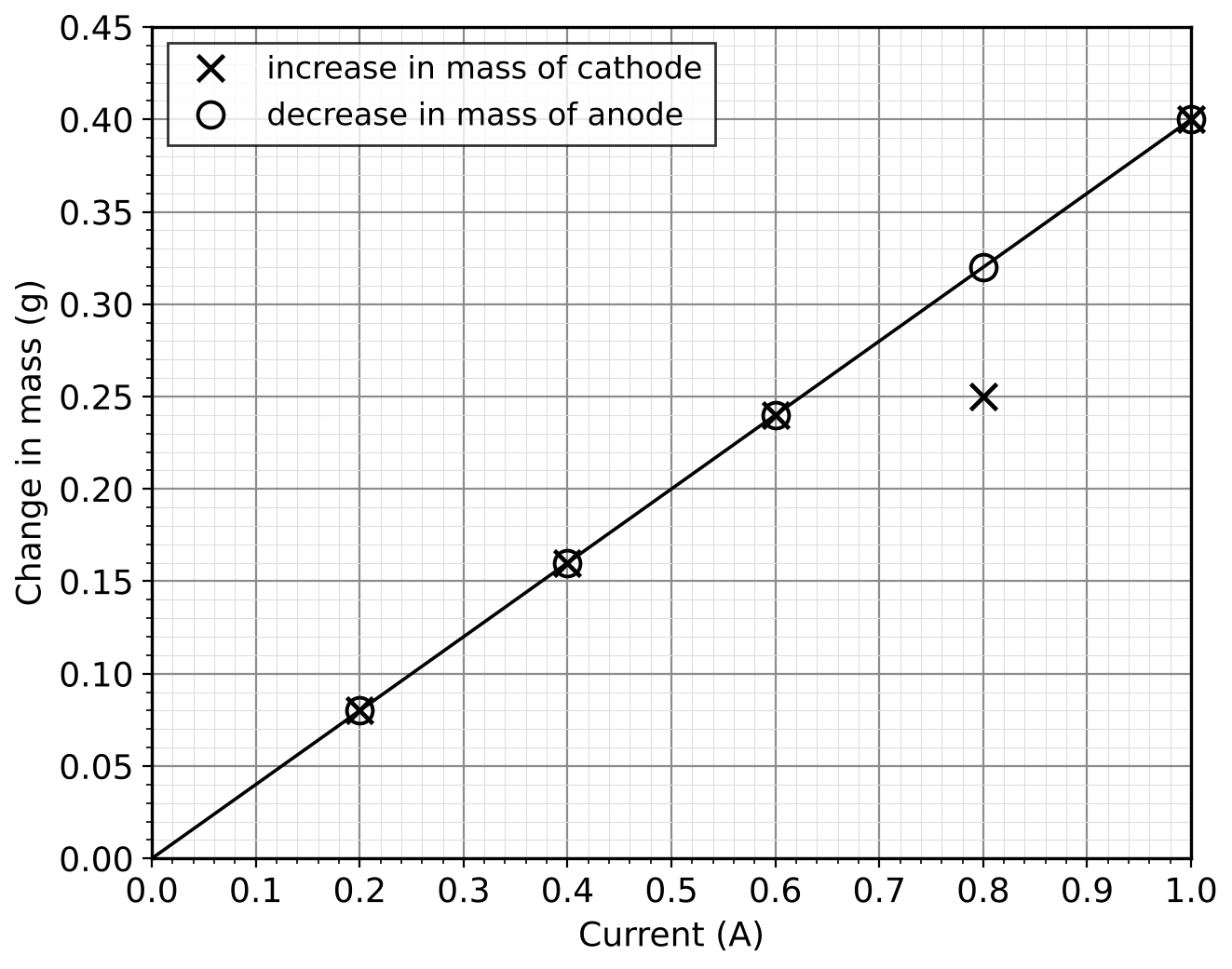
FA student electrolyses copper sulfate solution using copper electrodes.
The student weighs the cathode and the anode, then passes a current through the solution for 20 minutes. The student then washes and dries both electrodes and weighs them again.
The student repeats the experiment with a different current each time. New electrodes and fresh copper sulfate solution are used each time.
The graph shows the results.
a.[2]
Describe what happens at the cathode and at the anode during this electrolysis.
b.i.[1]
One result for the cathode is anomalous.
Write down the current for the anomalous result.
b.ii.[1]
Suggest what happened to cause this anomalous result.
c.[1]
Describe the relationship between the current and the change in mass of the cathode.
d.[2]
Explain why the student washes and dries the electrodes before weighing them.
e.[2]
The blue colour of the copper sulfate solution stays the same during the electrolysis.
Explain why.
f.[1]
Give one variable, other than the electrodes and the solution, that the student must keep the same.
g.[2]
The mass of copper deposited on the cathode is also directly proportional to the time.
Use the graph to predict the change in mass of the cathode if the student uses a current of 0.5 A for 40 minutes.
Change in mass = ...... g
3.4 Electrolysis Questions
52 exam-style questions on OCR GCSE Chemistry 3.4 Electrolysis, covering 3.4.1 Products formed at the electrodes in electrolysis and 3.4.2 The technique of electrolysis. Each one has a worked solution and a mark scheme showing where the marks go.