Crude oil is a hydrocarbon mixture and a feedstock
Hydrocarbon
A compound containing carbon and hydrogen atoms only.
Feedstock
A raw material that an industrial process turns into other useful substances.
- Crude oil is a thick, dark mixture of many different hydrocarbons, pumped from rocks beneath the land and the seabed.
- Most of these hydrocarbons are alkanes, with chains ranging from one carbon atom to more than fifty.
- Crude oil is the main source of the hydrocarbons used as fuels, such as petrol, diesel and kerosene.
- It is also a feedstock for the petrochemical industry, which turns its hydrocarbons into new substances.
- Plastics, solvents, detergents, lubricants, dyes and many medicines are all made from crude oil hydrocarbons.
- Crude oil is of little use as it comes out of the ground, because each use needs hydrocarbons with a particular chain length.
Crude oil has to be separated into simpler mixtures before its hydrocarbons can be used as fuels or feedstocks.
Each fraction contains alkanes of similar chain length
Fraction
A mixture of hydrocarbons with similar numbers of carbon atoms and similar boiling points, collected together from crude oil by fractional distillation.
Alkane
A hydrocarbon in which all the bonds between carbon atoms are single covalent bonds.
- Fractional distillation separates crude oil into fractions with different boiling point ranges.
- Each fraction is still a mixture, containing hydrocarbons with similar numbers of carbon atoms and similar boiling points.
- The fractions are made up largely of alkanes, which form a homologous series.
- Each alkane has one more CH2\text{CH}_2CH2 unit than the one before, and all of them fit the general formula: CnH2n+2\text{C}_n\text{H}_{2n+2}CnH2n+2
- In the formula, nnn is the number of carbon atoms, so octane, with 888 carbon atoms, is C8H18\text{C}_8\text{H}_{18}C8H18.
- Alkanes contain only single bonds, so each carbon atom is bonded to as many hydrogen atoms as possible.
- Find the formula of the alkane with 121212 carbon atoms, then decide whether C10H20\text{C}_{10}\text{H}_{20}C10H20 is an alkane.
- Substitute n=12n = 12n=12: 2n+2=(2×12)+2=262n + 2 = (2 \times 12) + 2 = 262n+2=(2×12)+2=26, so the formula is C12H26\text{C}_{12}\text{H}_{26}C12H26.
- An alkane with 101010 carbon atoms needs (2×10)+2=22(2 \times 10) + 2 = 22(2×10)+2=22 hydrogen atoms.
- C10H20\text{C}_{10}\text{H}_{20}C10H20 has only 202020 hydrogen atoms, so it does not fit CnH2n+2\text{C}_n\text{H}_{2n+2}CnH2n+2 and is not an alkane.
In fractional distillation, vapours condense at different heights
Fractionating column
A vertical tube in which vapour repeatedly condenses and evaporates, improving the separation of liquids with different boiling points.
- Crude oil is heated to about 350 ∘C350\ ^{\circ}\text{C}350 ∘C in a furnace, so most of it boils and turns to vapour.
- The hot vapour is piped into the bottom of a tall fractionating column.
- The column has a temperature gradient, being hottest at the bottom and coolest at the top.
- The vapours rise up the column through holes in a series of trays, cooling as they go.
- Each hydrocarbon condenses to a liquid when it reaches a tray that is cooler than its boiling point, and the liquid is piped off.
- The smallest molecules never condense, so they leave the top of the column as refinery gases.
- The largest molecules do not boil at all, so they run out of the bottom as a thick residue called bitumen.
- From the top of the column down, the main fractions are refinery gases, petrol, naphtha, kerosene, diesel oil, fuel oil and bitumen.
- Refinery gases are bottled as liquefied petroleum gas, petrol and diesel fuel cars, and kerosene fuels aircraft.
- Naphtha is the main feedstock for making chemicals, fuel oil powers ships and bitumen surfaces roads.
Larger molecules have higher boiling points
Intermolecular force
An attraction between separate molecules.
Boiling point
The temperature at which a liquid changes to a gas at a stated pressure.
- Hydrocarbon molecules are held to each other by weak intermolecular forces.
- Longer molecules have more surface in contact with their neighbours, so the intermolecular forces between them are stronger.
- Stronger forces need more energy to overcome, so larger molecules have higher boiling points.
- Molecules with high boiling points condense in the hot lower part of the column, while small molecules with low boiling points rise to the cooler top.
- The covalent bonds inside the molecules do not break, so fractional distillation separates the hydrocarbons without changing them chemically.
- Boiling point rises steadily with chain length, from −162 ∘C-162\ ^{\circ}\text{C}−162 ∘C for methane to 174 ∘C174\ ^{\circ}\text{C}174 ∘C for decane.
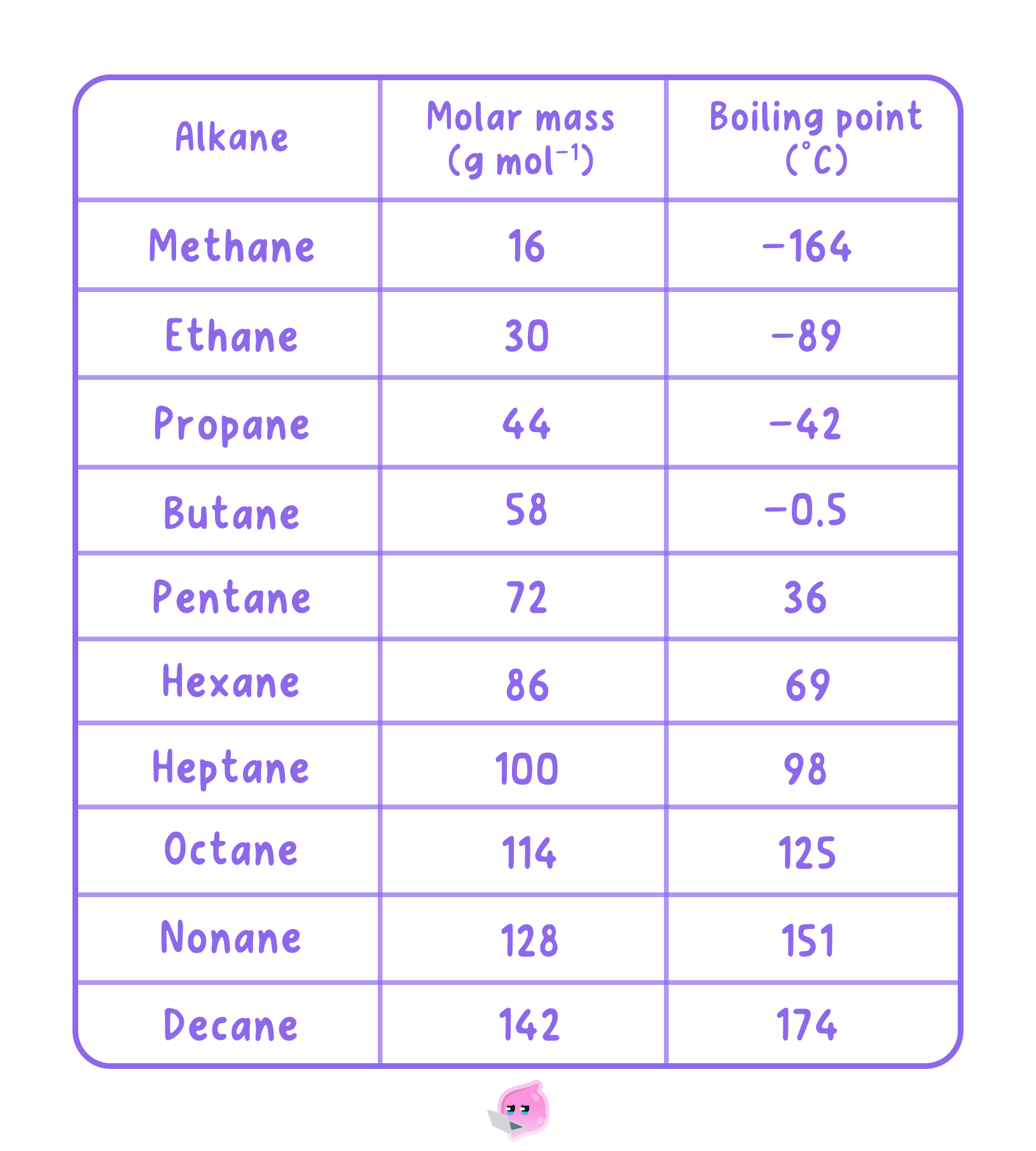
- When a question asks you to explain fractional distillation, link the steps in order: chain length, strength of intermolecular forces, boiling point and height in the column.
- Say that intermolecular forces are overcome, never that covalent bonds break.
- What is a fraction?
- What is the formula of the alkane with 777 carbon atoms?
- Where in the fractionating column do the fractions with the highest boiling points condense?
- Why do larger hydrocarbon molecules have higher boiling points?
- Name two types of product that the petrochemical industry makes from crude oil.
