Question 3
HThis question is about substances with covalent bonds.
The table shows the electronic structures of some atoms.
| Atom | Electronic structure |
|---|---|
| hydrogen | 1 |
| carbon | 2.4 |
| nitrogen | 2.5 |
| oxygen | 2.6 |
a.[2]
Ammonia, NH3\mathrm{NH_{3}}NH3, is a simple molecule.
The diagram shows an incomplete dot and cross diagram for a molecule of ammonia.
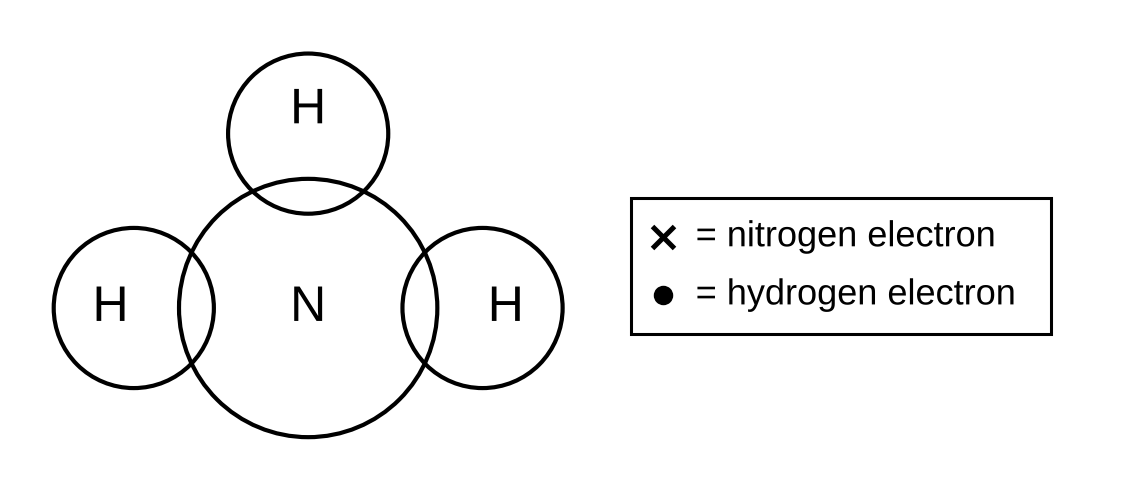
Complete the dot and cross diagram. Show the outer shell electrons only.
b.[3]
In a molecule of carbon dioxide, CO2\mathrm{CO_{2}}CO2, the carbon atom forms a double covalent bond with each oxygen atom.
Explain how this gives every atom in the molecule a full outer shell.
Use the electronic structures in the table.
c.[2]
Nitrogen gas is made of N2\mathrm{N_{2}}N2 molecules.
Deduce the number of covalent bonds between the two nitrogen atoms in a nitrogen molecule.
Explain your answer.
d.[2]
Explain how a covalent bond holds two atoms together.
e.[2]
Poly(ethene) is a polymer made of very long chains.
Describe the bonding within each chain and between the chains.
2.2 Bonding Questions
64 exam-style questions on OCR GCSE Chemistry 2.2 Bonding, covering 2.2.1 Metals, non-metals and the Periodic Table, 2.2.2 Types of chemical bonding and dot and cross diagrams, 2.2.3 Limitations of bonding models, and 2.2.4 Reactivity, atomic number and the modern Periodic Table. Each one has a worked solution and a mark scheme showing where the marks go.