Question 4
HSodium chloride has a giant ionic lattice.
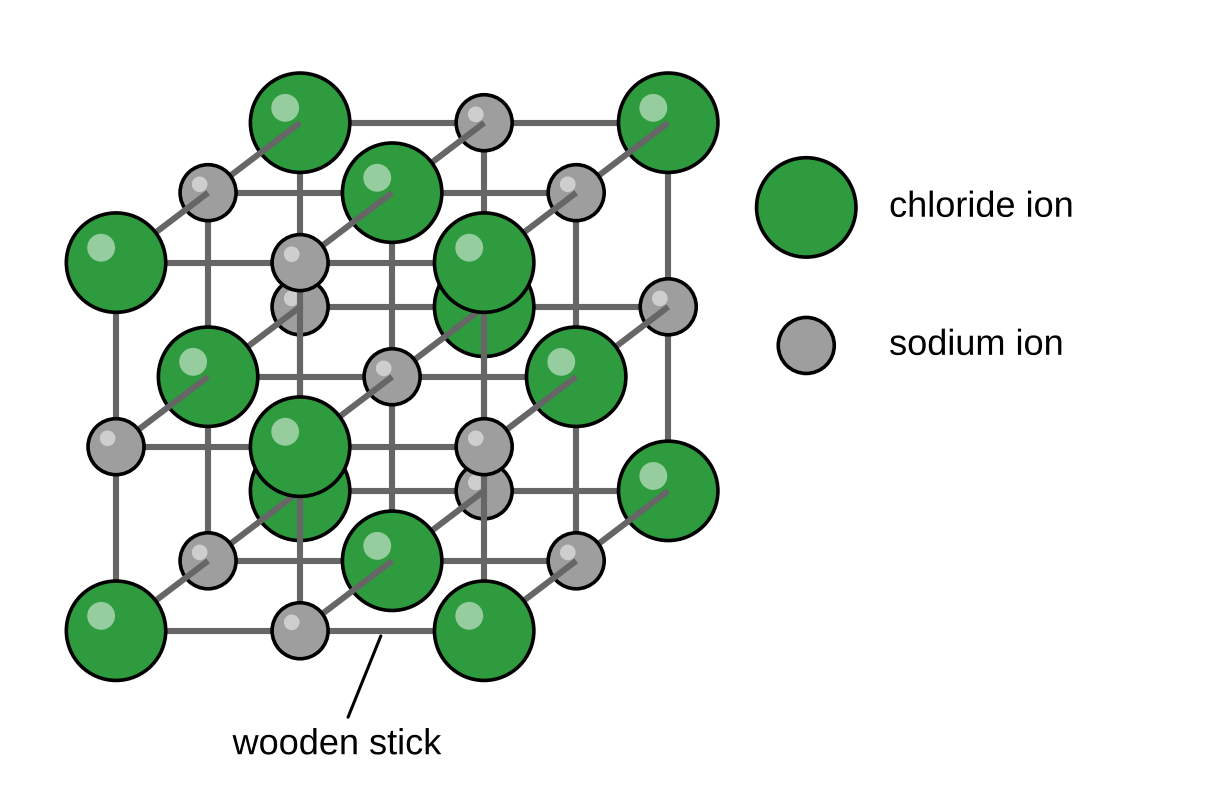
In the lattice, each sodium ion is surrounded by six chloride ions, and each chloride ion is surrounded by six sodium ions.
A student builds a ball-and-stick model of part of the lattice. The student uses large green balls for chloride ions and small grey balls for sodium ions, joined by wooden sticks.
The diagram shows the student's model.
a.i.[2]
The radius of a chloride ion is 0.181 nm. The radius of a sodium ion is 0.102 nm.
The student uses balls with a diameter of 4.5 cm for the chloride ions.
Calculate the diameter of the balls the student should use for the sodium ions, so that the model is to scale.
Give your answer to 2 significant figures.
Diameter = ...... cm
a.ii.[2]
The distance between the centres of a sodium ion and a neighbouring chloride ion in the lattice is 0.283 nm.
Use this information to explain why the sticks are a limitation of the model.
b.[1]
Give one other limitation of the ball-and-stick model of sodium chloride.
c.[2]
Another student writes:
"Each sodium ion is bonded only to the chloride ion that took its electron."
Explain why this statement is not correct.
d.[2]
A dot and cross diagram of sodium chloride shows one sodium ion and one chloride ion.
Give one thing a dot and cross diagram shows that the ball-and-stick model does not, and one thing that the dot and cross diagram does not show.
e.[1]
Explain why the formula of sodium chloride is NaCl, even though the lattice contains a huge number of ions.
2.2 Bonding Questions
64 exam-style questions on OCR GCSE Chemistry 2.2 Bonding, covering 2.2.1 Metals, non-metals and the Periodic Table, 2.2.2 Types of chemical bonding and dot and cross diagrams, 2.2.3 Limitations of bonding models, and 2.2.4 Reactivity, atomic number and the modern Periodic Table. Each one has a worked solution and a mark scheme showing where the marks go.