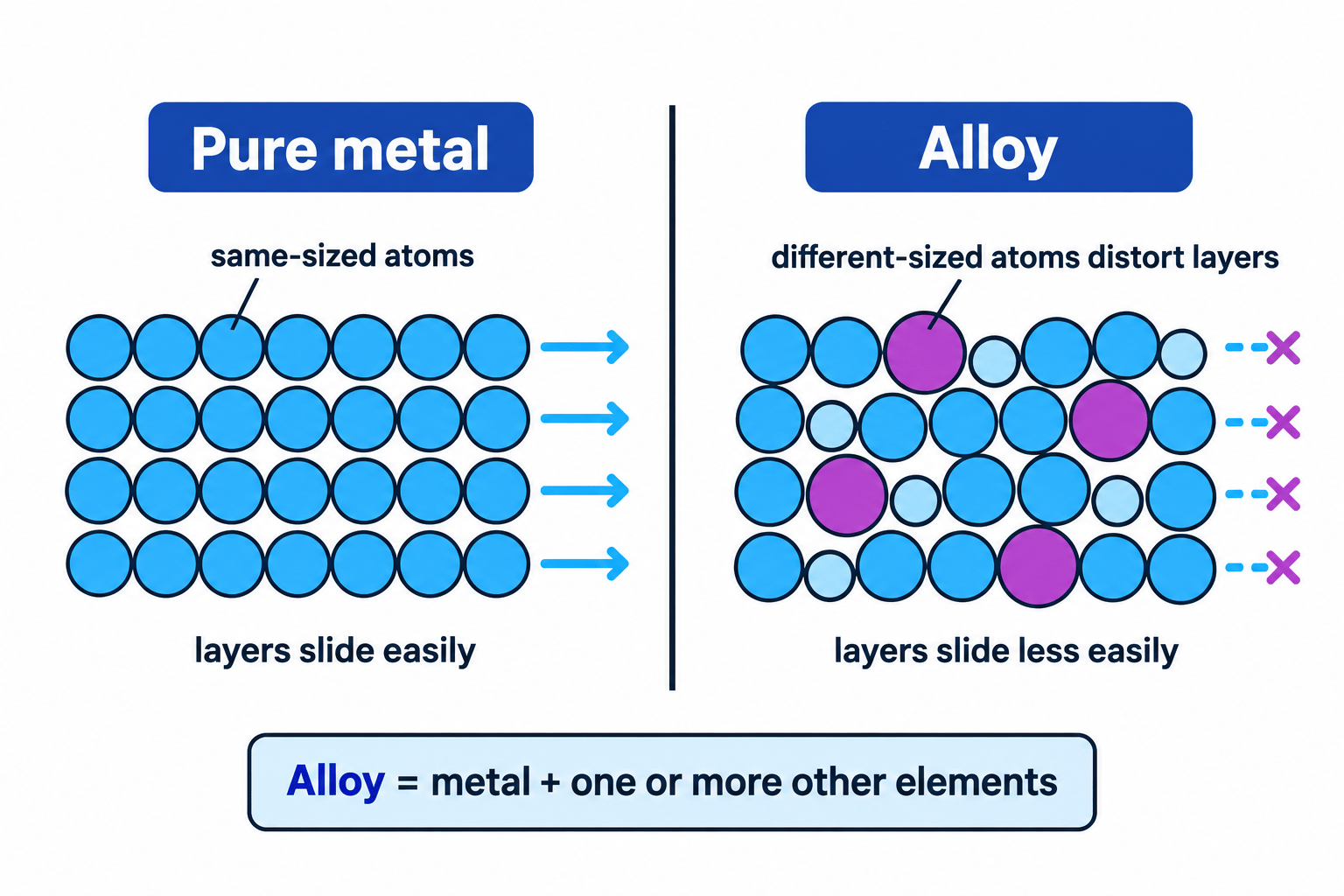
Adding elements to a metal makes an alloy
Definition
Alloy
A mixture of a metal with one or more other elements, usually other metals or carbon.
- In a pure metal, the atoms are all the same size and sit in regular layers that slide over each other easily, so many pure metals are soft.
- In an alloy, atoms of a different size distort the layers, so the layers cannot slide as easily and the alloy is harder.
- Changing the composition of an alloy changes its properties, so the proportions are chosen to suit each use.
- Alloys can also be stronger, more resistant to corrosion or lower in melting point than the pure metal.
Common Mistake
Do not call an alloy a compound, because its elements are mixed rather than chemically bonded in a fixed ratio.
Carbon content decides the properties of steel
- Steel is mainly iron mixed with a small percentage of carbon.
- Low-carbon steel, with about 0.1% to 0.3% carbon, is soft and easily shaped, so it is used for car bodies and food cans.
- High-carbon steel, with about 0.6% to 1.5% carbon, is much harder but more brittle, so it is used for cutting tools and chisels.
- Stainless steel is iron mixed with chromium and often nickel, and a common type contains about 18% chromium and 8% nickel.
- The chromium makes it very resistant to corrosion, so it is used for cutlery, saucepans and surgical instruments.
Example
- A 250 g250\,\text{g}250g sample of steel contains 2.0 g2.0\,\text{g}2.0g of carbon; calculate the percentage of carbon and decide which type of steel it is.
- Percentage of carbon =2.0250×100=0.80%= \dfrac{2.0}{250} \times 100 = 0.80\%=2502.0×100=0.80%.
- A carbon content of 0.80%0.80\%0.80% lies in the high-carbon range, so the steel is hard and suits a cutting tool.
Copper alloys are harder than copper and resist corrosion
- Brass is copper mixed with zinc, often about 70% copper and 30% zinc.
- It is harder than copper, does not corrode easily and has a gold colour, so it is used for door handles, musical instruments and the pins of plugs.
- Bronze is copper mixed with tin, usually about 88% copper and 12% tin.
- It is hard, strong and resists corrosion even in sea water, so it is used for statues, bells and ship propellers.
- Cupronickel, copper mixed with nickel, is hard-wearing and silver-coloured, so it has been used for coins.
Example
Pure copper is used for the wire inside a cable because it conducts better, but brass is used for the plug pins because they must be hard enough not to bend.
Uses of aluminium, tin and gold alloys
- Duralumin is aluminium with about 4% copper and small amounts of magnesium and manganese.
- It has a low density but is much stronger than pure aluminium, so it is used for aircraft bodies.
- Solder is mainly tin with small amounts of copper and silver, and it melts at a low temperature.
- This lets it melt and join electrical components without damaging them.
- Pure gold, called 24-carat gold, is too soft for jewellery, so it is mixed with copper or silver.
- 18-carat gold contains 18 parts of gold in every 24 parts of alloy, which is 75% gold.
Example
- An 18-carat gold ring has a mass of 6.0 g6.0\,\text{g}6.0g; calculate the mass of gold it contains.
- Fraction of gold =1824=0.75= \dfrac{18}{24} = 0.75=2418=0.75.
- Mass of gold =0.75×6.0 g=4.5 g= 0.75 \times 6.0\,\text{g} = 4.5\,\text{g}=0.75×6.0g=4.5g.
Self review
- Why is an alloy usually harder than the pure metal it is made from?
- How does the carbon content of steel affect its properties?
- Which elements are mixed to make brass, and which to make bronze?
- Why is duralumin used for aircraft?
- What percentage of an 18-carat gold ring is gold?